Making Sense of FEMA’s Migrant-Payment Schemes
- External Source
admin
- 0
- 23 minutes read

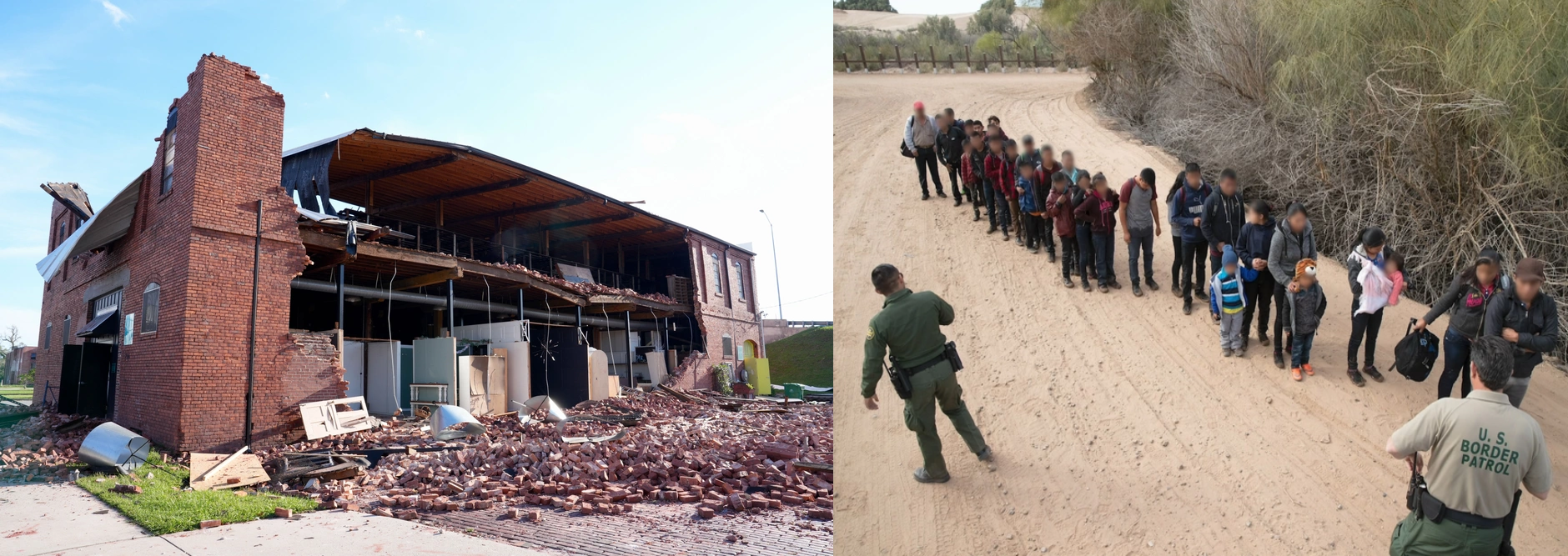
GASTONIA, N.C. — As recovery and clean-up from Tropical Storm Helene continues, assistance from the Federal Emergency Management Agency (FEMA) to residents here in western North Carolina has been cast into the national spotlight. Indignation over meager agency aid payments to locals whose lives have been — quite literally — washed away by the storm has been heightened by the hundreds of millions of dollars FEMA’s spending on illegal migrants encountered by CBP at the Southwest border and released into the United States. What’s happening is both more and less than meets the eye, as I’ll explain.
The FEMA Emergency Food and Shelter Program (ESFP). The FEMA migrant-spending program began as an offshoot of a Reagan-era plan called the Emergency Food and Shelter Program (EFSP). EFSP had the goal of providing aid to homeless Americans, most notably the elderly, handicapped, families with kids, Native Americans, and (especially) veterans.
That was essentially where ESFP funding went until a border crisis in the late spring and early summer of 2019. More than 111,000 adult migrants travelling with children in “family units” (FMUs) and unaccompanied alien children (UACs) crossed the border illegally that May, and President Trump needed additional money to get the kids out of CBP facilities.
One would assume money for needy migrant children would have prompted a rapid bipartisan response, but congressional Democrats left Trump twisting in the political wind for weeks before they gave him the funding he needed.
If you need proof, just take a look at this tweet from that period:
I’ll never forget this, because it was the moment I saw with my own eyes that the America I love was becoming a nation that steals refugee children from their parents,& caged them.
More kids died after this. To date, no one has been held accountable.
We need to save these kids. https://t.co/HhdMqc5zML
— Alexandria Ocasio-Cortez (@AOC) June 25, 2019
The spending bill (the “Emergency Supplemental Appropriations for Humanitarian Assistance and Security at the Southern Border Act”), was finally delivered to the president’s desk in late June, and it expanded EFSP by providing $30 million for “assistance to aliens released from” DHS custody but then only “to jurisdictions or local recipient organizations serving communities that have experienced a significant influx of such aliens”.
Trump asked for ESFP to be ended in his FY 2020 and FY 2021 budget requests as duplicative of other federal activities, but as Reagan himself explained, “a government bureau is the nearest thing to eternal life we’ll ever see on this earth”. Consequently, ESFP received $125 million in FY 2020 and $130 million in FY 2021.
After taking office, President Biden pushed for and received spending legislation called the “American Rescue Plan” (ARP).
ARP appropriated $400 million for what FEMA termed “regular EFSP” (the one Reagan approved), and an additional $110 million for “humanitarian relief to families and individuals encountered by” DHS. The temporary ESFP for migrants (called “ESFP-H”, for “humanitarian”) from the 2019 supplemental was now a line item.
In the FY 2022 appropriations bill (signed almost halfway through the fiscal year), those proportions shifted, with $130 million in appropriations for regular EFSP, with an additional $150 million for what that bill termed “providing shelter and other services to families and individuals encountered by” DHS, EFSP-H.
The White House, in its FY 2023 FEMA budget request, asked for $130 million for regular EFSP and $154 million for the migrant version. The request explained: “Since 2019, services to migrants provided by NGOs and local jurisdictions have significantly increased and in many cases quadrupled.”
Of course, “services to migrants” increased and “in many cases quadrupled” over that period because instead of detaining those migrants — which the Immigration and Nationality Act (INA) mandates — the Biden-Harris administration has released the vast majority of them into the United States, 5.6 million-plus and rising.
“We’ll Continue to Do What We Can as a Federal Government to Support these Cities”. To take pressure off small border-adjacent towns in the Lone Star State that were dealing with massive numbers of released migrants, in April 2022, Texas Gov. Greg Abbott started busing those migrants, first to Washington, D.C. and then to New York City and elsewhere in the north and northeast.
Those Democratically controlled cities struggled to deal with the flow, incurring billions in costs to house, feed, educate, and otherwise care for those migrants. Fortunately for New York City Mayor Eric Adams (D) and others, the White House rushed to the rescue.
At a September 2022 press conference, Biden-Harris Press Secretary Karine Jean-Pierre outlined the administration’s response to those cities’ migrant travails:
FEMA Regional Administrators have been meeting with city officials on site to coordinate — to coordinate available federal support from FEMA and other federal agencies.
Funding is also available through FEMA’s Emergency Food and Shelter program to eligible local governments and not-for-profit organizations upon request to support humanitarian relief for migrants.
We’ll continue to do what we can as a federal government to support these cities as we rebuild our asylum processing system after it was gutted by the Trump administration. [Emphasis added.]
As an aside, “Trump gutted the asylum system” was a common refrain in the first two years of the Biden-Harris administration, even as the immigration-court backlog increased 42 percent, rising from less than 1.3 million cases in FY 2020 to nearly 1.8 million in FY 2022. Jean-Pierre doesn’t refer to it much now as the backlog nears 3.5 million.
That part about “funding is also available through” EFSP-H is confusing however, because it appears to suggest that other FEMA funds (that I will describe below) were also being used for migrant care. Jean-Pierre may want to explain that further.
Note though that Jean-Pierre’s statements were consistent with Pillar 4 (of six) in DHS Secretary Alejandro Mayorkas’s April 2022 “Plan for Southwest Border Security and Preparedness,” which began:
We are bolstering the capacity of non-governmental organizations (NGOs) to receive noncitizens after they have been processed by CBP and are awaiting the results of their immigration removal proceedings. And, we are ensuring appropriate coordination with and support for state, local, and community leaders to help mitigate increased impacts to their communities.
Mayorkas’s plan was issued at almost the exact same time Abbott started sending migrants north, so the administration’s complaints about the “cruel” impacts of the governor’s busing policies should have been taken with a grain of salt (they weren’t).
Again, according to FEMA, it disbursed $150 million in ESFP-H funding in FY 2022 — an increase of $40 million compared to the fiscal year before.
ESFP-H Morphs Into the FEMA Shelter and Services Program (SSP) and Swells. Continuing with “Great Communicator” quotes, Reagan famously remarked: “Government is like a baby — it’s got an alimentary canal at one end and no sense of responsibility at the other.”
It’s almost as though FEMA and its migrant-funding scheme were determined to prove the Gipper right.
In 2023, ESFP-H morphed into the FEMA Shelter and Services Program (SSP). As an agency fact sheet explained:
SSP bolsters the capacity of states, localities, tribes and nonprofit organizations to receive noncitizens after they have been processed by DHS. It also ensures appropriate coordination with and support for state, local and community leaders to help mitigate increased impacts to their communities.
Note the use of “mitigate” and “impacts” in that passage, and couple it with the fact that ESFP-H/SSP is administered by FEMA and you’ll realize it’s all a tacit admission that the Biden-Harris migrant surge has been a disaster, both for the country as a whole and for the cities and states that are struggling to keep up.
Some $363.8 million was made available under the program in FY 2023, broken up into two tranches, one of more than $291 million and a second of $77.3 million-plus. Beginning in April 2024, that was increased to $640.9 million administered through two separate programs: SSP Allocated (SSP-A); and SSP Competitive (SSP-C).
SSP-A is available only to designated entities, while SSP-C is available to any local government, Indian tribe, or U.S. state (plus D.C. and Puerto Rico) that meets certain criteria. If you want to see the entities that received SSP-A funding, you can find it here, and a compendium of SSP-C recipients is available here.
I’d attempt to explain the criteria further if I had the time and the inclination to sort it out, but at first blush it appears to be an opaque cash grab, with Uncle Sam shoveling out tons of taxpayer money (not that I can say any recipients don’t deserve it, but if I were still doing congressional oversight, I’d have a few questions).
That said, Congress bears some responsibility for going along with it all, because they appropriated the money for ESFP-H and SSP (both “A” and “C”).
Keep in mind though that nearly all of that money is headed to states (Arizona alone received $19 million in FY 2024 SSP-C), cities (Los Angeles got more than $21 million in SSP-C last fiscal year), and counties (El Paso hauled in $16.69 million for SSP-C for FY 2024), and representatives are more likely to get reelected when they’ve sent some pork back home.
When you hear critics say that the Biden-Harris FEMA has “spent more than $1.4 billion since the fall of 2022 to address the migrant crisis”, however, you’ll know where the figures are coming from.
FEMA’s Disaster Relief Fund (DRF). Separate and apart from ESFP-H/SSP is FEMA’s “Disaster Relief Fund” (DRF), “the largest source of federal financial assistance after disasters”.
Congress’s FY 2024 appropriations — formally the “Further Consolidated Appropriations Act, 2024”, signed into law nearly six months after FY 2024 had begun — included $20.26 billion for the DRF.
The problem was that even before Helene hit Florida and the Southeast between September 26 and 27, the United States had already suffered 20 separate events in which damages exceeded $1 billion apiece.
On September 25, Congress passed a stopgap funding bill to avert a government shutdown, which included $20 billion for the DRF, but that also excluded additional requested supplemental disaster relief funding.
During an October 2 White House press conference, Mayorkas detailed the federal government’s response to Helene, and complained:
We — we are meeting the immediate needs with the money that we have. We are expecting another hurricane hitting. We do not have the funds. FEMA does not have the funds to make it through the season and what — what is imminent.
Criticism of Slow Federal Response. Having lived through numerous disasters (both natural and man-made), I can assure you that FEMA has been the target of significant criticism in the past (see Hurricane Katrina). Generally, however, the gripes have been bipartisan responses to what has been perceived as the agency’s inadequate response. One can hardly criticize God for his acts, but federal bureaucrats are an evergreen target.
That SSP migrant funding, however, stands in stark contrast to what many have complained has been an inadequate FEMA — and federal government-wide — response to Helene.
For example, North Carolina is home to numerous military installations, including the Army’s Fort Liberty (formerly Fort Bragg), “home of the Airborne” with more than 43,000 active-duty soldiers, and Marine Corps Base Camp Lejeune, with 63,000-plus active-duty military.
Decades of military involvement in the mountains of Afghanistan has provided the U.S. military both the experience and the equipment to operate in hilly terrain.
It wasn’t until October 2 — five days after the storm hit western North Carolina — however, that President Biden approved “active-duty military personnel and equipment to support ongoing rescue, relief and recovery operations” there, and then just 1,000 troops.
Then, there have been a number of tone-deaf statements out of the administration itself.
During October 2 remarks in Augusta, Ga., for example, Vice President Harris explained that “the federal relief and assistance that we have been providing has included FEMA providing $750 for folks who need immediate needs being met, such as food, baby formula, and the like. And you can apply now”.
That $750 payment will not be the full amount of aid that will eventually be made available to those affected by Helene, of course, but that amount seems like a pittance to those who lost everything. Moreover, Harris’s funding offer assumes residents will have the ability to file the necessary paperwork to receive that funding, which many (if not most) will not.
In that vein, and more personally, at 2:44 PM EDT on Friday, October 4 — almost exactly a week after the storm had passed — I received the following text:
Andrew, last Thursday, Sept 26th, the Biden-Harris Administration declared a federal emergency in North Carolina and directed the Federal Emergency Management Administration to coordinate disaster relief to areas of the state affected by Hurricane Helene. Governor Roy Cooper reports that 57,000 people have applied for relief and funds are starting to be distributed.
To find a local shelter or recovery center, find volunteer opportunities, or apply for disaster relief, visit https://www.disasterassistance.gov/
Stay safe.
I failed to realize either that I was on a first-name basis with the government or that Uncle Sam had my cell number, but in any event if I’d gone without potable water, food, and power (as many of my western neighbors have) for a week, that offer would have been a little late — even assuming I had cell service to receive it, which again many of the affected do not.
Then there’s the fact that three days after she spoke in Augusta, the Vice President issued the following tweet:
The people of Lebanon are facing an increasingly dire humanitarian situation. I am concerned about the security and well-being of civilians suffering in Lebanon and will continue working to help meet the needs of all civilians there.
To that end, the United States will provide…
— Vice President Kamala Harris (@VP) October 5, 2024
That tweet came just a day after Secretary of State Antony Blinken also weighed in on Lebanon aid:
The U.S. is at the forefront of humanitarian response to the growing crisis in Lebanon, announcing nearly $157 million in assistance today. We are committed to supporting those in need and delivering essential aid to displaced civilians, refugees and the communities hosting them.
— Secretary Antony Blinken (@SecBlinken) October 4, 2024
Finally note that Title V, section 501(c) of the FY 2024 appropriations bill for DHS provides:
Up to 5 percent of any appropriation made available for the current fiscal year for the Department of Homeland Security by this Act or provided by previous appropriations Acts may be transferred between such appropriations if the Committees on Appropriations of the House of Representatives and the Senate are notified at least 30 days in advance of such transfer, but no such appropriation, except as otherwise specifically provided, shall be increased by more than 10 percent by such transfer.
That gives the DHS secretary significant authority to move (or “reprogram”) money from one FEMA account — like SSP — to another, like DRF. In fact, he could reprogram any DHS appropriations for such purpose.
A Wake-Up Call for Americans. Although I have written extensively about ESFP-H/SSP in the past, I was one of the few, and so the vast majority of Americans had no idea FEMA was doling out hundreds of millions in disaster aid to support illegal migrants. Now they do, and they’re not happy.
Photo credits: Department of Defense photos of Hurricane Helene damage in Georgia and migrants in Yuma, Ariz.


