A Quick Review of Two Poorly Understood Trump Immigration Orders
- External Source
admin
- 0
- 16 minutes read

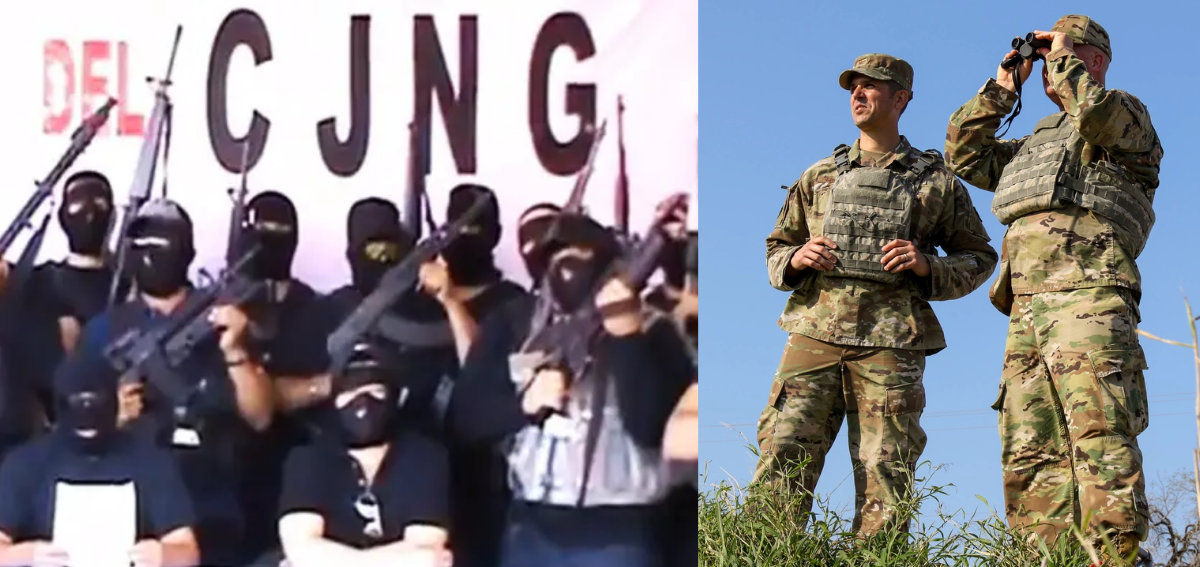
Much has been made over the past few days of the various orders and proclamations issued by the White House since Donald Trump was inaugurated for a second time. Much of that analysis has been perfunctory and inexact. Here’s a quick review of a two of the least understood orders, one having to do with military assets being used at the border and the other with the designation of cartels and other criminal organizations as “terrorists”.
“The Military’s Role in Protecting the Territorial Integrity of the United States”. On January 20, the president issued an executive order captioned “Clarifying the Military’s Role in Protecting the Territorial Integrity of the United States”.
Utilizing his constitutional authority as commander in chief, the order states that it is U.S. policy “to ensure that the Armed Forces of the United States prioritize the protection of the sovereignty and territorial integrity of the United States along our national borders”.
That is — or should be — an unexceptional statement. The preamble of the U.S. Constitution speaks only of “the common defense” and from the beginning, Americans looked askance at large standing armies being sent to foreign conflicts.
Two world wars and engagement in other foreign actions plainly expanded the military’s size and mission, of course, as evidenced by the following from President Dwight Eisenhower’s famous January 1961 farewell address:
Our military organization today bears little relation to that known by any of my predecessors in peace time, or indeed by the fighting men of World War II or Korea.
Until the latest of our world conflicts, the United States had no armaments industry. American makers of plowshares could, with time and as required, make swords as well. But now we can no longer risk emergency improvisation of national defense; we have been compelled to create a permanent armaments industry of vast proportions.
…
This conjunction of an immense military establishment and a large arms industry is new in the American experience.
Eisenhower spent 38 years in the Army beginning with his entry to West Point in 1911, and after he left the presidency returned to active duty (he was buried in his World War II uniform), so he knew of which he spoke. Remember, however, that Ike’s words were a warning — not as an encomium.
Even before Trump issued that order, the Department of Defense (DoD) website stated the department “is responsible for homeland defense”, defined as “the protection of U.S. sovereignty, territory, [and] domestic population … against external threats and aggression”.
The heart of Trump’s order is section 3, “Implementation”.
The president therein gives DoD 10 days to revise “the Unified Command Plan” (UCP) to assign U.S. Northern Command (NORTHCOM) “the mission to seal the borders and maintain the sovereignty, territorial integrity, and security of the United States by repelling forms of invasion including unlawful mass migration, narcotics trafficking, human smuggling and trafficking, and other criminal activities”.
NORTHCOM, which “plans, organizes and executes homeland defense and civil support missions”, is one of seven “geographic combatant commands” in DoD, and the UCP is “a strategic document that establishes the missions, responsibilities, and geographic areas of responsibility for commanders of combatant commands”.
Note that the president doesn’t directly state how NORTHCOM should carry out that mission, though as commander in chief he likely could have. Instead, he gave DoD broad parameters and left it to the department itself to craft a plan.
As I explained in early December, the use of the military in border security roles is nothing new.
Various administrations (including President Obama’s) have detained migrants on military bases in the past, and troops performed surveillance and other “ancillary” border duties for more than two decades.
In his first term, Trump used DoD assets for border wall construction, and in May 2023, Biden’s DoD secretary, Lloyd Austin, approved a DHS request to send active duty troops to the border (2,500 troops were stationed there by the end of the last administration).
In any event, on January 22, it was reported that an additional 1,500 troops were headed to the border and that DoD “would provide airlift support to expedite deportations of illegal immigrants”, while plans may also be in the works to convert DoD bases into migrant housing centers.
A separate executive order issued on January 20, simply titled “Securing Our Borders”, directs the DoD and DHS secretaries to “take all appropriate action to deploy and construct temporary and permanent physical barriers to ensure complete operational control of the southern border of the United States”.
Given that, expect the Army Corps of Engineers to start digging trenches, pouring concrete, and standing up the thousands of fence panels that have been stacked and sitting rusting in the desert since President Biden “paused” border infrastructure improvements on his first day in office.
Again, none of this is new, but don’t expect the president’s opponents in the media to tell you that.
“Designating Cartels as Foreign Terrorist Organizations”. Yet another first day executive order, captioned “Designating Cartels and Other Organizations as Foreign Terrorist Organizations and Specially Designated Global Terrorists”, also requires a bit of background and explanation.
Those phrases, “foreign terrorist organization” and “specially designated global terrorists”, are terms of art, and federal statutes provide processes by which any organization can be designated thereunder.
Interestingly, “foreign terrorist organization” or “FTO” is defined in an often-overlooked section of the Immigration and Nationality Act (INA), section 219.
To be designated as an FTO, an organization must satisfy three requirements: (1) it must be a foreign organization; (2) it must engage in “terrorist activity” as defined in the section 212(a)(3)(B) terrorist grounds of inadmissibility provision in the INA or “terrorism” as defined for State Department reporting purposes in 22 U.S.C. § 2656f(d)(2); and (3) that terrorism or terrorist activity must threaten the security of the United States or its nationals.
“Specially designated global terrorist” (SGDT) designations, on the other hand, originate from Executive Order (EO) 13224, which was issued by President George W. Bush 12 days after September 11th under his authority in the International Emergency Economic Powers Act (“IEEPA”, 50 U.S.C. § 1701 et seq.).
The secretary of State, in consultation with the DHS secretary and the attorney general (AG), can designate an individual or group as an SGDT based on various criteria, most prominently that such entities “have committed, or pose a significant risk of committing, acts of terrorism that threaten the security of U.S. nationals or the national security, foreign policy, or economy of the U.S.”.
While both designations have various implications for the individuals or groups so designated, the most significant ones are financial. Under section 219(a)(2)(C) of the INA, the Treasury secretary can require U.S. banks to freeze the assets of FTOs, and similar penalties are imposed on SGDTs.
Providing material support to such groups is a big non-no, too.
The January 20 order itself focuses on international cartels (like the Mexican-based Sinaloa, CJNG, and Gulf cartels, each of which is a drug-trafficking organization or “DTO”, though none are specifically listed in the order), as well as Tren de Aragua (TdA) and La Mara Salvatrucha (MS-13).
TdA is a violent outfit that emanated from the prisons of Venezuela before spreading out to engage in heinous crimes across South America. The Biden border crisis, which hundreds of thousands of Venezuelan nationals exploited to enter this country illegally, allowed the group to get a solid foothold in at least 16 U.S. states.
MS-13 likely needs no introduction, but it is a violent street gang that got its start among Salvadoran nationals in Los Angeles in the 1980s before shifting its headquarters operations to El Salvador. Recruiting young Salvadoran and other Central American migrants in the United States is crucial to its overall operations, which include sex and drug trafficking, extortion, and random murders.
The Trump order does not designate the cartels, TdA, MS-13, or any other organized groups as FTOs or specially designated global terrorists, but instead leaves it to Treasury, DHS, and the AG to assess whether they should be so designated under the statutes listed above.
With that in mind, I note that both section 2656f(d)(2) and EO 13224 include specific definitions of “terrorism”.
In the former, the term is defined as “premeditated, politically motivated violence perpetrated against noncombatant targets by subnational groups or clandestine agents”. Similarly, section 3(d) of EO 13224 defines it as:
an activity that — (i) involves a violent act or an act dangerous to human life, property, or infrastructure; and (ii) appears to be intended — (A) to intimidate or coerce a civilian population; (B) to influence the policy of a government by intimidation or coercion.
The phrases “politically motivated” and “influence the policy of a government” both show that terrorism differs from common criminality because it has a political aspect, which raises the question of whether cartels and groups like TdA and MS-13 — all of which were created to secure illicit profits — qualify.
Section 1 of the Trump order addresses that issue, explaining:
The Cartels functionally control, through a campaign of assassination, terror, rape, and brute force nearly all illegal traffic across the southern border of the United States. In certain portions of Mexico, they function as quasi-governmental entities, controlling nearly all aspects of society.
…
TdA and … MS-13 pose similar threats to the United States. Their campaigns of violence and terror in the United States and internationally are extraordinarily violent, vicious, and similarly threaten the stability of the international order in the Western Hemisphere.
Again, it’s up to the State and Treasury Departments, DHS, and the AG to determine whether those activities and others are sufficient to designate the cartels, TdA, and MS-13 as FTOs and SGDTs, and they have two weeks to make that determination and return it to the president.
That order also gives the AG and DHS two weeks to “take all appropriate action, in consultation with the Secretary of State, to make operational preparations regarding the implementation of any decision” that Trump may make to invoke the Alien Enemies Act (AEA), 50 U.S.C. § 21 et seq.
My colleague George Fishman has written extensively about the potential impacts that the AEA may have on those cartels, criminal organizations, and their members and associates here in the context of this executive order, and it would gild the lily for me to expound on it further.
You Know Where to Turn. By necessity, most press and media outlets can only provide shorthand explanations of what laws and executive actions do. The devil may be in the details, but the details are also where you find the real-world implications of those laws and actions. And for that analysis when the subjects are immigration and the border, you know where to turn.


