What’s Happening in Mexico?
- External Source
admin
- 0
- 17 minutes read

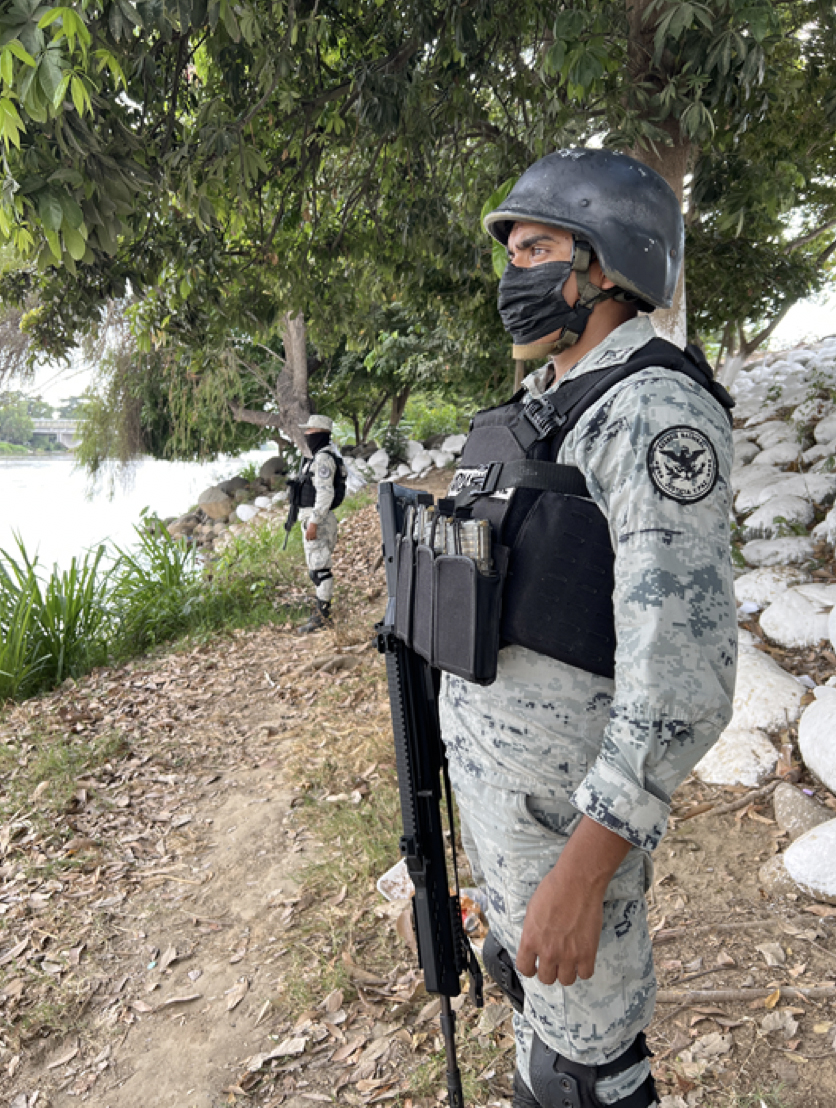
Mexican National Guard posted on Mexico’s border with Guatemala in 2022. Photo by Todd Bensman.
Mexico is struggling to manage a swollen population of restive foreign nationals blocked by President Donald Trump’s border policies, a content analysis of recent Mexican media reporting reveals.
Border Patrol sources say fewer than 500 foreign nationals a day now dare even try the border since Trump’s new administration abruptly replaced the prior administration’s mass-release policies with rapid expulsions — down two-thirds from Biden’s last week in office and compared to 10,000-14,000 a day in fall 2023. The new administration also ended the CPB One app-based “lawful” parole programs that had escorted in thousands by appointment, leaving them inside Mexico.
Untold tens of thousands are now blocked in Mexico behind the Trump dam, which will soon be double walled as 10,000 Mexican troops move up to reinforce against crossings, a move Trump forced upon Mexico by threatening a 25 percent export tariff on Mexican exports. All this swift action has left little room for interpretation: The U.S. border is physically closed to most, leaving hundreds of thousands of non-Mexicans effectively wards of the Mexican state.
“We have to tell things as they are,” Enrique Serrano, coordinator of the Chihuahua State Population Agency told CNN Spanish language television. “They will not achieve anything by trying to cross borders in the hope that the United States will accept them.”
“There is a risk that Mexico will go from being a ‘transit’ country to a ‘destination country,’” as a February 2, 2025, Lasilla Orota news analysis, in part, described Mexico’s unpleasant new situation, one long familiar to the United States.
Too late. As a destination country, Mexico takes over for the United States in abruptly having to oversee the expensive physical care of these foreigners and also to now build bureaucratic machines that will manage two broad outcomes: either voluntary or involuntary deportations home, or the “regularization” of them as Mexican guestworkers, residents, or asylees. Assuming steadfastness at the U.S. border, Mexico will have to carry these heavy new responsibilities for at least the next four years.
“My intention was to get to Pennsylvania,” as one emblematic Venezuelan man told El Heraldo news on January 21. “At the moment, I only have two options: staying or returning to my country.”
Indeed, many of Mexico’s new wards are embracing their replacement Great American Dream.
“We want to be Mexicans like you!” Daniel Moreno, a Cuban told an interviewer in Villahermosa, Tabasco State, while waiting at the local office of the federal refugee and asylum agency, the Mexican Commission for Refugee Assistance (Comar). “We want to work here. We want to establish our legal status and stay in the country for the rest of our lives, not return to Cuba.”
Others are boarding humanitarian flights home, which Mexico hastily organized, such as four to Honduras recently.
Accommodating foreigners like Moreno, the Cuban, or shipping others home while supporting and protecting them all poses an unwanted logistical, humanitarian, and political management nightmare for Mexican President Claudia Sheinbaum that she couldn’t have expected before the American election. Sharing her burden are mayors and governors all over Mexico who are now organizing themselves to manage the herculean task — pretty much alone, as was the U.S., and its governors and mayors, these past four years.
And there’s a third problem to manage amid all of this: The Americans are deporting thousands back to Mexico and may well ramp up the numbers, a prospect that has spawned a shelter-building boom in northern states.
Mexican media reports already tell of tens of thousands of migrants from around the world clogging Mexican cities and towns from south to north, sleeping on public streets and in public parks, trying to decide whether to stay or go home while hoping against hope that the Americans will change their minds about letting them all in.
Chaos
In Mexico’s north, migrant shelter managers in Juarez say they’re almost full of foreigners staying longer than expected. They’re running low on food and cleaning supplies.
“We call on people who want to bring us supplies, such as oil, milk, something that is long-lasting, that does not spoil quickly. We also receive sugar, whatever they can have, for us, it is of great help, because this infrastructure can receive many people but although that is true, what are we going to feed them?” Ruth Rivera, deputy director of the Buen Samaritano shelter told a Juarez newspaper on February 4.
In Mexico’s farthest south state of Chiapas, the city of Tapachula near the Guatemala border is reeling from the pressures imposed by Mexico’s own containment policies keeping the foreigners in southern provinces per the tariff agreement with Trump.
A February 2, 2025, Lasilla Orota news analysis concluded that Trump’s border policies “have had an immediate impact not only in the cities on the northern border of our country, which are on ‘alert,’ but have also impacted Tapachula, which is once again emerging as the epicenter of the Mexican migration crisis”.
A collapse of basic services in Tapachula is expected because the city doesn’t have the capacity for the thousands of migrants who are and will continue to arrive in the city and Mexico’s own military “containment policy” blockading migrants from reaching northern Mexico.
“No one can deny that the uncontrolled presence of foreigners has caused severe damage to trade in Tapachula, which is why we fear what could happen in this area following the policies implemented by Donald Trump,” said Anibal Enrique Nunez, secretary of the business organization Procentro.
Five migrant caravans that left southern Mexico after Trump’s election ran headlong into Mexican migration roadblocks where all had to take temporary documents that were only valid within Chiapas, “trapping them in a state that is completely militarized”, a January 27, 2025, Diario Del Sur report said. Contrary to U.S. media reporting, it was Mexico that devised the caravans to relieve pressure on Tapachula to the other towns. (See CIS video “Caravans to Nowhere?”, November 2024.)
Thousands are in line to gain Mexican residence and avoid Mexican deportation. Crowds in Tapachula at times became so restive that National Guard units arrived in riot gear amid shouting and pushing to restore order.
Mayors in southern Mexico established a “consultative forum” that convened a first meeting to arrange humanitarian aid, shelter, and policing for what it deems the “new migration phenomenon”, a January 29, 2025, Diario Del Sur story reported.
Chiapas Governor Eduardo Ramirez launched a “humanitarian assistance program” for migrants in Tapachula called “Human Mobility is Transformation” featuring the idea that foreigners are not “criminalized but are recognized as people seeking a better future”, a January 31 story in Diario Del Sur reported. But along with that, the governor also announced creation of a “tourist police” force that will “aid visitors and contribute to the tranquility of the population and commercial sector”.
A Desperate Quest for Mexican Documents
Some of the chaos stems from widespread uncertainty about whether Mexico will tolerate the expense and management of a large foreign national population for very long, as any “destination” country might ponder.
President Sheinbaum has publicly said she would force some repatriations to home countries of at least those who didn’t make in on the CBP One app.
“Being foreigners, they would be returned to their countries of origin through the mechanisms of immigration policies and the foreign policy in force in Mexico,” she said, adding that agreements with Central American countries will allow “voluntary returns. But anyone caught in the north will be deported out of Mexico, including to Cuba.”
This messaging has spurred thousands to file asylum claims or to petition for other kinds of status.
On January 30, for instance, at least 9,000 migrants were lined up at the COMAR office in Naucalpan, in the central State of Mexico and in other offices on the southern border of Mexico, such as Tapachula to register for a “certificate of legal residence” that will allow them to stay in Mexico, according to a February 4 Infobae news report.
But Mexico is proving stingy with asylum grants, probably because it hasn’t decided how many foreign nationals it wants to stay and doesn’t mind inducing self-deportations.
COMAR officials are rejecting the asylum claims of tens of thousands of South Americans as ineligible “economic migrants”, according to Garcia Villagran, a migrant activist quoted on January 29 in Tapachula.
In a refrain long familiar in the United States, the president of the Mexican Institute of Finance Executives in Ciudad Juárez , Alejandro Sandoval, told the Herald of Juarez that containing the “migration phenomenon” in Mexico was a great opportunity to fill 30,000 jobs in Mexico’s manufacturing sector. Jobs Mexicans won’t do?
Some of the foreigners either can’t afford to wait any longer and have no interest in working jobs Mexicans won’t do. The Mexican National Guard is running flights home for Hondurans from Villahermosa, the first two the day after Trump’s inauguration, according to a leading Tabasco State news outlet.
That’s a rational decision for thousands trapped in Villahermosa sleeping on the streets and in public parks, with nowhere to go but home.
“Honestly, staying in Villahermosa is not an option,” one told a reporter. “If humanitarian flights home become available, I’d consider taking one.”
Even as Mexico begins to take on the care, cost, and management responsibilities the United States would have borne before Trump was elected, the Mexican bureaucracy is preparing for something with which its northern neighbor is also greatly familiar: more influx, much more.
Only this time, it’s coming from the United States back to Mexico.
An Expectation of Worse to Come
One bit of good news from Mexico’s point of view is that Trump’s border closure and the travails it is causing seems to be deterring much new travel toward it. Northward migration through Colombia, Panama, Costa Rica, Nicaragua, and on up to Mexico has fallen to a fraction of what it was when Biden’s mass-release policies were luring millions.
Traffic through the infamous Colombia-Panama “Darien Gap”, a place to take a pulse reading for that, has fallen 90 percent this year over last year.
I recently texted the head of Panama’s SENAFRONT border police agency for an update. Director General Jorge Gobea confirmed to me that traffic was 8 percent of what it was last year. When I asked why he thought that was the case, he replied with a single word: “Trump.”
No, Mexico is far more concerned about what’s coming south to it from the United States: expellees and deportees.
In its first weeks, the Trump administration took over expedited land and air expulsions probably already put into play by the Biden administration. In the first week, the U.S. expelled some 4,000 that included several truckloads of Mexicans driven over the Brownsville-Matamoros International bridge, from McAllen to Reynosa, and from El Paso to Juarez. Other expulsions included 4,094 mostly Mexican nationals on four U.S. planes that landed at the Felipe Angeles International Airport at Mexico City.
Some of those migrants evidently were caught in the U.S. interior and dropped over the border. Others were caught right after their crossings near the border and returned. Mexican authorities took control of them all. In Matamoros, many expellees were still wearing the white uniforms they received in U.S. detention centers as Mexican troops quickly hustled the expellees from reporters and cameras “amid secrecy”, according to El Sol de Tampico.
“I was arrested for an accident in New York. They took me to a center and now they brought me here,” one man who would not give his name told the newspaper.
In all cases, the Mexicans were put on buses back to home states, including 50 recently detained female Mexican nationals delivered in Juarez and dozens dropped off in Reynosa. Most appeared to have been Mexicans recently caught and returned.
“I was detained for five days, but they [U.S. officials] treated us well,” one of them, Sebastian Holduin Lopez, told CNN Espanol.
“We were entering and they caught us,” added Edgar Gomez.
But Mexican planners are preparing for these relatively small numbers to ramp up significantly because they know a main thrust of Trump’s expulsion program is to return mainly Mexicans back to Mexico, and there are an estimated five million living illegally inside the United States.
As well, the Border Patrol may return many kinds of non-Mexican nationalities, a permission Trump obtained by threatening trade tariffs, although a senior Trump official told me the plan is to airlift as many non-Mexicans as possible directly to safe, designated-third-countries like El Salvador or to home countries, lest they keep trying to cross.
So Mexico is frantically constructing at least 25 large temporary shelters across its northern states to process thousands of possible U.S. returns and to transport them southward or deport them, according to a plan floated in December. Each shelter could receive up to 2,500 people, providing them with food, medical care, and educational support.
The shelters have gone up in Reynosa, Juarez, and Nuevo Laredo, “offering quality service to deported compatriots”, El Sol De Tampico reported on December 20, as well as other reports. In them, each migrant will receive the “Paisano Welfare Card” pre-loaded with 2,000 pesos “to help them in traveling to their communities of origin”, Mexican Interior Secretary Rosa Icela Rodriguez was quoted saying.
But in a sign that Mexico’s political class fears domestic political backlash of the sort that defeated Biden and the Democratic Party in the U.S. elections, Tamaulipas leadership doesn’t want any of them lingering around causing problems and costing taxpayers. The Mexicans and non-Mexicans will be moved out, fast.
“We have to encourage them to return to their entities, their municipalities, their communities and that we jointly facilitate this transit and that this population begins to disperse,” Tamaulipas Governor Americo Villarreal Anaya was quoted saying. “Maintaining this flow of transit of compatriots to their different entities … the important thing is that this movement occurs.”
Sounds familiar.


