Under Biden, Democrats Shifted on Immigration
- External Source
admin
- 0
- 50 minutes read

Summary
A remarkable transformation took place in the views of Democrats regarding the issue of immigration from the era of the 1980s/1990s/2000s to that of the 2010s through President Trump’s first term. The proportion of Democrats who believed immigration levels to be a threat to U.S. interests fell dramatically, as did the proportion who believed controlling and reducing illegal immigration to be an important goal, while the proportion of Democrats who believed that illegal aliens should be granted amnesty increased dramatically, as did the proportion who thought that legal immigration levels should be raised even higher, and who dismissed concerns about the impact of immigration on American workers.
Then there was a second remarkable transformation of the views of Democrats, but this time measured not in decades but over the few short years of the Biden administration. The proportion of Democrats who believed immigration levels to be a threat rose, recouping a third of its decrease over the previous decades. The proportion who believed controlling and reducing illegal immigration to be an important goal also rose, recouping over 40 percent of its prior decrease. The proportion who opposed increased border patrols was actually lower by 2022 than it was in 2007 and the proportion who opposed border wall construction essentially erased its Biden-era gains by 2024. The proportion of Democrats who approved of how President Biden was handling immigration decreased substantially from the early to the later days of his presidency, in tandem with and likely driving these attitudinal shifts.
There is some conflicting data. The proportion of Democrats who dismissed concerns about immigration’s negative impact on American workers rose even higher through the middle of the Biden presidency in 2022 and the proportion who believed that high immigration levels strengthen American society stayed pretty much unchanged from 2019 to 2023. And different polls provide inconsistent evidence regarding Democrats’ views regarding amnesty for illegal aliens and legal immigration levels. While one poll found that the proportion of Democrats who supported amnesty had increased modestly during the Biden years, another found that it had decreased modestly, and a third found that it had remained stable (at least through 2022). And while one poll found that the proportion of Democrats who supported increased immigration levels rose modestly (at least through 2022), another found that the proportion had decreased substantially, recouping close to half of its gains over the preceding decades.
Overall, it is hard to dispute that Democrats’ views on immigration soured substantially during the Biden years — despite the fact that the proportion of Democrats identifying themselves as liberal kept increasing.
Rep. Richie Torres (D-N.Y.), who represents a majority-Latino congressional district in New York City and has been talked about as a possible candidate for mayor or governor, concluded following the election of Donald Trump as president for a second time that “[t]he main reason [Democrats] lost was inflation and immigration” and that the “main reason” for Trump’s inroads among voters of color was “inflation and immigration and public safety”. To cut to the chase — “if you remove inflation and immigration from the table, we win the election. … [Donald Trump] was seen as … an alternative to a status quo marked by inflation and the migrant crisis.” Torres specifically blamed the Democrats’ leftward lurch on immigration, proclaiming that “we swung the pendulum too far to the left” and that Kamala Harris and Joe Biden’s advocacy of far-left policies “cost us the election”. Torres called all of this political malpractice on the part of the Democratic Party: “I do feel there was political malpractice that led to our loss of credibility on the issue of immigration.” To Torres, “the problem was the reality of the migrant crisis and the administration’s failure to address it with the urgency that the public demanded”.
While I certainly welcome any restrictionist turn in Democrats’ attitudes, Torres surely does not, noting that “I’m self-aware enough to recognize that I’m considerably to the left of the rest of the country [o]n immigration.” But he is quite perceptive, understanding that “If we swing the pendulum too far to the left on issues like immigration and public safety, we will risk a public reaction that will make our country more right wing, not less; more restrictionist on immigration, not less; more conservative on public safety, not less.”
Introduction
Before the coming of the Biden administration and former President Biden’s obsessive goal of being the “anti-Trump” on all things immigration — seeking, as Christian Paz put it last July in Vox, “to create the sharpest contrast possible with Donald Trump’s legacy” — rank-and-file Democrats had embarked on a decades-long trek leading toward full acceptance of mass immigration and mass lawlessness.
Possibly this was because Democrats were following in the footsteps of their political pied pipers. Trent Ollerenshaw, now an assistant political science professor at the University of Houston, and Ashley Jardina, now a public policy and politics professor at the University of Virginia, have suggested that “Americans could be adopting immigration attitudes consistent with in-party elites as immigration becomes salient.”
I witnessed first-hand this Democratic voyage to explore strange new worldviews as a Republican counsel to the House Judiciary Committee’s immigration subcommittee. In 1996, a majority of House Democrats (105 to 80) voted for U.S. Rep. Lamar Smith’s (R-Texas) immigration law enforcement juggernaut H.R. 2202 — which in large measure became the Illegal Immigration Reform and Immigrant Responsibility Act, signed into law by President Bill Clinton. Of course, that was before the Blue Dog Democrats suffered the largest mass extinction since the dinosaurs. Consequently, a decade later in 2005, when the House passed H.R. 4437, Judiciary Committee Chairman F. James Sensenbrenner, Jr.’s (R-Wis.) next-generation juggernaut, only 18 percent of House Democrats voted in favor of it (36 to 164). A decade later, Judiciary Committee Chairman Bob Goodatte’s (R-Va.) H.R. 4760, juggernaut 3.0, garnered zero Democratic votes.1
On the other hand, as Ollerenshaw and Jardina also noted, “Alternatively, immigration attitudes could be stable at the individual-level … but polarizing due to partisan sorting.” Partisan sorting? Zoltan Hajnal, professor of political science at the University of California at San Diego, has explained that “there is little doubt that liberals and conservatives have increasingly sorted themselves into two opposing parties”.
Regardless of who was doing the leading and who was being led, in 2023, Ollerenshaw and Jardina concluded in “The Asymmetric Polarization of Immigration Opinion in the United States”2 that Democrats had been “quite anti-immigrant during the 1990s and early 2000s, [but] became much more supportive of immigrants and immigration, especially after 2016”.
And then a funny thing happened on the way to the border, or maybe not so funny: the Biden administration and its disastrous immigration policies. Last summer, Melanie Mason wrote in Politico that “[a] migrant surge under Biden … has stirred a visceral public response beyond the border states, including in heavily Democratic cities”, and Christian Paz wrote in Vox that “Nonwhite voters and especially Latino voters are more likely than in the past to want less immigration, and anti-immigrant sentiment is rising across all partisan groups, including among Democrats.”
I saw a headline on November 6, 2024, proclaiming: “Voters Were Fed Up Over Immigration. They Voted for Trump. Voters across party lines shifted to the right on immigration. They blamed Biden-Harris for failing to control the chaotic border.”
As some might say, “well duh!” But wait one New York minute — the headline appeared not in the New York Post, but in the New York Times! I had to read this article. In it, Mirian Jordan, the Times’s national immigration correspondent, wrote about Democrat Emily Schaefer:
Emily Schaefer supports mass deportations. She wants less immigration. And she opposes a path to citizenship for undocumented people who have been living in the United States for decades.
She is not a Republican.
Ms. Schaefer, 52, is a lifelong Democrat who said that she “cannot stand” Donald J. Trump. Yet she voted for him.
“I have never voted for a Republican, ever. But we are being flooded with immigrants who are prioritized over the needs of citizens,” said Ms. Shaefer, who lives in Beaverton, Ore.
Ms. Schaefer said that Mr. Trump’s tough approach to immigration resonated with her for many reasons. The quality of education at her 15-year-old son’s public school has declined because of the large population of students who do not speak English, she said. In Oregon, many undocumented people are eligible for health care, based on their low incomes. They receive assistance from nonprofits while needy Americans struggle, she said.
“It’s absurd what Biden and Harris have allowed,” she said.
And Jordan wrote about Democrat Sonya Duffy:
“I was so angry, just so angry, that a lot of the Democratic Party wouldn’t say it was a crisis, let alone propose anything to deal with it,” said Sonya Duffy, 53, a Democrat who lives in New York City. She said that she voted for Ms. Harris because reproductive rights were her overriding issue.
The gravity of the border problem “clicked,” she said, when migrants, by the thousands, began arriving on buses sent by Greg Abbott, the governor of Texas, to Democratic strongholds like New York.
Jordan concluded (again, in the N-E-W Y-O-R-K T-I-M-E-S) that:
-
The surge in migration across the southern border, which reached record levels during the Biden administration, has reverberated across the country and hardened many Americans’ views on immigration.
While Republican voters have shown the biggest shift, Democrats and independents have also moved to the right, according to polls conducted in recent months.
-
Republicans, Democrats and independents interviewed by The Times blamed the Biden administration for failing to acknowledge the chaos at the border and promptly take aggressive steps to address it.
In this piece, I will review polling data demonstrating the extent to which rank-and-file Democrats moved to the right on immigration during the Biden administration. And I will review polling data demonstrating the extent to which they had moved to the left in the years preceding the Biden administration. I will also examine the reaction of Democratic members of congress and Democratic Party officials to this turn of events, both before and after the 2024 election.
The Polling Evidence of Democrats’ Pre-Biden Embrace of Mass Immigration and Mass Lawlessness
In their article, Ollerenshaw and Jardina presented polling data providing striking evidence for their conclusion that while “Republicans have maintained their longstanding anti-immigrant orientation”, Democrats have “became much more supportive of immigrants and immigration” — at least until the coming of the Biden administration.
I will first review the pre-Biden administration trends among Democrats. While I highlight the results in the text below, 12 tables with the full polling results are available here.
Feelings Regarding Immigrants and Immigration
– Warmth of Feelings Toward Illegal Aliens
In 1988, Democratic respondents’ mean “feeling thermometer” rating for “illegal aliens”/“illegal immigrants” was 41 (with 100 being the warmest), while Republicans’ was 33 (see Table 1). By 2020, Democrats’ thermometer had risen by 54 percent, to 63, and Republicans’ had risen by 6 percent, to 35.
Thus, while in 1988 both Democrats and Republicans’ attitudes toward illegal aliens were relatively “chilly”, by 2020, Democrats’ attitudes had become dramatically “warmer” and Republicans’ remained relatively consistent.
The polling was conducted by the American National Election Study (ANES), funded by the National Science Foundation in a collaborative effort between Stanford University and the University of Michigan.
– Is Immigration a Threat?
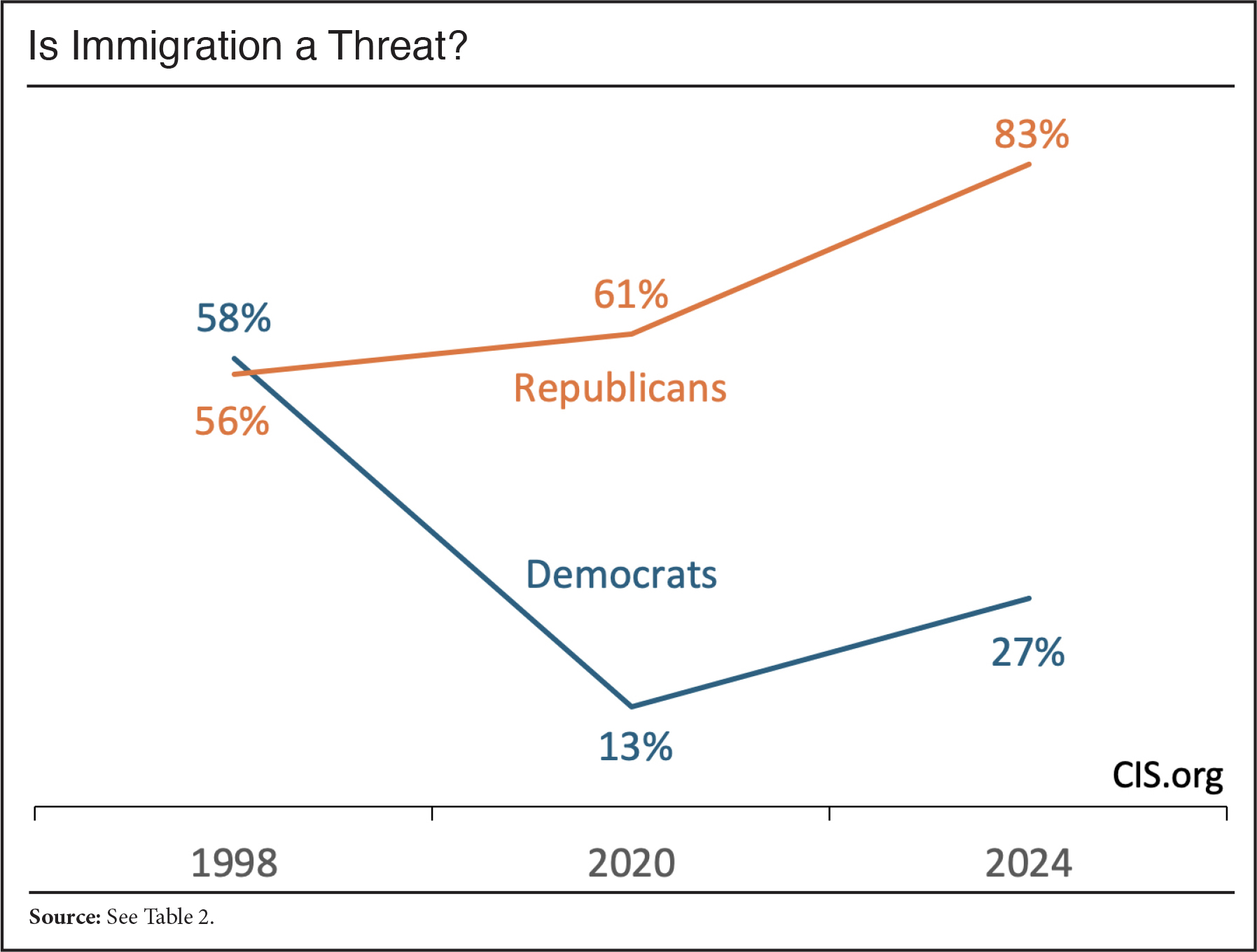
In 1998, 58 percent of Democratic respondents and 56 percent of Republican respondents thought that the large number of immigrants and refugees coming into the U.S. was a critical threat to the vital interests of the U.S. (see Table 2). By 2020, the proportion of Democrats believing the level of immigration level to be a critical threat had fallen by 45 percentage points, to 13 percent, while the proportion of Republicans had risen by five percentage points, to 61 percent.
Thus, while in 1998 similar majorities of both Democrats and Republicans considered the level of immigration to be a critical threat to the national interest, by 2020 Democrats had become almost totally dismissive of this concern and Republicans’ views remained relatively consistent.
The polling, not cited by Ollerenshaw and Jardina, was conducted by the Chicago Council on Global Affairs (CCGA) and the Lester Crown Center on US Foreign Policy (LCC).
Illegal Immigration
– Should Reducing Illegal Immigration Be a Goal?
In 1998, 53 percent of Democratic respondents and 57 percent of Republican respondents believed that controlling and reducing illegal immigration should be a very important foreign policy goal (see Table 3). By 2018, the proportion of Democrats so believing had fallen by 33 percentage points, to 20 percent, while the proportion of Republicans had risen by 14 percentage points, to 71 percent.
Thus, while in 1998 similar majorities of both Democrats and Republicans believed in the need to control and reduce illegal immigration, by 2018 Democrats had largely abandoned this view and Republicans had increasingly embraced it.
The polling, not cited by Ollerenshaw and Jardina, was conducted by CCGA and LCC.
– Should Border Security Funding Be Increased?
In 2000, 51 percent of Democratic respondents and 43 percent of Republican respondents opposed increased federal spending on tightening border security to prevent illegal immigration (see Table 4). By 2020, the proportion of Democrats opposing increased spending had risen by 30 percentage points, to 81 percent, while the proportion of Republicans had fallen by 16 percentage points, to 27 percent.
Thus, while in 2020 about half of Democrats and a substantial minority of Republicans opposed increased spending on border security, by 2020 the level of opposition by Democrats had increased dramatically and that of Republicans had fallen substantially.
The polling was conducted by ANES.
– Should Border Patrols Be Increased?
In 2007, 60 percent of Democrats and 37 percent of Republicans opposed the U.S. government increasing the number of patrols on the U.S.-Mexico border (see Table 5). By 2020, the proportion of Democrats opposing increased patrols had risen by three percentage points, to 63 percent, while the proportion of Republicans had fallen by 28 percentage points, to 9 percent.
Thus, while in 2007 a majority of Democrats and a substantial minority of Republicans opposed increased border patrols, by 2020 Republican opposition had decreased dramatically and Democratic opposition remained relatively stable.
The polling is “a set of cross-sectional surveys fielded via YouGov” and “collaboratively funded by research teams who receive team-specific content and contribute to the publicly available Common Content CES [formerly the Cooperative Congressional Election Study] samples”.
– Should a Border Wall Be Constructed?
According to polling conducted by the Public Religion Research Institute (PRRI), a nonpartisan, independent research organization, in 2016, 80 percent of Democratic respondents and 31 percent of Republican respondents opposed or strongly opposed building a wall along the U.S. border with Mexico (see Table 6). By 2020, the proportion of Democrats opposing construction had risen by seven percentage points, to 87 percent, while the proportion of Republicans had fallen by 16 percentage points, to 15 percent.
According to polling by CCGA and LCC, in 2016 72 percent of Democratic respondents and 11 percent of Republican respondents opposed expanding the 700 miles of border wall and fencing with Mexico to reduce illegal immigration into the U.S. By 2019, the proportion of Democrats had risen by 17 percentage points, to 89 percent, and the proportion of Republicans had risen by nine percentage points, to 20 percent.
Thus, while in 2016 large majorities of Democrats opposed more border wall construction, as did a minority of Republicans, by 2019/2020 Democratic opposition had increased to near unanimity and Republican opposition had either risen or fallen to a level of about two out of 10.
Immigration Levels
– Should Immigration Levels Be Increased?
In 1992, only 10 percent of Democratic respondents and 6 percent of Republican respondents who thought that the number of immigrants from foreign countries permitted to come to the U.S. to live should be increased/increased a lot/a little (see Table 7). By 2020, the proportion of Democrats who thought that the numbers should be increased had risen by 37 percentage points, to 47 percent, while the proportion of Republicans had risen by five percentage points, to 11 percent. The polling was conducted by ANES.
In 1994, only 5 percent of both Democratic and Republican respondents thought that the number of immigrants to America nowadays should be increased a little or a lot. By 2018, the proportion of Democrats who thought that the numbers should be increased had risen by 30 percentage points, to 35 percent, while the proportion of Republicans had risen by five percentage points, to 10 percent. The polling was conducted by the General Social Survey (GSS), funded by the National Science foundation and fielded by NORC at the University of Chicago.
In 2002, only 14 percent of Democratic respondents and 10 percent of Republican respondents thought that legal immigration into the U.S. should be increased. By 2020, the proportion of Democrats who thought that the numbers should be increased had risen by 29 percentage points, to 43 percent, while the proportion of Republicans had increased by one percentage point, to 11 percent. The polling was conducted by CCGA and LCC.
Thus, while in 1992, 1994 and 2002 only small numbers of both Democrats and Republicans thought that immigration levels should be increased, by 2018/2020 Democratic support for increased levels had risen dramatically, with one poll showing a near majority of Democrats in support and Republican support remained miniscule.
Impact of Immigration
– Are Immigrants a Drain on Resources?
In June 2020, 13 percent of Democratic respondents and 56 percent of Republican respondents agreed that immigrants were a drain on national resources (see Table 8).
The polling, not cited by Ollerenshaw and Jardina, was conducted by Yougov.com. Earlier polling data is not available.
– Do Immigrants Take Away Jobs from Americans?
In 1996, 29 percent of both Democratic and Republican respondents disagreed/disagreed strongly with the proposition that immigrants take jobs away from people who were born in America (see Table 9). By 2014, the proportion of Democrats who disagreed had risen by 17 percentage points, to 46 percent, and the proportion of Republicans had risen by six percentage points, to 35 percent. The polling was conducted by GSS.
In 2004, only 14 percent of both Democratic and Republican respondents thought it not at all likely that recent immigration levels would take jobs away from people already here. By 2020, the proportion of Democrats had risen by 39 percentage points — to 53 percent — and the proportion of Republicans had risen by two percentage points — to 16 percent. The polling was conducted by ANES.
Thus, in 1996, according to GSS, about three out of 10 Democrats and Republicans were dismissive of concerns that immigration levels would reduce job opportunities for American workers, while by 2014, the proportion of dismissive Democrats had increased to a near majority and the proportion of dismissive Republicans had increased modestly. And while in 2004, according to ANES, few Democrats or Republicans were utterly dismissive of concerns about the impact of immigration on American workers, by 2020, the proportion of utterly dismissive Democrats had dramatically increased to a majority and the proportion of Republicans had increased modestly.
– What Is Immigration’s Impact on American Society?
In 2010, 61 percent of Democratic respondents and 41 percent of Republican respondents believed that the growing number of newcomers from other countries strengthened American society (see Table 10). By 2019, the proportion of Democrats had risen by 17 percentage points, to 78 percent, while the proportion of Republicans had fallen by six percentage points, to 35 percent.
The polling was conducted by PRRI.
Thus, while in 2010 six out of 10 Democrats and four out of 10 Republicans believed increasing immigration levels strengthened American society, by 2019, the proportion of Democrats holding this anodyne view increased substantially, to eight out of 10, and the number of Republicans fell modestly.
Amnesty
– Should Illegal Aliens Be Given Amnesty?
In 2007, 48 percent of Democratic respondents and 23 percent of Republican respondents thought the U.S. government should grant legal status to all illegal immigrants who have held jobs and paid taxes for at least three years and have not been convicted of any felonies (see Table 11). By 2013, the proportion of Democrats supporting amnesty had risen by 15 percentage points, to 63 percent, while the proportion of Republicans had risen by four percentage points, to 27 percent. By 2020, the proportion of Democratic supporters had risen by another 26 percentage points, to 89 percent, and the proportion of Republican supporters had risen by 19 percentage points, to 46 percent. The polling was conducted by CES.
In 2013, 71 percent of Democratic respondents and 53 percent of Republican respondents supported a pathway for immigrants living in the country illegally to become citizens, provided they met certain criteria. By 2020, the proportion of Democratic supporters had risen by three percentage points, to 74 percent, while the proportion of Republican supporters had fallen by five percentage points, to 48 percent. The polling was conducted by PRRI.
Pew Research Center polling not cited by Ollerenshaw and Jardina found that in 2017, 93 percent of Democratic respondents and 60 percent of Republican respondents thought that undocumented immigrants currently living in the U.S. should be allowed to stay in the country legally. By 2020, the proportion of Democratic supporters had fallen by two percentage points, to 91 percent, and the proportion of Republican supporters had fallen by two percentage points, to 58 percent.
Thus, while in 2007 about half of Democrats and a quarter of Republicans favored amnesty, by 2013 the proportion of Democrats supporting amnesty had increased to about two-thirds and the proportion of Republican supporters either increased modestly or was a small majority, and by 2020 the proportion of Democratic supporters increased dramatically to either three-quarters or nine out of 10, and the proportion of Republican supporters was either close to a majority or even approached six out of 10.
– Should Illegal Aliens Who Arrived as Minors Be Given Amnesty?
In 2011, 58 percent of Democratic respondents and 41 percent of Republican respondents favored allowing immigrants who had come to the U.S. illegally as children to obtain citizenship if they joined the military or completed four years of college (see Table 12). By 2020, the proportion of Democratic supporters had risen by 15 percentage points to, 73 percent, and the proportion of Republican supporters had risen by four percentage points, to 45 percent.
The polling was conducted by PRRI.
Thus, support for amnesty for illegal aliens who arrived as minors was fairly large in 2011 — about six out of 10 Democrats and four out of 10 Republicans — and by 2020 Democratic support had risen even more, while Republican opinion remained relatively stable.
What to Make of the Polling Results
The polling data provides evidence of a remarkable transformation in the views of Democrats regarding the issue of immigration from the era of the 1980s/1990s/2000s to that of the 2010s through President Trump’s first term. The proportion of Democrats who believed immigration levels to be a threat to U.S. interests fell dramatically, as did the proportion who believed controlling and reducing illegal immigration to be an important goal, while the proportion of Democrats who believed that illegal aliens should be granted amnesty increased dramatically, as did the proportion who thought that legal immigration levels should be raised even higher, and who dismissed concerns about the impact of immigration on American workers.
The Polling Evidence of Democrats’ Renewed Questioning of Mass Immigration and Mass Lawlessness after Feeling the Impact of President Biden’s Policies
Attitudes Toward President Biden’s Handling of Immigration
Polling conducted by the Economist/YouGov in February-March 2021 indicated that 74 percent of Democratic respondents, 73 percent of liberal respondents, and 11 percent of Republican respondents (all U.S. citizens) approved of how President Biden was handling immigration. By October 2024, Economist/YouGov polling indicated that the approval rating for Biden’s handling of immigration had decreased by 11 percentage points for Democrats, to 63 percent; 13 percentage points for liberals, to 60 percent; and five percentage points for Republicans, to 6 percent.
Polling conducted by Gallup in August 2021 indicated that 76 percent of Democratic respondents, 66 percent of liberal respondents, and 9 percent of Republican respondents (all adults) approved of Biden’s handling of immigration. Then:
- Gallup’s polling in February 2023 indicated that approval of Biden’s handling of immigration decreased by 14 percentage points for Democrats, to 62 percent; nine percentage points for liberals, to 57 percent; and decreased by three percentage points for Republicans, to 6 percent.
- Gallup’s polling in November 2023 indicated that, since February 2023, Democrats’ approval of Biden’s handling of immigration had stayed steady at 62 percent, while Republicans’ approval had increased by three percentage points, to 9 percent.
- Gallup’s polling in February 2024 indicated that since the previous November, Democrats’ approval had decreased by seven percentage points, to 55 percent, and Republicans’ approval had decreased by six percentage points, to 3 percent.
Polling by Morning Consult/Politico in January-February 2021 indicated that 80 percent of Democratic respondents, 79 percent of liberal respondents, and 15 percent of Republican respondents (all registered voters) approved or strongly approved of President Biden’s handling of immigration, while its polling in October 2022 indicated that Biden’s approval rating had decreased by 15 percentage points for Democrats, to 65 percent; decreased by nine percentage points for liberals, to 70 percent; and decreased by five percentage points for Republicans, to 10 percent.
Thus, from early to late in the Biden administration, Democrats’ support of President Biden’s handling of immigration decreased by either 11 or 21 percentage points.
Feelings Toward Immigration
– Is Immigration a Threat?
Recall that in 1998, 58 percent of Democrats and 56 percent of Republicans thought that the large number of immigrants and refugees coming into the U.S. was a critical threat to our vital interests, while by 2020, the proportion of Democrats believing immigration levels to be a critical threat had fallen to 13 percent and that of Republicans had risen to 61 percent.
By 2024, the proportion of Democrats believing immigration levels to be a critical threat had risen by 14 percentage points from 2020, to 27 percent, and the proportion of Republicans had risen by 22 percentage points, to 83 percent.
Thus, between 2020 and 2024, the proportion of Democrats believing immigration levels to be a critical threat reversed 31 percent of its 1998 to 2020 decline (see Table 2).
Illegal Immigration
– Should Reducing Illegal Immigration Be a Goal?
Recall that in 1998, 53 percent of Democrats and 57 percent of Republicans believed that controlling and reducing illegal immigration should be a very important foreign policy goal, while by 2018 the proportion of Democrats believing so had fallen to 20 percent and that of Republicans had risen to 71 percent.
By 2024, the proportion of Democrats believing that controlling and reducing illegal immigration should be a very important goal had risen by 14 percentage points from 2018, to 34 percent, and the proportion of Republicans had risen by 15 percentage points, to 86 percent.
Thus, between 2018 and 2024, the proportion of Democrats believing that controlling and reducing illegal immigration should be a very important goal reversed 42 percent of its 1998-2018 decline (see Table 3).
– Should Border Patrols Be Increased?
Recall that in 2007, 60 percent of Democrats and 37 percent of Republicans opposed increasing the number of patrols on the U.S.-Mexico border, while by 2020, the proportion of Democrats opposing an increase had risen to 63 percent and the proportion of Republicans had fallen to 9 percent (see Table 5).
By 2022, the proportion of Democrats who opposed increasing the number of border patrols had fallen by 14 percentage points from 2020 to 49 percent and the proportion of Republicans had fallen by two percentage points to 7 percent.
Thus, the proportion of Democrats who opposed increasing the number of border patrols fell substantially from 2007 to 2022 — from 60 to 49 percent.
– Should a Border Wall Be Constructed?
Recall that in 2016, according to PRRI polling, 80 percent of Democrats and 31 percent of Republicans opposed building a wall along the U.S. border with Mexico, while by 2020 the proportion of Democrats who opposed construction had risen to 87 percent and the proportion of Republicans had fallen to 15 percent. Well, by 2024 the proportion of Democrats who opposed construction had fallen by eight percentage points from 2020, to 79 percent, and the proportion of Republicans had fallen by three percentage points, to 12 percent.
Recall that, in 2016 according to CCGA and LCC polling, 72 percent of Democrats and 11 percent of Republicans opposed expanding the 700 miles of border wall and fencing with Mexico to reduce illegal immigration into the U.S., while by 2019 the proportion of Democrats who opposed expansion had risen to 89 percent and the proportion of Republicans had risen to 20 percent. Well, by 2024 the proportion of Democrats who opposed expansion had fallen by 15 percentage points from 2019, to 74 percent, and the proportion of Republicans had fallen by nine percentage points, to 11 percent.
Thus, while Democrats have consistently been opposed to building a border wall, by 2024 the proportion in opposition declined by more than it had increased from 2016 to 2020, and the proportion in opposition reversed 88 percent of its 2016 to 2019 increase (see Table 6).
Immigration Levels
– Should Immigration Levels Be Increased?
Recall that in 1994, according to GSS polling, only 5 percent of both Democrats and Republicans believed that the number of immigrants permitted to come to the U.S. to live should be increased, while by 2018, the proportion of Democrats who believed so had risen by 30 percentage points, to 35 percent, and the proportion of Republicans had risen by five percentage points, to 10 percent. Well, by 2022 the proportion of Democrats who believed that immigration levels should be increased had risen by four percentage points from 2018, to 39 percent, and the proportion of Republicans had risen by two percentage points, to 12 percent.
Recall that in 2002, according to CCGA and LCC polling, only 14 percent of Democrats and 10 percent of Republicans believed that legal immigration into the U.S. should be increased, while by 2020 the proportion of Democrats who believed so had risen to 43 percent and the proportion of Republicans had risen to 11 percent. Well, by 2024 the proportion of Democrats who believed so had fallen by 13 percentage points from 2020, to 30 percent, while the proportion of Republicans remained constant at 11 percent.
So we have conflicting results here. According to GSS polling, after the proportion of Democrats who favored increased levels of immigration rose dramatically from 1994 to 2018, the proportion rose again from 2018 to 2022, albeit modestly. However, according to CCGA and LCC polling, after the proportion of Democrats who favored increased levels rose dramatically from 2002 to 2020, the proportion reversed 45 percent of its 2002 to 2020 increase (see Table 7).
Impact of Immigration
– Are Immigrants a Drain on Resources?
Recall that in June 2020, 13 percent of Democrats and 56 percent of Republicans believed that immigrants were a drain on national resources.
Well, by December 2023 the proportion of Democrats believing immigrants to be a drain on resources had risen by 18 percentage points, to 31 percent, while the proportion of Republicans had risen by eight percentage points, to 64 percent (see Table 8).
– Do Immigrants Take Jobs Away from Americans?
Recall that in 1996, 29 percent of both Democrats and Republicans disagreed/disagreed strongly with the proposition that immigrants take jobs away from people who were born in America, while by 2014, the proportion of disagreeing Democrats had risen by 17 percentage points, to 46 percent, and the proportion of Republicans had risen by six percentage points, to 35 percent.
Well, by 2022, the proportion of Democrats who did not agree that immigrants take jobs away from Americans had risen by 25 percentage points from 2014, to 71 percent, while the proportion of Republicans had risen by one percentage point, to 36 percent.
Thus, the proportion of Democrats not agreeing that immigrants take jobs away from Americans not only continued to increase during the Biden years but increased dramatically (see Table 9).
– What Is Immigration’s Impact on American Society?
Recall that in 2010, 61 percent of Democrats and 41 percent of Republicans agreed that the growing number of newcomers from other countries strengthens American society, while by 2019, the proportion of Democrats believing that immigrants strengthen society had risen to 78 percent and the proportion of Republicans had fallen to 35 percent.
Well, by 2023 the proportion of Democrats who agreed that the growing number of newcomers strengthens society had fallen by two percentage points from 2019, to 76 percent, while the proportion of Republicans fell by 10 percentage points, to 25 percent.
Thus, between 2019 and 2023, the proportion of Democrats who agreed that the growing number of newcomers strengthens society reversed 11 percent of its 2010 to 2019 increase (see Table 10).
Amnesty
– Should Illegal Aliens Be Given Amnesty?
Recall that in 2007, according to CES polling, 48 percent of Democrats and 23 percent of Republicans believed the government should grant legal status to all illegal aliens who met certain conditions, while by 2020, the proportion of Democrats in favor of amnesty had risen to 89 percent, and the proportion of Republicans had risen to 46 percent. Well, by 2022 the proportion of Democrats supporting amnesty had fallen by one percentage point from 2020, to 88 percent, and the proportion of Republicans had fallen by two percentage points, to 44 percent.
Recall that in 2013, according to PRRI polling, 71 percent of Democrats and 53 percent of Republicans believed there should be a pathway to citizenship for illegal aliens, provided they meet certain criteria, while by 2020, the proportion of Democrats in favor of amnesty had risen to 74 percent and the proportion of Republicans had fallen to 48 percent. Well, by 2024, the proportion of Democrats supporting amnesty had risen by three percentage points from 2020, to 77 percent, while the proportion of Republicans had fallen by 12 percentage points, to 36 percent.
Recall that in 2017, according to Pew polling, 93 percent of Democrats and 60 percent of Republicans believed that illegal aliens should be allowed to stay in the U.S. legally, while by 2020 the proportion of Democrats in favor of amnesty had fallen to 91 percent and the proportion of Republicans had fallen to 58 percent. Well, by 2024, the proportion of Democrats supporting amnesty had fallen by seven percentage points from 2020, to 84 percent, and the proportion of Republicans had fallen by 24 percentage points, to 34 percent.
Thus, one of the polls (CES) indicated that the proportion of Democrats who supported amnesty for illegal aliens rose dramatically from 2007 to 2020, and then remained stable through 2022; another poll (PRRI) indicated that about three-quarters of Democrats supported amnesty in 2013, 2020, and 2024, even rising modestly as the Biden presidency drew to a close in 2024; and the third poll (Pew) indicated that while a very high proportion of Democrats supported amnesty in 2017, 2020, and 2024, the proportion dropped by seven percentage points as the Biden presidency drew to a close (see Table 11).
– Should Illegal Aliens Who Arrived as Minors Be Given Amnesty?
Recall that in 2011, 58 percent of Democrats and 41 percent of Republicans favored allowing illegal aliens who came illegally as children to obtain citizenship if they met certain conditions, while by 2020, the proportion of Democrats favoring amnesty had risen to 73 percent and the proportion of Republicans had risen to 45 percent. Well, by 2024, the proportion of Democrats supporting amnesty (who favored allowing immigrants brought illegally to the U.S. as children to gain legal resident status) had risen by four percentage points from 2020, to 77 percent, and the proportion of Republicans had fallen by 18 percentage points, to 27 percent.
Thus, support by Democrats for amnesty for illegal aliens who entered illegally as children had risen significantly from 2011 to 2020 and had risen again, albeit modestly, as the Biden presidency was coming to a close in 2024 (see Table 12).
What to Make of the Poll Results II
The foregoing polling data provides evidence of a second remarkable transformation in the views of Democrats regarding immigration, but this time measured not in decades but over the few short years of the Biden administration. The proportion of Democrats who believed immigration levels to be a threat rose, recouping a third of its decrease over the previous decades. The proportion who believed controlling and reducing illegal immigration to be an important goal also rose, recouping over 40 percent of its prior decrease. The proportion who opposed increased border patrols was actually lower by 2022 than it was in 2007 and the proportion who opposed border wall construction essentially erased its Biden era gains by 2024. The proportion of Democrats who approved of how President Biden was handling immigration decreased substantially from the early to the later days of his presidency, in tandem with and likely driving these attitudinal shifts.
There is some conflicting data. The proportion of Democrats who dismissed concerns about immigration’s negative impact on American workers rose even higher through the middle of the Biden presidency in 2022 and the proportion who believed that high immigration levels strengthen American society stayed pretty much unchanged from 2019 to 2023. And different polls provide inconsistent evidence regarding Democrats’ views regarding amnesty for illegal aliens and legal immigration levels. While one poll found that the proportion of Democrats who supported amnesty had increased modestly during the Biden years, another found that it had decreased modestly, and a third found that it had remained stable (at least through 2022). And while one poll found that the proportion of Democrats who supported increased immigration levels rose modestly (at least through 2022), another found that the proportion had decreased substantially, recouping close to half of its gains over the preceding decades.
Overall, it is hard to dispute that Democrats’ views on immigration soured substantially during the Biden years.
These results cannot be dismissed as merely indicative of Democrats becoming more conservative over time. CCGA and LLC polling found that the proportion of self-identified Democrats who described themselves as extremely liberal, liberal, or slightly liberal increased from 44 percent in 2004 to 51 percent in 2016 to 57 percent in 2020 to 67 percent in 2024, while the proportion who described themselves as moderate, slightly conservative, conservative, or extremely conservative, fell from 56 percent in 2004 to 49 percent in 2016 to 43 percent in 2020 to 33 percent in 2024.
The Reaction of the Democratic Party to Democrats’ Renewed Questioning of Mass Immigration and Mass Lawlessness
On August 22, 2024, during the Democratic National Convention, Christian Paz wrote in Vox that:
-
[T]he DNC [Democratic National Convention] sounds a lot different [than it did in 2012, 2016, or 2020], reflecting how public opinion toward immigration in general has soured as concerns over how secure the border is have risen. Gone are the heartfelt testimonies from undocumented immigrants, the repudiation of Trump-era policies, and the calls for better treatment of migrants and expansion of asylum protections. Instead, Wednesday evening’s speakers embraced tougher policies for asylum seekers, praised President Joe Biden’s attempts to negotiate a bipartisan border security bill, and conceded the changed reality of immigration politics since the pandemic’s dawn.
In other words, Democrats’ speeches on immigration and the border were drastically different than the ones at the conventions of 2012, 2016, or 2020 — because reality and the public’s feelings have changed drastically too.
-
[I]t can be easy to miss the Democrats’ own right-ward shift in recent years.
In past party conventions, Democrats made significant attempts to highlight the plight of young immigrants and immigrant families — be they families split apart because of immigration policy, young DREAMers struggling and succeeding in America despite not having documentation, or activists working toward immigration reform.
-
[S]peakers balanced two messages: that Democrats are not the same flavor of anti-immigrant as Republicans — they value diversity and believe in the humane treatment of migrants — but they understand the need for reform and bolstered security. They’re starting to sound like the fictional vice president from HBO’s Veep, who once described a need to “reform, reaffirm, and repel” immigration.
Actually, Julia Louis-Dreyfus’ character Vice President Selina Meyer was supposed to say “reaffirm, reform, and renew”, but “can’t remember the last one … [and] says ‘repel’”.
In any event, Paz concluded that:
-
[T]here was hardly any wholehearted embrace of immigration in general … rarely a welcoming of economic migrants seeking “a better life,” as in past conventions. And that’s because reality has changed.
-
Gone are the Obama- and Clinton-era days of casting the Democratic Party as the unequivocal pro-immigrant party. The differences in the convention platforms make that clear as well.
As to the Democratic platform, as I have written, convention delegates approved by voice vote the “24 Democratic Party Platform”. The platform asserted that “Congress should … dedicate resources to detain” aliens who cross the border unlawfully”, that “Congress should … dedicate resources to … remove individuals quickly” who are crossing unlawfully and that “Democrats believe that … those who are determined not to have a legal basis to remain should be quickly removed”, and that “we need Congress to strengthen requirements for valid asylum claims” and “Congress must pass legislation to reform our asylum system … so that we can … ensure it is not used as an alternative to legal immigration by” aliens not actually fleeing persecution.
And then came election day. As the results came in, Natasha Korecki and Yamiche Alcindor reported for NBC News that:
Some [Democratic campaign aides, strategists, elected officials and battleground state Democrats] spoke of revamping the party’s outlook on immigration, calling for stricter enforcement on the border. They saw the rising support for Trump in metro areas as a backlash from early policies during President Joe Biden’s administration that enabled migrants to flood into blue states, where they were often housed and financially supported even as working-class residents struggled to receive services.
Some Democratic politicians recognized the peril in which President Biden’s immigration policies had placed the party. Melanie Mason also wrote in Politico last summer that:
-
While Republicans have coalesced on the right, the Democrats’ trajectory induced whiplash. The party tacked left during Trump’s first term, powered by fury over Trump policies such as family separations at the border or the immigration ban from some Muslim-majority countries. Democratic presidential hopefuls in 2020 jostled to prove their pro-immigrant bona fides, with most vowing to decriminalize illegal border crossings.
But with Biden occupying the Oval Office amid a historic surge of migrants at the U.S.-Mexico border, Democrats have abruptly changed their tune.
-
House Democrats in tough races are increasingly following the lead of colleagues like Rep. Tom Suozzi of New York, who won a special election in a bellwether district earlier this year in part by promising to tackle an immigrant influx spilling into his suburban district.
George Nassar, a Republican pollster who works on races across the country, said the steady stream of headlines about violent crime committed by people in the country illegally and government resources being diverted to new migrants has given the issue newfound oomph beyond the hard-right base.
“Back in the day when I would test immigration messaging, it was only moving Republicans. Now it’s moving independents and persuadable voters,” Nassar said. “That’s why Democrats are now trying to say, ‘We’re strong on the border.’”
Listen to the trenchant analysis of U.S. Rep. Richie Torres (D-N.Y.), who represents a congressional district in New York City’s borough of the Bronx “that’s over 50 percent Latino” but that nevertheless “shifted right by 11 points” in the 2024 election, according to Hanna Rosin in The Atlantic. Rosin described Torres with these words: “He’s young — 36. He’s Afro Latino. He’s gay. He grew up poor. And he didn’t finish college. He’s also a proud Democrat.”
Rep. Torres (who has been talked about as a candidate for mayor or governor) has come to the conclusion that “[t]he main reason we lost was inflation and immigration” and the “main reason” for Trump’s inroads among voters of color “is inflation and immigration and public safety”. He concluded that “it is not surprising that Trump fatigue was outweighed by the popular discontent over inflation and immigration” and that “if you remove inflation and immigration from the table, we win the election. … [Donald Trump] was seen as a change agent, as an alternative to a status quo marked by inflation and the migrant crisis.” Torres noted that “the most Latino county in America was Starr County, right at the border” and pointed to the facts that “In 2016, Hillary Clinton won it by 60 percentage points. And in 2024, Donald Trump won nearly 60 percent — a complete collapse of Latino support. Look — my view is that we do not have a messaging problem; we have a reality problem.”
Torres blamed the election results on the Democrats’ leftward lurch on immigration, saying that “we swung the pendulum too far to the left” and Kamala Harris and Joe Biden’s advocacy of far-left policies “cost us the election”. He noted that “you cannot have a system where anyone anywhere can cross the border, declare asylum, and then remain here indefinitely”.
Torres pointed to the costs of Biden’s policies: that “there was a point at which the sheer number of people coming became overwhelming” and that “since 2022, there has been an unprecedented wave of migration, whose impact was felt not only at the border but in cities like New York, where the shelter system and the social safety net and municipal finances were completely overwhelmed”.
Torres called this political malpractice on the part of the Democratic Party:
-
I do feel there was political malpractice that led to our loss of credibility on the issue of immigration.
-
Despite clear signs of popular discontent, the Biden administration waited two and a half years before issuing an executive order regulating migration at the border. And by then it was too late. The political damage had been done. The Republicans had successfully weaponized the issue against us.
-
I know [New York City] Mayor Adams came under severe criticism for excoriating the administration. But for me, the problem was not Mayor Adams complaining about the migrant crisis; the problem was the reality of the migrant crisis and the administration’s failure to address it with the urgency that the public demanded.
-
When the migrant crisis was unfolding, we should have responded with the sense of urgency that the public demanded of us. The public saw it as a crisis. So it’s not a messaging problem. It’s a reality problem. When there is a crisis, when there’s an emergency, when there’s a metaphorical fire, we have to extinguish the fire. We have to do everything we can to extinguish the fire, or else we’re going to pay a price at the ballot box.
Conclusion
While I certainly welcome any restrictionist turn in the attitudes of Democratic voters, Rep. Torres surely does not, noting that “I’m self-aware enough to recognize that I’m considerably to the left of the rest of the country in immigration.” But he is quite perceptive, understanding that “If we swing the pendulum too far to the left on issues like immigration and public safety, we will risk a public reaction that will make our country more right wing, not less; more restrictionist on immigration, not less; more conservative on public safety, not less.”
End Notes
1 I should note that I had the privilege of working for all three members on these pieces of legislation.
2 The final version of this paper was published in December 2023 in Volume 87, Issue 4 of Public Opinion Quarterly 1038-1053 (Winter 2023), available here (behind a paywall).


