The Argument Over Immigration You Don’t Realize You’re Having
- External Source
admin
- 0
- 16 minutes read
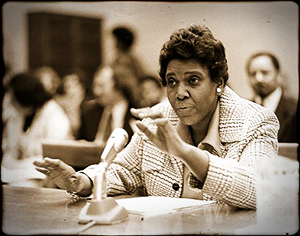
One thing we all can agree on is there are strong disagreements over immigration, with one side decrying any ICE enforcement and the other demanding more removals and fewer new arrivals. Most in the latter camp probably don’t realize that the issue for the other side has more to do with the very legitimacy of the United States than it does with allowing those “seeking a better life” to remain, as a very wise woman predicted more than 30 years ago in a landmark op-ed.
Barbara Jordan
Barbara Jordan may be little known today, but she was a towering force before she died of leukemia at age 59 in 1996.
In its January 1996 obituary of Jordan, the New York Times described her as “one of American politics’ pioneer black women”, winning election as the first black state senator in Texas history in 1966 and then “the first woman and first black elected to Congress from Texas” in 1972.
“In 1976, she was the first black woman to deliver a keynote address at the Democratic National Convention”, the Times intoned, “riveting her audience on national television as she spoke magisterially from the stage at New York’s Madison Square Garden.”
The high point of her legislative career, however, was as a member of the House Judiciary Committee during its Watergate investigation, when she proclaimed: “My faith in the Constitution is whole, it is complete, it is total, and I am not going to sit here and be an idle spectator to the diminution, the subversion, the destruction of the Constitution.”
She left the House in 1979 and taught political ethics at the University of Texas’s Lyndon B. Johnson School of Public Affairs, and that’s where she was when President Clinton tapped her to become the chair of the bipartisan U.S. Commission on Immigration Reform in December 1993.
The Times made only passing reference in Jordan’s obituary to her service on that commission, mainly to note “she spoke out last year against a proposal to deny automatic citizenship to the children of illegal immigrants born in this country”.
Her support for birthright citizenship is also the sole reference to her work on the commission that accompanies her exhibit at the National Portrait Gallery at the Smithsonian Institution in Washington, as well:
Jordan remained a strong advocate for justice. While serving as chair of the Commission on Immigration Reform in 1995, she denounced a proposal to deny birthright citizenship to children born in the United States to undocumented parents.
Doing so, she declared, “would derail this engine of American liberty.”
Curiously, both the “Gray Lady” and our flagship museum omitted other points Jordan made as chair of that commission, most notably the following: “The credibility of immigration policy can be measured by a simple yardstick: people who should get in, do get in; people who should not get in are kept out; and people who are judged deportable are required to leave.”
“The Americanization Ideal”
Jordan summarized her conclusions as chair into an op-ed published in the Times on September 11, 1995, headlined “The Americanization Ideal”.
While conceding that the term “Americanization” had been hijacked “by racists and xenophobes in the 1920’s”, Jordan proclaimed she was “taking it back” by redefining it as “becoming a part of the polity – becoming one of us”.
She continued, arguing that “becoming one of us” did “not mean conformity”, and scrapping the old “melting pot” analogy to instead compare “Americanization” to “a kaleidoscope, where every turn of history refracts new light on the old promise”.
The eighth paragraph of that op-ed is key to her argument, as it explains how Jordan envisioned Americanization working:
Immigration imposes mutual obligations. Those who choose to come here must embrace the common core of American civic culture. We must assist them in learning our common language: American English. We must renew civic education in the teaching of American history for all Americans. We must vigorously enforce the laws against hate crimes and discrimination. We must remind ourselves, as we illustrate for newcomers, what makes us America.
Note that Jordan assigns five different duties there, but just one of them to immigrants: embracing American civic culture.
The remaining four are to be borne by the rest of us, and two are closely linked: learning our own history and embracing it.
“We the People”
The inclusion of those points may have seemed odd at the time, as they reflected what I remember as the zeitgeist of the mid-1990s in the United States: Americans had their differences, to be sure, but we understood not only of the imperfections of our own history but also the sacrifices made to overcome them, and as a result were more or less united in our core beliefs.
In that vein, consider the following, from Jordan’s opening statement at the Judiciary Committee’s July 24, 1974, oversight hearing on Watergate:
Earlier today, we heard the beginning of the Preamble to the Constitution of the United States: “We, the people.” It’s a very eloquent beginning. But when that document was completed on the seventeenth of September in 1787, I was not included in that “We, the people.” I felt somehow for many years that George Washington and Alexander Hamilton just left me out by mistake. But through the process of amendment, interpretation, and court decision, I have finally been included in “We, the people.”
“Presentism” Versus “The Shoulders of Giants”
The intervening years have seen the rise of a different way of viewing history that focuses primarily (if not exclusively) on the failures of the past, often referred to as “presentism”.
Here’s what one British historian had to say in July 2023 in support of such a view:
Controversies over history now capture far greater public attention than they did . . .: from the legacies of slavery and white supremacy in the US via Russian claims to the territory of Ukraine to the unhealed scars from Japanese colonialism in Asia, among a host of other chafing points around the world. More than ever, historians must write to the present because people in that present demand accounting for the past and, by necessity, want historical answers to contemporary questions.
Fair enough, but note how Jordan didn’t so much excoriate Washington or Hamilton in her statements as she came to give credit to the process they had started that now allowed her – “the first black elected to Congress from Texas after Reconstruction”, as the Times’ obituary noted – to sit in judgment of the president of the United States.
Just less than three centuries before then-Rep. Jordan offered her view of the present through the prism of the past, Isaac Newton told fellow scientist Robert Hooke that, “If I have seen further, it is by standing upon the shoulders of giants”.
If examining the present is, in St. Paul’s reckoning, to “see through a glass, darkly”, then reviewing the past is like looking into a muddy pond.
But as I recall the mid-1990s, when we assessed our U.S. history, we did it with Newton’s “shoulders of giants” modesty: our founders weren’t perfect, but they were great by their standards and we’re a fairer, freer, and more open-minded country because of them, not despite them.
“Settler Colonialism”
Which brings me to a rather novel concept in geopolitical thought with immigration implications, “settler colonialism”, defined by the Legal Information Institute as:
a system of oppression based on genocide and colonialism, that aims to displace a population of a nation (oftentimes indigenous people) and replace it with a new settler population. Settler colonialism finds its foundations on a system of power perpetuated by settlers that represses indigenous people’s rights and cultures by erasing it and replacing it by their own.
In June, I appeared before the Oxford Union Society at Oxford University in England to debate against the question “This House Believes that No One Can Be Illegal on Stolen Land”. While I was familiar with the term settler colonialism before, it was ringing in my ears by the time I adjourned to the bar to enjoy one of the Union’s featured drinks that night, “Manifest Daiquiris”.
It was a term my opponents applied not only to the United States, but to Australia and “Palestine” as well, to support the proposition that any society founded on “settler colonialism” had no right to keep anyone else out.
In fact, one of my opponents suggested even the United Kingdom should offer “reparations” visas to nationals of former British empire countries, concluding “justice [is] not just a famed apology but a passport in a pocket”.
The Biden Administration’s “Considerations Memo”
Whether you realize it or not, the unnamed individual(s) who crafted President Biden’s immigration policies did so in virtual intellectual lockstep with my opponents at the Oxford Union that night.
As proof, consider the following from September 30, 2021, guidance issued by DHS under the Biden administration, “Significant Considerations in Developing Updated Guidelines for the Enforcement of Civil Immigration Law” (the “Considerations memo”):
On his first day in office, President Biden affirmed that “advancing equity, civil rights, racial justice, and equal opportunity is the responsibility of the whole of our Government.” In the immigration enforcement context, scholars and professors have observed that prosecutorial discretion guidelines are essential to advancing this Administration’s stated commitment to “advancing equity for all, including people of color and others who have been historically underserved, marginalized, and adversely affected by persistent poverty and inequality.” [Footnotes omitted.]
By “prosecutorial discretion guidelines”, the author(s) means “ignoring the immigration laws as Congress wrote them”, and underlying theme of that paragraph is that the rules established by our own settler colonialists are largely to be ignored because they’re inherently unfair, unjust, and inequitable.
“A Nation of Immigrants”
We’ve long referred to our country as “a nation of immigrants”, in that most of us descend from past immigrants who built a common American political and social culture from their collective values and experiences.
But according to one historian writing for the Boston Review in August 2021, we have “never been ‘a nation of immigrants’” but are instead “a settler state with a core of descendants from the original colonial settlers, that is, primarily Anglo-Saxons, Scots, Irish, and Germans”, the “vortex” of which “sucked immigrants through a kind of seasoning process of Americanization”.
In that context, we are still (I guess) a nation of immigrants, but that fact undermines – not bolsters – any claim we currently have to impose any limit on the entry of any future immigrants. That’s not a basis for national cohesion, let alone sovereignty; it’s a recipe for the next Balkans war.
Barbara Jordan had a pre-response ready in “The Americanization Ideal”, 26 years earlier:
Legitimate concern about weaknesses in our immigration policy should not . . . obfuscate what remains the essential point: the United States has been and should continue to be a nation of immigrants. A well-regulated system of legal immigration is in our national interest. [Emphasis added.]
“We Must Renew Civic Education in the Teaching of American History”
The philosopher George Santayana famously proclaimed: “Those who cannot remember the past are condemned to repeat it.”
Worse than forgetting the past is misinterpreting it and then tearing down society’s institutions and norms out of theoretical and puerile self-righteousness.
In 1995, Barbara Jordan – civil rights icon and statesman – warned us this “nation of immigrants” will fail if we don’t know our history and can’t appreciate “what makes us America”. Demagogues have spun American history to push their own agendas since she passed, and it’s time take a page from her book and “take it back”.


