‘Mommy, Where Do Federal Judges Come From?’
- External Source
admin
- 0
- 21 minutes read
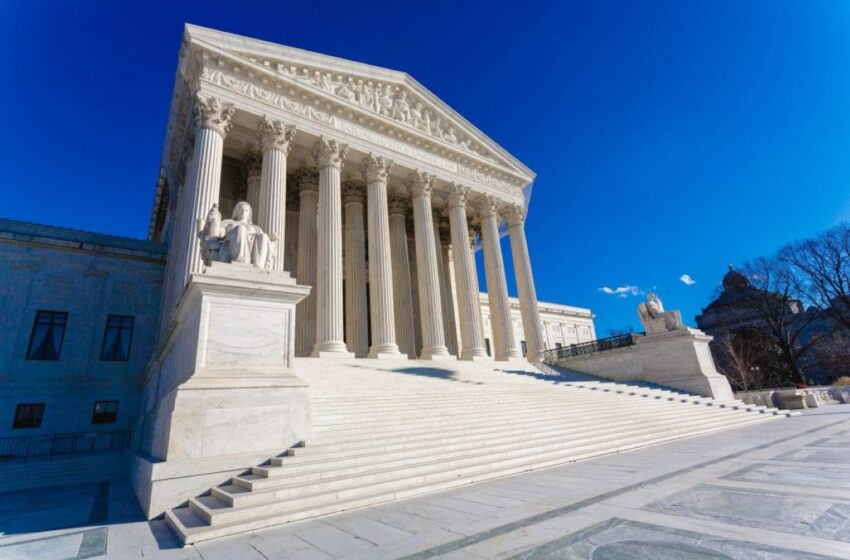

Recently, I noted that advocates have increasingly turned to the courts to secure control over the issue of immigration. But how exactly do lawyers become federal judges, with lifetime tenure and limited accountability? Buckle up for a trip through “blue slips”, filibusters, internecine fights, a cinema classic, three John Jay sightings, and a controversial 19th-century Supreme Court opinion that boosted the power of what was supposed to be the weakest of the three branches of the federal government – and the decisions of two presidents who simply ignored what the courts had to say.
American independence was declared on July 4, 1776, but only became a reality on September 3, 1783, with the approval of the Treaty of Paris. That document, signed by John Adams, John Jay, and Benjamin Franklin for the United States and David Hartley for Great Britain, recognized the new nation and set its boundaries.
By that point, the United States had been operating for two years under its first organizing document, the Articles of Confederation. As the National Constitution Center explains, however, the articles “created a weak central government—a ‘league of friendship’—that largely preserved state power (and independence)”.
That “league of friendship” among 13 disparate states with their own interests and vastly different economies worked about as well as could have been expected, and by May 1787, the founding fathers were back to work in Philadelphia on a more permanent constitution.
They finished on September 17, 1787, sending the agreed-upon result out for review by the states.
Federalist No. 78
For the constitution to be adopted, nine state legislatures had to ratify it. To persuade the states, three delegates – Alexander Hamilton, James Madison, and John Jay (again) – wrote 85 essays beginning in October 1787 that were published in various newspapers explaining how the new federal government would work, which have come to be known as “The Federalist Papers”.
American colonists viewed British judges as lackeys of the crown, so in Federalist 78, Hamilton described how the proposed U.S. federal courts would operate, and argued why they shouldn’t be feared:
[T]he judiciary, from the nature of its functions, will always be the least dangerous to the political rights of the Constitution; because it will be least in a capacity to annoy or injure them. The Executive not only dispenses the honors, but holds the sword of the community. The legislature not only commands the purse, but prescribes the rules by which the duties and rights of every citizen are to be regulated. The judiciary, on the contrary, has no influence over either the sword or the purse; no direction either of the strength or of the wealth of the society; and can take no active resolution whatever. It may truly be said to have neither FORCE nor WILL, but merely judgment; and must ultimately depend upon the aid of the executive arm even for the efficacy of its judgments. [Emphasis added.]
The trio’s sales job worked, and on June 21, 1788, New Hampshire became the ninth state to ratify the constitution, followed quickly thereafter by Virginia and New York.
On September 24, 1789, new President George Washington signed the Judiciary Act of 1789, and on February 2, 1790, the third and supposedly weakest branch was up and running, with (who else?) John Jay as the first chief justice of the Supreme Court, supported by five associate justices.
“Chief justice” was a short-term gig in the beginning, as Jay was replaced in August 1795 by John Rutledge, who handed the baton off to Oliver Ellsworth in March 1796. It wasn’t until Adams appointed John Marshall to the position on February 4, 1801, that any chief really stuck around.
Marbury v. Madison
That date is telling, because it was three months after Adams lost reelection, and two weeks before the House approved Adams’ rival, Thomas Jefferson, to be the third president (a story for another day).
There was little love lost between Jefferson, a Democratic-Republican, and Marshall, Adams’s Federalist secretary of State and Jefferson’s second cousin.
As William & Mary Law School, his alma mater, glowingly notes, “Marshall is best known for two important contributions to modern U.S. government”: establishing the judiciary as a co-equal branch of government; and “interpret[ing] the Constitution in ways that significantly enhanced the powers of the federal government”.
The latter is a reference to Marbury v. Madison, in which the Court weighed in on some questionable 11th hour appointments made by the outgoing Adams administration to impede Jefferson’s agenda.
Marshall’s ultimate opinion in Marbury technically favored James Madison, Jefferson’s secretary of State, but it was a pyrrhic victory, as the Court there gave itself the authority to declare laws unconstitutional and thereby oversee the other actions of the other two branches of government.
Jefferson later tried to have Marshall impeached over his handling of the trial of Aaron Burr for treason, but he was unsuccessful and Marshall lingered around, vexing the successors of the third president (including Madison) until July 1835.
The Appointment and “Blue Slip” Process
The judiciary has since played a role in American life and politics that would have been unrecognizable to the author of Federalist No. 78, particularly after Franklin Roosevelt’s February 1937 threat to add up to six new justices to the Supreme Court brought the nine who were already there more in line with his New Deal policies.
The process of placing judges on the bench begins when the president submits nominations for the bench to the Senate under the “Appointments Clause”, Article II, sec. 2, cl. 2 of the U.S. Constitution, for its “advice and consent”.
Those nominations are referred to the powerful Senate Judiciary Committee, and ever since 1917, the chairman of that committee thereafter initiates what’s known as the “blue slip process” for district and circuit court judges.
The “blue slip” refers to a form the chairman forwards to the senators who represent the nominee’s home state, and as the Congressional Research Service (CRS) recently explained:
If a home state Senator has no objection to a nominee, the blue slip is returned to the chairman with a positive response. If, however, a home state Senator objects to a nominee, the blue slip is either withheld or returned with a negative response. For the purposes of this report, any instance of a blue slip being withheld is treated the same as if a blue slip were returned with a negative response — that is, both instances indicate a nominee lacked the support of at least one home state Senator.
This is a traditional, not mandatory practice, and some chairmen have required approval from both home-state senators for the committee to move on judicial nominations, and some only for one to approve. But as CRS notes:
Regardless of the blue slip policy used by a chairman, it was nonetheless relatively rare, at least from 1956 to 2016, for the Senate to confirm a nominee who did not have the support of both home state Senators. For example, during this 61-year period, CRS has identified four nominees who were confirmed without such support.
Of course, federal circuit courts have jurisdiction over multiple states, not just the one from which the nominee hails, and in the 115th Congress in 2017, the Republicans who controlled the committee allowed circuit court nominees to proceed without securing positive blue slips from their two home state senators.
The blue slip process for district court judges remains in effect, which you should keep in mind the next time you hear that so-and-so, a “Reagan”, “George H.W. Bush”, or “George W. Bush” nominee from a liberal state has struck down some Trump policy (or vice-versa, depending on the administration).
The (Now Abandoned) Filibuster and (Slightly Modified) Confirmation Process
Once would-be judges are favorably reported out of the Senate Judiciary Committee, their nominations go to the Senate floor for a vote.
In August 2020, I explained in detail a concept known as the “filibuster” (from the Dutch for “pirate”), but briefly it is legislative maneuver senators use to block or delay the passage of legislation.
Senate rules require a supermajority of 60 votes to end a filibuster and move to consideration of a bill, and at present the majority GOP only holds 53 seats in the upper chamber – a key reason why the country is struggling to dig itself out of a recent 43-day government “shutdown”.
While there had long been questions about the constitutionality of applying the filibuster to judicial nominees (needless to say, it’s not in the Appointments Clause), apply it did until November 2013, when then-Senate Majority Leader Harry Reid (D-Nev.), at the behest of the Obama administration, ended the practice for district- and circuit-court nominations.
Norms once broken are hard to fix, and with Republicans now in charge of the Senate and Donald Trump in his first term in the White House, then-Senate Majority Leader Mitch McConnell (R-Ky.) in April 2017 used the so-called “nuclear option” to change the rules to allow the nomination of then-Judge Neil Gorsuch for the Supreme Court to proceed with just 51 votes – not the 60 required to break a filibuster.
“Old Hickory”, Lincoln, and “A Man for All Seasons”
One could argue that the filibuster kept unfit lawyers and bitter partisans off the federal court bench, and if you want to test that logic, look up whatever judge issued a decision that appears to be wildly at odds with law and logic and see when that jurist was appointed and by whom.
Regardless, a few on the right argue Trump II should simply ignore lower-court decisions that don’t go its way (particularly in the immigration sphere), and oddly enough, there’s precedent for doing so.
In his 1832 opinion in Worcester v. Georgia, Marshall, writing for a majority of the Supreme Court, held that a Georgia law that prevented non-Native Americans from “residing within the limits of the Cherokee nation without a license” and “without having taken the oath to support and defend the constitution and laws of the state of Georgia” unconstitutional.
Marshall concluded that the Cherokees were “an independent political community to which the state of Georgia could not apply its laws”, a conclusion that did not sit well with the then-president, Andrew Jackson, who thus refused to force the Georgia court to comply with Marshall’s order.
In fact, Georgia only repealed the law nine months later, in December 1832, and pardoned Samuel Worcester, the petitioner, the following January at Jackson’s behest when “Old Hickory” needed a precedent to rebuke South Carolina when it got chippy with the federal government over tariffs.
Then, there’s Ex Parte Merryman, decided by Marshall’s successor, Chief Justice Roger Taney, at the outset of the Civil War in 1861.
John Merryman was a Maryland secessionist arrested on May 25, 1861, and imprisoned at Fort McHenry in Baltimore on conspiracy charges. The next day, Taney issued a writ of habeas corpus and a summons directing the commander of the fort, Gen. George Cadwalader, to appear in his court with Merryman.
Cadwalader refused, sending Taney a letter on May 27 explaining that President Lincoln had authorized officers to suspend the writ in response to public safety concerns, and when Taney responded with a notice to Cadwalader that he was in contempt, soldiers at the fort refused to accept it.
In his opinion that followed, Taney concluded that only Congress, not the president, had authority to suspend habeas corpus, but he also admitted there wasn’t much he could do about it, complaining: “I have exercised all the power which the constitution and laws confer upon me, but that power has been resisted by a force too strong for me to overcome.”
Lincoln was unmoved, and it wasn’t until March 1863 that he received Congress’s assent to suspend habeas corpus in instances where “the public safety may require it”.
Respectfully, however, neither president’s actions should be emulated: Jackson’s response to Worcester wasn’t his finest hour, and Trump likely doesn’t need any more “civil war” analogies on his watch.
Perhaps those militating for executive branch indifference to judicial branch “intransigence” over immigration should spend part of Thanksgiving watching the 1966 film adaptation of Robert Bolt’s 1960 play on the life (and death) of Sir Thomas More, “A Man for All Seasons”.
More (now the patron saint of lawyers, politicians, and civil servants) had been Lord Chancellor to Henry VIII, but was executed after he refused to endorse the king’s divorce from his first wife (of six), Catherine of Aragon.
At one point, More argues with William Roper, an attorney courting his daughter, on the need to adhere to the law, even if it benefits the Devil. Roper responded that he’d “cut down every law in England” to get to Old Scratch, prompting the following retort from More:
Oh? And when the last law was down, and the Devil turned ’round on you, where would you hide, Roper, the laws all being flat? This country is planted thick with laws, from coast to coast, Man’s laws, not God’s! And if you cut them down, and you’re just the man to do it, do you really think you could stand upright in the winds that would blow then? Yes, I’d give the Devil benefit of law, for my own safety’s sake!
As noted, political norms once broken are generally irreparable, and (again respectfully) the Republic has been through enough in the past 25-plus years without ditching the core tenet of our society that we obey what courts have to say, even if that’s not exactly what the founders may have had in mind and even if judges’ decisions appear wildly at odds with both reason and law.
“I Made Two Mistakes”
Simply put, what goes around comes around, and for my own sake and that of my country, I am willing to subject myself to the rulings of jurists on immigration and all other matters, even when they are wrong.
But what about all those judges who have been slugged onto the courts on party-line votes since Reid abandoned the filibuster in 2013?
Many appointees turned out to disappoint the presidents who championed them. Notably, as Dwight Eisenhower quipped in 1958, “I made two mistakes and both of them are sitting on the Supreme Court”, referring to Earl Warren, “perhaps the most liberal chief justice in American history”, and William Brennan, whose views aligned more with Warren’s than Eisenhower’s.
The bench also has a tendency – not always, but often – to curb the partisan instincts of those who ride it. Issuing decisions can be an arduous task, and over time many judges realize that following statute and precedent to their logical conclusions is a lot easier than writing opinions to fit one’s political tastes.
There are certain customary obligations we accept as U.S. citizens, and one is obeying “legitimate” court orders, even if they’re wrong. If you’re vexed by nonsensical and counter-productive judicial verdicts related to immigration, you’re not alone – but that’s no reason to abandon a crucial norm that helps make our society function.


