USCIS Expanding the Issuance NTAs
- External Source
admin
- 0
- 10 minutes read

U.S. Citizenship and Immigration Services (USCIS) has typically not initiated removal proceedings after denying an immigration benefit in most cases, even when the agency knew that the applicant lacked lawful presence in the country.
That is now changing.
USCIS last month issued a policy memorandum titled “Issuance of Notices to Appear (NTAs) in Cases Involving Inadmissible and Deportable Aliens” (PM-602-0187) to expand its policy to issue NTAs to inadmissible and deportable aliens who have requested benefits from the agency. The notice to appear (Form I-862) is a charging document that, among other things, instructs an alien to appear before an immigration judge on a certain date and specifies the legal authority for the removal proceedings and the charges against the alien. When an NTA is issued to an alien, it is also filed with the immigration courts to commence removal proceedings under section 240 of the Immigration and Nationality Act (INA).
USCIS, like U.S. Immigration and Customs Enforcement (ICE) and U.S. Customs and Border Protection (CBP), has legal authority to issue NTAs and regularly exercises this authority, but in a limited capacity (see, e.g., INA §§ 103(a), 239; 8 CFR §§ 2.1, 239.1). For example, USCIS asylum officers are required by statute is issue an NTA if they issue a positive credible fear determination to an alien, so that the alien may request asylum from an immigration judge. USCIS immigration officers also issue NTAs with the termination of conditional permanent resident status and denials of petitions to remove the conditions of residence (Form I-751 and Form I-829), among a handful of other situations.
But most denials of immigration benefits by USCIS have not in the past resulted in the issuance of an NTA. USCIS explained the change by saying that it is, “updating its NTA policy to address national security, public safety, and the overall integrity of our immigration system through enforcement of the INA against inadmissible and deportable aliens. Accordingly, USCIS will no longer exempt classes or categories of removable aliens from potential enforcement, which includes referring cases to ICE and issuance of NTAs.”
In 2018, the first Trump administration issued a similar policy memorandum titled “Updated Guidance for the Referral of Cases and Issuance of Notices to Appear (NTAs) in Cases Involving Admissible and Deportable Aliens” (PM-602-0050.1). This memorandum similarly broadened the circumstances under which USCIS would issue NTAs, specifically to cases involving individuals with criminal convictions, fraud, or misrepresentation, and in cases where, upon denial of an application, petition, or benefit request, the alien is not lawfully present in the United States.
The 2018 policy was modeled after former Secretary of Homeland Security John Kelly’s February 20, 2017, memorandum titled “Enforcement of the Immigration Laws to Serve the National Interest”. This memorandum was issued to implement President Trump’s January 25, 2017, Executive Order 13768, “Enhancing Public Safety in the Interior of the United States”, which set DHS enforcement priorities.
The 2018 policy marked a significant shift in agency practices. Prior administrations limited the agency’s functions to primarily adjudicating immigration benefit requests and left most enforcement actions to ICE, which has a finite number of officers, attorneys, and detention facilities and has consistently faced significant backlogs issuing and processing NTAs and pursuing removal proceedings.
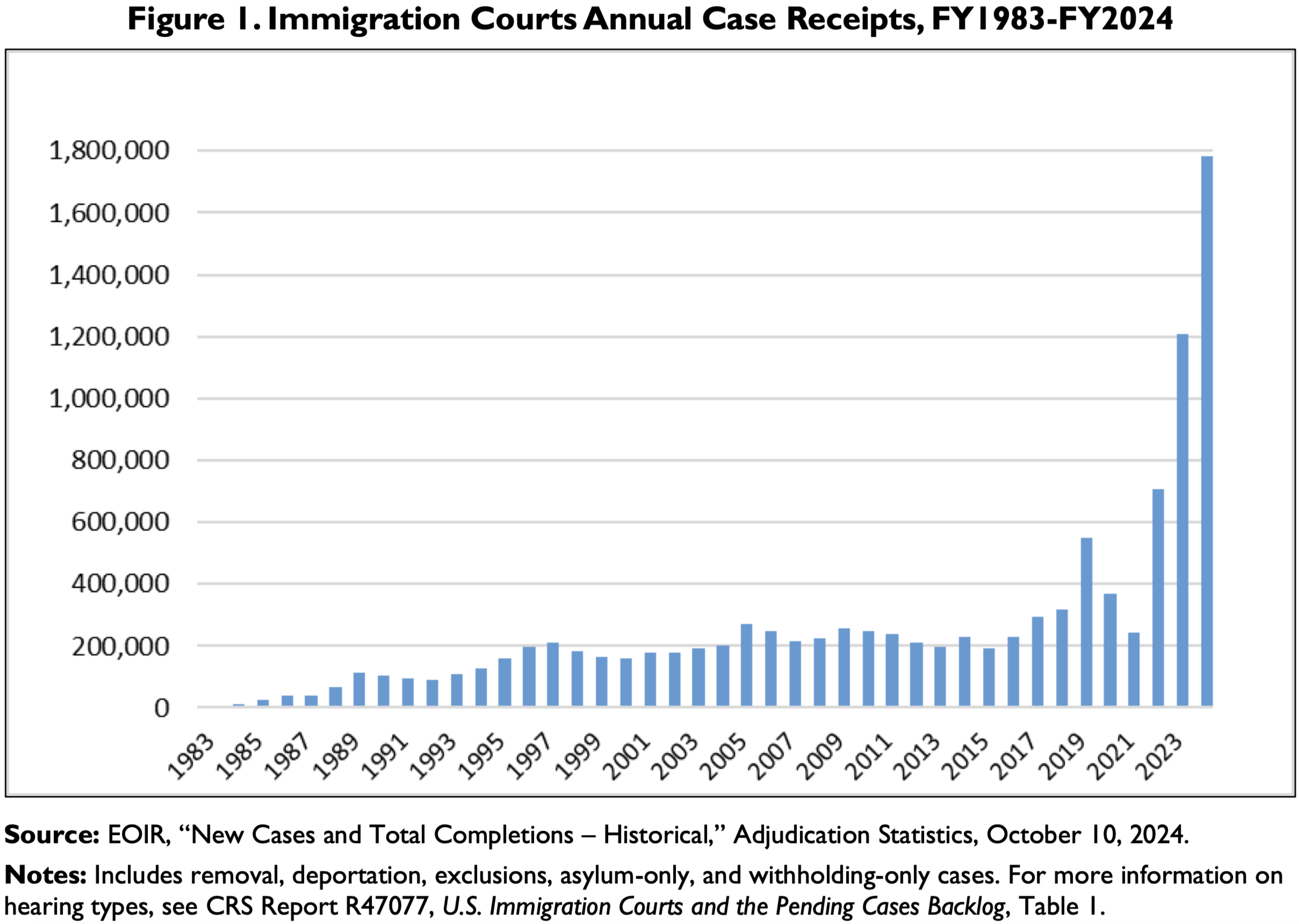
Figure 1, from the Congressional Research Service’s report “FY2024 EOIR Immigration Court Data: Caseloads and the Pending Cases Backlog”, shows the dramatic increase in immigration court case receipts in recent decades, which corresponds directly to ICE prosecutor workload.
 |
The 2018 policy, however, was never fully implemented while the Trump administration was still in office, and it is possible that USCIS will again choose to phase in its new policy for administrative reasons. The Biden administration rescinded the policy in January 2021, shortly after inauguration day.
What Does USCIS’s 2025 NTA Policy Say?
With exceptions, USCIS will generally issue an NTA where, upon issuance of an unfavorable decision on a benefit request, the alien is not lawfully present in the United States. In limited circumstances, USCIS will also issue an NTA at the request of an alien to allow that alien to seek lawful status or other relief in removal proceedings. (USCIS stipulates, however, that such requests will “generally be viewed as disfavored absent compelling and exceptional circumstances”.) The 2025 policy will also not amend NTA issuance to Temporary Protected Status (TPS) denials or Deferred Action for Childhood Arrivals (DACA) denials, which are both governed by regulation. Moreover, the policy makes the following changes in these specific circumstances:
National Security Cases. The policy states that it will continue to prioritize the apprehension and removal of aliens who pose a danger to national security. This policy requires USCIS officers, however, to coordinate with ICE and obtain approval from the ICE principal legal advisor (the agency’s head attorney) or his or her delegate to include a section 212(a)(3) or 237(a)(4) (of the INA) charge in an NTA.
Criminal Cases. Previously, USCIS only referred cases involving criminal conduct, arrests, or convictions to ICE for enforcement action decisions by issuing what is called a “Referral to ICE” (RTI). This policy now also requires USCIS to issue an NTA against a removable alien if they have been arrested for, charged with, or convicted of a criminal offense if a benefit request submitted to USCIS has been denied or withdrawn, so long as the alien is not subject to mandatory detention under INA § 236(c). The memorandum instructs USCIS to ensure that when a criminal charge is included on an NTA, it is supported by evidence in the alien’s record.
Fraud and Misrepresentation. The new policy also states that USCIS officers should issue an NTA when fraud or material misrepresentation is part of the record and the alien is removable. In such cases, USCIS will issue an NTA upon adverse action of the benefit request, or other unfavorable determination or action, regardless of whether fraud or misrepresentation was the actual basis of denial.
Beneficiaries of Employment-Based Petitions. The 2025 policy also now includes a carve-out for many beneficiaries of employment-based petitions. USCIS will only issue an NTA to a removable alien if that beneficiary of the employment-based petition is also the signatory on the Petition for Nonimmigrant Worker (Form I-129).
A beneficiary of an employment-based petition can also be the signatory on Form I-129 in limited cases, typically when they are also the owner of the petitioning company. This situation sometimes arises with entrepreneurs, investors, or self-employed individuals who are petitioning for themselves under employment-based visa categories. The carve-out, however, does not appear to apply to any dependent beneficiaries (immediate family) of employer-sponsored visa holders.
USCIS did not provide a justification for this carve-out, but I suspect the agency is choosing to allow ICE prosecutors to focus on higher priority cases. The breadth of this NTA policy has the potential to increase ICE prosecution backlogs drastically.
The policy decision may also insulate the Trump administration from criticism from U.S. businesses. As I’ve written for CIS previously, USCIS has experienced a sharp increase in processing times for many of its portfolios since fiscal year 2020. Employment-based immigrants and nonimmigrants often must rely on visa extensions, change in status, or adjustment of status processes that can be delayed due to these backlogs. The Trump administration may be choosing to avoid disrupting U.S. businesses by not issuing NTAs for minor lapses that could be the result of administrative delays rather than intentional violations.
Certain Naturalization Cases. USCIS’s new policy will allow its officers to issue NTAs in connection with the submission of a Form N-400 (Application for Naturalization) in two circumstances. First, when the alien seeking to naturalize is deportable under section 237 of the INA. Second, a USCIS officer is instructed to issue an NTA to a naturalization applicant when USCIS determines that the alien was inadmissible at the time of adjustment or admission to the United States. In this case, the alien is both ineligible for naturalization under section 318 of the INA (and therefore should have their application denied), as well as deportable under section 237.
Prosecutorial Discretion. While acknowledging that USCIS officers have prosecutorial discretion when deciding whether to issue an NTA, the 2025 policy limits officers’ discretion by clarifying that, the “exercise of prosecutorial discretion to not issue an NTA should only be exercised in very limited and compelling instances and on a case-by-case basis after considering all USCIS and DHS guidance, DHS’s enforcement priorities, the individual facts presented, and any DHS interest(s) implicated (e.g., federal court litigation-related considerations or deconfliction with law enforcement priorities of other agencies)”.
The policy also requires that the agency track all exercises of prosecutorial discretion in a USCIS system. Officers must record a summary of the analysis and decision in an official record for each exercise of prosecutorial discretion. This policy was likely put into place to discourage abuse but may also provide members of Congress or the public who request this data insight on enforcement trends.


