President Trump’s Gold Card Needs to Pass Through Congress’s Golden Gate . . . or Does It?
- External Source
admin
- 0
- 42 minutes read

Summary
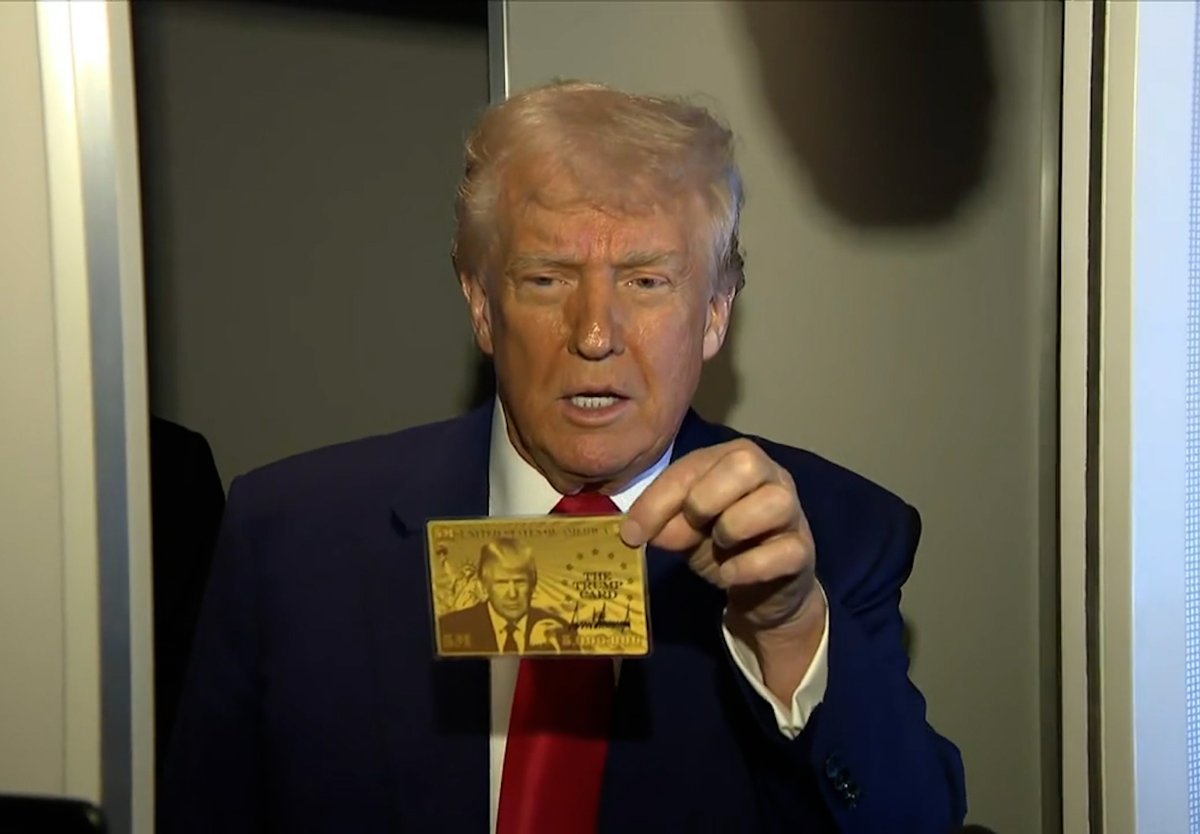
President Trump has announced plans for a new “gold card” visa with a path to citizenship to replace the current “EB-5” investor visa immigrant visa program. Would a gold card program require Congress to pass legislation and President Trump to then sign it into law?
- The gold card does not fit within the Immigration and Nationality Act as currently enacted. The INA requires that an alien seeking admission to the U.S. have been issued a temporary (nonimmigrant) visa, enter as a short-term visitor through the visa waiver program, or have been issued an immigrant visa. The INA sets forth the only available immigrant visa categories, including the EB-5 program. Aliens can only become lawful permanent residents through such programs, and only aliens with lawful permanent residence are eligible to become naturalized citizens.
- Could a President establish an immigration program not authorized by, or even a program specifically barred by, the INA? Likely not.
- The Supreme Court has concluded that, under the Constitution, Congress has plenary power over immigration and concluded that the principle that “the formulation of … policies [pertaining to the entry of aliens and their right to remain here] is entrusted exclusively to Congress has become about as firmly imbedded in the legislative and judicial tissues of our body politic as any aspect of our government.”
- However, the Supreme Court did conclude in a 1950 case that: “The right to [exclude aliens] stems not alone from legislative power, but is inherent in the executive power to control the foreign affairs of the nation. When Congress prescribes a procedure concerning the admissibility of aliens, it is not dealing alone with a legislative power. It is implementing an inherent executive power.” This doctrine could conceivably justify a gold card program not authorized by Congress. There are strong reasons to discount the 1950 case’s continuing relevance, especially since the Court has never again brought up the doctrine. But it is of course always possible that the Court in the future could newly adopt it.
The Gold Card
On February 25, Shawn McCreesh reported in the New York Times that President Trump “previewed his plans for a new visa program he was calling the gold card” that “would allow ‘very high-level people’ a new ‘route to citizenship[]’” and that Commerce Secretary Howard Lutnick said that the gold card “would replace the EB-5 visa program, which similarly provides a pathway to citizenship for wealthy foreign investors”. On April 16, Ryan Mac and Hamed Aleaziz reported in the New York Times that “members of [the Trump administration’s Department of Government Efficiency] are building a system for the [U.S.] to sell” gold cards, elaborating that:
Engineers associated with [Elon] Musk’s team have been working with employees from the State Department, the Department of Homeland Security and [U.S.] Citizenship and Immigration Services to create a website and application process for the visas, according to three people familiar with the discussions and documents seen by The New York Times.
. . .
“So if you have a gold card — which used to be a green card — you’re a permanent resident of America,” [Commerce Secretary Howard Lutnick] said, suggesting that most holders would not go on to become U.S. citizens. He added, “They pay $5 million, and they have the right to be an American and the right to be in America as long as they’re good people and they’re vetted and they can’t break the law.”
I will not address here the merits of gold cards. Rather, I will consider whether the administration can implement the proposal without Congress passing and the president signing into law an amendment to the Immigration and Nationality Act (INA).
The Gold Card and the Immigration and Nationality Act
How would the gold card fit into the INA? The short answer – it wouldn’t.
Section 101 of the INA provides that “every alien except an alien who is within [enumerated] classes of nonimmigrant[s]” (here on temporary visas) is considered to be an immigrant.
How may an immigrant legally come to the U.S.?:
- Section 211 of the INA provides that “no immigrant shall be admitted into the [U.S.] unless at the time of application for admission he … has a valid unexpired immigrant visa” (with certain exceptions, most notably for refugees and lawful permanent residents returning from temporary visits abroad). (Emphasis added.)
- Section 212 generally provides that “any immigrant at the time of application for admission … who is not in possession of a valid unexpired immigrant visa … is inadmissible.” (Emphasis added.)
- Section 201 provides that “aliens … who may be issued immigrant visas or who may otherwise acquire the status of an alien lawfully admitted to the [U.S.] for permanent residence are limited to” the numerically capped family-sponsored, employment-based and diversity immigrant visa categories and the numerically uncapped categories, all set forth in section 203. (Emphasis added.)
- Section 203 provides that EB-5 visas are available “for the purpose of engaging in a new commercial enterprise … in which [an] alien has invested … or, is actively in the process of investing, capital in an amount not less than [currently $800,000 or $1,050,000] … which will benefit the [U.S.] economy by creating full-time employment for not fewer than 10” domestic workers.
Thus, other than aliens coming to the U.S. with nonimmigrant visas, short-term visitors under the visa waiver program, or inadmissible aliens with grants of temporary parole, aliens must be recipients of immigrant visas to come to the U.S. And the INA sets forth the only categories of immigrant visas (which grant their recipients lawful permanent residence), including the EB-5 program.
Finally, section 316 provides that “[n]o person, except as otherwise provided in this subchapter, shall be naturalized unless such applicant … has resided continuously, after being lawfully admitted for permanent residence, within the [U.S.] for at least five years….” (Emphasis added.) Thus, only aliens who have received immigrant visas (or who have changed status from nonimmigrant to immigrant while in the U.S.) can become naturalized citizens.
The gold card program cannot be implemented, and the EB-5 program cannot be terminated, under the INA as currently enacted. The EB-5 program is one of the specified immigrant vias categories – the gold card program is not. An alien could not lawfully be admitted as an immigrant on the basis of having received a gold card. Further, an alien could not become a naturalized citizen on the basis of having received a gold card, as a gold card would not provide lawful permanent residence.
To establish the gold card program within the INA, Congress would have to pass, and the president sign into law, appropriate amendments.
Who Controls Federal Immigration Law under the Constitution, Congress or the President?
But that is not the end of the story. What would bar a President from establishing an immigration program not authorized by, or even a program specifically barred by, the INA or other immigration statutes?
Republicans in the House of Representatives have staunchly believed that the Executive Branch may not violate federal immigration statutes. After President Obama’s Department of Homeland Security created a “deferred action” program for illegal aliens who arrived in the U.S. as minors (“Deferred Action for Childhood Arrivals” (DACA)) and attempted to create such a program for illegal alien parents with U.S. citizen or lawful permanent resident children (“Deferred Action for the Parents of Americans” (DAPA)), the House of Representatives voted on March 17, 2016, for H.Res. 639, a resolution authorizing Speaker Paul Ryan to appear as amicus curiae on behalf of the House in a case before Supreme Court “in support of the position that [President Obama’s DHS] ha[s] acted in a manner that is not consistent with [its] duties under the Constitution and laws of the [U.S.]” by expanding DACA and creating DAPA. The Republican-controlled House Rules Committee explained in its Committee Report that:
[President Obama] bypassed the legislative process to essentially create law by executive fiat. These unilateral actions have shifted the balance of power in favor of the presidency, thereby diminishing Congress’ constitutional powers. Such a shift in power should alarm Members of both political parties because it threatens the very institution of Congress.
Contrary to its duty to faithfully execute the laws, the Administration has acted unilaterally to rewrite the Nation’s immigration laws. These actions undermine the framework of the Constitution, which separates power between the branches to best protect liberty.
House Republicans voted in favor of the resolution by a margin of 234-5 while Democrats unanimously opposed it.
On February 13, 2024, House Republicans voted by a margin of 214-3 to impeach Alejandro Mayorkas, President Biden’s Secretary of Homeland Security, for high crimes and misdemeanors. House Democrats unanimously opposed impeachment. The first article of Impeachment stated in part that:
In his conduct while Secretary … Alejandro N. Mayorkas, in violation of his oath to support and defend the Constitution of the [U.S.] against all enemies, foreign and domestic, to bear true faith and allegiance to the same, and to well and faithfully discharge the duties of his office, has willfully and systemically refused to comply with Federal immigration laws, in that:
Throughout his tenure as Secretary … Mayorkas has repeatedly violated laws enacted by Congress regarding immigration and border security. In large part because of his unlawful conduct, millions of aliens have illegally entered the [U.S.] on an annual basis with many unlawfully remaining in the [U.S.] His refusal to obey the law is not only an offense against the separation of powers in the Constitution … it also threatens our national security and has had a dire impact on communities across the country.
. . .
Mayorkas created, re-opened, or expanded a series of categorical parole programs never authorized by Congress for foreign nationals outside of the [U.S.] … which enabled hundreds of thousands of inadmissible aliens to enter the [U.S.] in violation of the laws enacted by Congress.
What in fact does the U.S. Constitution say about the matter, and how has the Supreme Court interpreted our Constitution’s text?
In Article I, section 1 provides that “[a]ll legislative Powers herein granted shall be vested in a Congress of the United States, which shall consist of a Senate and House of Representatives”, and section 8 provides that “[t]he Congress shall have Power … To establish an uniform Rule of Naturalization”.
In Article II, section 1 provides that “The executive Power shall be vested in a President of the United States of America”, section 2 provides that the president “shall have Power, by and with the Advice and Consent of the Senate, to make Treaties, provided two thirds of the Senators present concur”, and section 3 provides that the president “shall take Care that the Laws be faithfully executed”.
The Political Departments Control Immigration
The Supreme Court has long held that the “political departments” – the Legislative and Executive Branches – control immigration. The Court concluded:
- in 1924 in Mahler v. Eby that “[t]he sovereign power to expel aliens is political, and is vested in the political departments of the government”;
- in 1953 in Shaughnessy v. Mezei that “[c]ourts have long recognized the power to expel or exclude aliens as a fundamental sovereign attribute exercised by the Government’s political departments largely immune from judicial control”;
- in 1972 in Kleindienst v. Mandel that “[i]n accord with ancient principles of the international law of nation-states, the Court [has] … held broadly, as the Government describes it … that the power to exclude aliens is ‘inherent in sovereignty, necessary for maintaining normal international relations and defending the country … a power to be exercised exclusively by the political branches of government’, and that “the Court’s general reaffirmations of this principle have been legion”; and
- in 1977 in Fiallo v. Bell that “[o]ur recent decisions have not departed from this long-established rule”.
Congress Has Plenary Power Over Immigration
Professor Adam Cox at the New York University School of Law explained in 2007 in his article “Deference, Delegation, and Immigration Law” that “the immigration plenary power doctrine … in its classic formulation requires that courts give great deference to political branch decisions about immigration policy and enforcement.”
The Supreme Court has held:
- In 1909, in Oceanic Navigation Co. v. Stranahan that “over no conceivable subject is the legislative power of Congress more complete than it is over that with which the act we are now considering [the Act of March 3, 1903, ‘An Act to Regulate the Immigration of Aliens into the [U.S.]’] deals”, and that Congress has “absolute power … over the right to bring aliens into the [U.S.]” and “complete and absolute power … over the subject with which the statute deals”;
- in 1967 in Boutilier v. Immigration and Naturalization Service that “[i]t has long been held that the Congress has plenary power to make rules for the admission of aliens and to exclude those who possess those characteristics which Congress has forbidden”;
- in 1972 in Kleindienst v. Mandel that “[w]e are not inclined in the present context to reconsider this line of cases”; and
- in 1976 in Mathews v. Diaz that “[i]n the exercise of its broad power over naturalization and immigration, Congress regularly makes rules that would be unacceptable if applied to citizens.”
Congressional Supremacy over the Executive Branch?
A series of Supreme Court decisions dating back to the 19th century seemingly demonstrates that among the political branches, Congress reigns supreme with regards to immigration.
In 1892, the Supreme Court concluded in Nishimura Ekiu v. United States that the power “to forbid the entrance of foreigners within its dominions, or to admit them only in such cases and upon such conditions as it may see fit to prescribe” in the U.S. “belongs to the political department of the government, and may be exercised either through treaties made by the President and Senate, or through statutes enacted by Congress”. (Emphasis added.) As the Constitution provides, a president cannot make a treaty with a foreign nation or nations without the concurrence of the Senate.
In 1893, the Court similarly concluded in Fong Yue Ting v. United States that:
The power to exclude or to expel aliens, being a power affecting international relations, is vested in the political departments of the government, and is to be regulated by treaty or by act of Congress, and to be executed by the executive authority according to the regulations so established, except so far as the judicial department has been authorized by treaty or by statute, or is required by the paramount law of the Constitution, to intervene. [Emphasis added.]
In 1924, the Court concluded in Mahler that:
Even if the executive may not exercise [the power to expel aliens] without congressional authority, Congress cannot exercise it effectively save through the executive. It cannot, in the nature of things, designate all the persons to be excluded. It must accomplish its purpose by classification and by conferring power of selection within classes upon an executive agency. [Emphasis added.]
Most famously, in 1954, the Court concluded in Galvan v. Press that:
As to the extent of the power of Congress under review, there is not merely “a page of history,” … but a whole volume. Policies pertaining to the entry of aliens and their right to remain here are peculiarly concerned with the political conduct of government. In the enforcement of these policies, the Executive Branch of the Government must respect the procedural safeguards of due process…. But that the formulation of these policies [pertaining to the entry of aliens and their right to remain here] is entrusted exclusively to Congress has become about as firmly imbedded in the legislative and judicial tissues of our body politic as any aspect of our government. [Emphasis added.]
The Supreme Court in these cases had no difficulty squaring the vesting of the immigration power in the political branches with Congress’ inter-branch supremacy.
Professor Cox and Professor Cristina Rodriguez at Yale Law School wrote in 2009 in their article “The President and Immigration Law” that:
Many more recent cases, such as Kleindienst v. Mandel and Fiallo v. Bell, have reiterated this language [in Galvan], which could be read as simply limiting judicial review and recognizing political branch primacy generally. But the reference to “Congress” rather the political branches as a unit could also be read as recognizing congressional primacy.
“Could” also be read as recognizing congressional primacy? Galvan phrases it as “entrusted exclusively to Congress”! (emphasis added) I would say “must” be read as recognizing congressional primacy.
More recently, the Fifth Circuit Court of Appeals has added itself to the “must” contingent through its analysis of the Supreme Court’s “major questions” doctrine.
In 2014, the Supreme Court concluded in Utility Air Regulatory Group v. EPA that:
When an agency claims to discover in a long-extant statute an unheralded power to regulate “a significant portion of the American economy,” … we typically greet its announcement with a measure of skepticism. We expect Congress to speak clearly if it wishes to assign to an agency decisions of vast “economic and political significance.”
The Supreme Court then concluded in 2022 in West Virginia v. EPA that “the Government must — under the major questions doctrine — point to ‘clear congressional authorization’ to regulate in that manner”, quoting Utility Air.
In 2015, the Fifth Circuit utilized the major questions doctrine in concluding that the Obama administration’s DAPA program was unlawful. In Texas v. United States, it concluded that:
For the authority to implement DAPA, the government relies in part on … a provision that does not mention lawful presence or deferred action, and that is listed as a “[m]iscellaneous” definitional provision expressly limited to … a section concerning the “Unlawful employment of aliens”— an exceedingly unlikely place to find authorization for DAPA. Likewise, the broad grants of authority [in three statutory provisions] cannot reasonably be construed as assigning “decisions of vast ‘economic and political significance,’” such as DAPA, to an agency.
The interpretation of those provisions that the Secretary advances would allow him to grant lawful presence and work authorization to any illegal alien in the [U.S.]—an untenable position in light of the INA’s intricate system of immigration classifications and employment eligibility. Even with “special deference” to the Secretary, the INA flatly does not permit the [administration’s] reclassification of millions of illegal aliens as lawfully present and thereby make them newly eligible for a host of federal and state benefits, including work authorization. [Emphasis added.]
Further, the court concluded that:
Through the INA’s specific and intricate provisions, “Congress has ‘directly addressed the precise question at issue.’” [quoting the Supreme Court’s 2011 decision in Mayo Found. For Med. Educ. & Research v. United States]…. [T]he INA prescribes how parents may derive an immigration classification on the basis of their child’s status and which classes of aliens can achieve deferred action and eligibility for work authorization.
The Fifth Circuit ruled that DAPA was “foreclosed by Congress’s careful plan” and “‘manifestly contrary to the statute’ [quoting the Supreme Court’s decision in Mayo Found.] and therefore was properly enjoined”.
Then, in 2022, the Fifth Circuit similarly took on DACA in U.S. v. Texas:
Like DAPA, DACA “undoubtedly implicates ‘question[s] of deep “economic and political significance” that [are] central to this statutory scheme; had Congress wished to assign that decision to an agency, it surely would have done so expressly.’” [quoting from its 2015 decision]
There is no “clear congressional authorization” for the power that DHS claims. [quoting West Virginia and Utility Air.]
. . .
Like DAPA, DACA “is foreclosed by Congress’s careful plan; the program is ‘manifestly contrary to the statute.’” [quoting its 2015 decision]
Not So Fast – What About a President’s Inherent Constitutional Power Over Immigration?
Professors Cox and Rodríguez do not believe congressional supremacy to be so clearly established. Instead of clarity, they see confusion. Cox wrote in “Deference, Delegation, and Immigration Law” that:
Plenary power doctrine … focuses on the distribution of authority between the judiciary and the political branches of the federal government. For all this attention to the constitutional distribution of authority between courts and the political branches, however, immigration courts and commentators have consistently overlooked a second separation of powers issue: the difficult question of how immigration power is distributed within the political branches, between Congress and the executive generally, or more specifically between Congress and administrative agencies….
Cox fretted that “Constitutional immigration law provides little guidance about the distribution of immigration authority between Congress and the executive.” He wrote that “[t]he Supreme Court has sometimes suggested that immigration power is distributed within the political branches in the same fashion as most other lawmaking powers.” But he then contended that:
But it is far from clear that immigration is like other areas. In most other areas, Article I gives Congress clear supremacy with respect to lawmaking. Immigration law, however, is nothing like this; the constitutional source of power to make immigration law has always been contested and uncertain. While Article I confers on Congress power to establish a “uniform rule of naturalization,” the Supreme Court has not read this provision as the sole source of federal authority over immigration. Instead, the Court has for over a century made conflicting and ambiguous pronouncements about the source of federal immigration authority.
He noted that “[s]ometimes the Court has stated that the immigration power derives from an extraconstitutional source — from principles of international law, or from the foundational attributes of sovereignty.” He noted that “[o]n other occasions the Court has indicated that the immigration power is part and parcel of the foreign relations power.” And he noted that “the Court has from time to time suggested that the immigration power is entailed by the combination of a number of enumerated powers [including the Treatymaking Clause, the War Powers Clauses, the Foreign Commerce Clause, the Republican Government Clause, and the Naturalization Clause].”
Professor Cox concluded that “[c]onfusion about the source of immigration power creates substantial uncertainty about the distribution of that authority between Congress and the executive.” And Professors Cox and Rodríguez contended in “The President and Immigration Law” that:
The [Supreme] Court’s reliance on multiple, inconsistent conceptions of the distribution of immigration authority over the years means that the jurisprudential history of immigration law ultimately provides little guidance, much less definitive answers, regarding the political branches’ relative authority in immigration decisionmaking.
Yet, despite the conclusions reached by Professors Cox and Rodríguez, the Supreme Court’s constitutional analysis that I have set forth above seems to have declared a winner. What arguments do Cox and Rodríguez make to support their case?
Most significantly, Cox and Rodríguez point to the Supreme Court’s 1950 decision in United States ex rel. Knauff v. Shaughnessy, where the Court concluded that:
The exclusion of aliens is a fundamental act of sovereignty. The right to do so stems not alone from legislative power, but is inherent in the executive power to control the foreign affairs of the nation. [citing the Court’s 1936 decision in United States v. Curtiss-Wright Export Corp. and the Court’s decision in Fong Yue Ting] When Congress prescribes a procedure concerning the admissibility of aliens, it is not dealing alone with a legislative power. It is implementing an inherent executive power. [Emphasis added.]
As to Knauff, Professor Cox argued last year in his article “The Invention of Immigration Exceptionalism” that:
The Court’s reasoning, it seems, was that Congress cannot run afoul of the nondelegation doctrine if the Executive has inherent constitutional power to exclude noncitizens even absent any delegation of authority from Congress.
. . .
The Court asserted [wrongly, in Cox’s view] that the executive branch’s inherent constitutional authority to regulate admission was the reason why the Court had held in the late nineteenth century that it was constitutionally permissible to have executive-branch officials, rather than Article III courts, adjudicate exclusion cases.
The Supreme Court’s language in Knauff is seemingly dramatically at odds with that of multiple other Court decisions both preceding and following Knauff. If it was to become the Court’s prevailing doctrine, it would, in Professor Cox’s words (in “The Invention of Immigration Exceptionalism”), “have significant implications for the power of the President to set immigration policy”. Indeed, it would. As Cox elaborated:
At a minimum, it would dramatically change the posture of the countless lawsuits filed over the last decade challenging presidential immigration initiatives. The legal challenges to President Obama’s [DACA] program, to President Trump’s travel ban, and to President Biden’s humanitarian-parole initiatives would all look profoundly different and be much less likely to succeed in a world where the Supreme Court once again concluded that the President has inherent constitutional authority to regulate immigration.
Professor Cox further noted that, as I have mentioned, “in the challenge to [DACA] brought by Texas and other states, the Fifth Circuit … held that the executive branch lacked the authority to create DACA because it was a major question that could be authorized only by a clear statement from Congress”. Cox concluded that “[i]n a world of inherent presidential authority, the major questions doctrine indeed any kind of nondelegation doctrine would have no application.”
Cox and Rodriguez contemplated in “The President and Immigration Law” that:
It is far from clear what it would mean for Congress to implement an inherent executive power, though perhaps the Court was gesturing toward a conception of concurrent authority. Nor is it clear from Knauff whether the Court thought Congress could, by statute, limit the terms by which the President exercised his inherent authority, or whether the President could rely on his inherent authority to reject a congressional attempt to implement that authority. At a minimum, however, this statement suggests that the President possesses some power to act in the immigration arena without congressional authorization, and perhaps even despite congressional action.
But the game-changing possibilities of Knauff likely need to be discounted. First, as Cox explained in “The Invention of Immigration Exceptionalism”, “[t]his idea … has never again been taken up directly by the Supreme Court” and “the Court has never explicitly returned to the idea of inherent presidential power over immigration”. Given the Court’s decisions subsequent to Knauff, such as Galvan, Kleindienst, and Fiallo, it may well be that Knauff was simply a now-extinct evolutionary dead-end.
A second reason to discount Knauff is that the Court’s statements regarding inherent executive power can be read as only providing a basis for congressional delegation of immigration powers. A long line of Supreme Court cases has affirmed Congress’s ability to delegate immigration decision making to the Executive Branch. The Court concluded in its 1896 decision in Wong Wing v. United States that:
[W]e regard it as settled by our previous decisions that the [U.S.] can … by congressional enactment, forbid aliens or classes of aliens from coming within their borders and expel aliens or classes of aliens from their territory, and can, in order to make effectual such decree[s] … devolve the power and duty of identifying and arresting the persons included in such decree, and causing their deportation, upon executive or subordinate officials. [Emphasis added.]
Interestingly, the Supreme Court in Knauff had stated that:
Normally, Congress supplies the conditions of the privilege of entry into the [U.S.]. But, because the power of exclusion of aliens is also inherent in the executive department of the sovereign, Congress may in broad terms authorize the executive to exercise the power, e.g., as was done here, for the best interests of the country during a time of national emergency. Executive officers may be entrusted with the duty of specifying the procedures for carrying out the congressional intent.
Notice what the Court did not say. It did not say that the Executive Branch’s power of exclusion could be exercised without congressional authorization. It did not say that the Executive Branch’s power could be exercised outside of “carrying out the congressional intent”. Very possibly, the Court’s description of inherent power was only meant to allow the Executive Branch to carry out congressional delegations. On the other hand, the Court never said that the Executive Branch’s inherent power was indeed so limited.
Third, Professors Cox and Rodriguez wrote in “The President and Immigration Law” that:
Knauff … is in tension with conventional understandings of the separation of powers. The Court linked the power to the capacious and unique conception of executive power defended in United States v. Curtiss-Wright, the case famous for articulating “the very delicate, plenary and exclusive power of the President as the sole organ of the federal government in the field of international relations – a power which does not require as a basis for its exercise an act of Congress.”
They concluded that “[s]een in this light, the Court’s statement in Knauff regarding inherent executive immigration authority appears related to the complexities of the scope and source of the foreign affairs power” and “could be dismissed as an oddity, simply the product of a historically contingent conception of foreign affairs.” Further, since the Court in Knauff addressed only the excludability and admissibility of aliens yet to enter the U.S., it is not even clear that the Court at the time would have reached the same conclusion regarding power over aliens already in the U.S. and their deportability.
In support of their thesis, Professors Cox and Rodriguez also looked to the Bracero program, pointing out that:
[A]midst World War II and the so-called “Manpower Crisis,” immigration officials formed a committee to study the possibility of launching a [temporary agricultural worker] program to import Mexican workers
. . .
In July 1942, the U.S. Secretary of Agriculture … presented the labor importation plan to the Mexican government, and the countries signed a bilateral agreement laying out the plan’s details…. On September 29, 1942, the first installment of Bracero workers arrived in the [U.S.]….
Cox and Rodriguez pointed out that “[i]mportantly, [President] Roosevelt established the program without first seeking consent from Congress” and “Congress did not officially approve the Bracero Program until April 29, 1943”. But they concede that:
The administration might have believed that statutory authority for its program already existed in the Ninth Proviso of the Immigration Act of 1917, which authorized the Commissioner General of Immigration … to “issue rules and prescribe conditions … to control and regulate the admission and return of otherwise inadmissible aliens applying for temporary admission.”
They also pointed out that:
The [Bracero] program was initially set to expire in July of 1947. A few months before its expiration, Congress extended [it] until December 31, 1947. But the statutory extension required that the program “shall be liquidated within thirty days” thereafter.
. . .
On February 21, 1948, the State Department arranged a new accord with Mexico and labor importation resumed…. [T]he Bracero Program continued to operate from 1948 until 1951 without any statutory sanction – and in apparent direct contravention of a statutory command that the program be “liquidated.”
Cox and Rodriguez concluded that “it is difficult to defend the Truman Administration’s extension of the Bracero Program without reference to the assumption that the President possesses inherent authority over immigration policy.” But while the Truman administration might possibly have assumed as much, such an assumption was never tested in federal court. We do not know if it would have survived judicial scrutiny.
Professors Cox and Rodriguez also highlighted the fact that when in 1981 President Reagan “declared that the parole of unauthorized Haitians would cease and would be prevented by interdiction of vessels [on the high seas] carrying such aliens”, Theodore Olson, the assistant attorney general in charge of the Department of Justice’s Office of Legal Counsel, issued Proposed Interdiction of Haitian Flag Vessels, an opinion for the Attorney General that justified President Reagan’s action on both statutory and “implied constitutional authority” grounds.
What Olson wrote was that:
[T]he government of Haiti and the [U.S.] will enter into an agreement … permitting the [U.S.] Coast Guard to stop Haitian flag vessels, board them and ascertain whether any of the Haitians aboard have left Haiti in violation of its travel laws and whether they intend to travel to the [U.S.] in violation of U.S. immigration laws…. Those who have left Haiti, whether legally or illegally, in an attempt to enter the [U.S.] illegally will be returned to Haiti pursuant to the President’s [statutory] authority … to enforce U.S. immigration laws, to protect our sovereignty, and as an exercise of his power in the field of foreign relations. [Emphasis added throughout.]
. . .
The authority for returning the Haitians who are attempting to enter the [U.S.] illegally may be found in both statutory authority and implied constitutional authority under Article II.
. . .
Where Congress has acted, the regulation of immigration is an area in which Congress exercises plenary power. [citing the Supreme Court’s 1972 decision in Kleindienst] There has been recognition, however, that the sovereignty of the Nation, which is the basis of our ability to exclude all aliens, is lodged in both political branches of the government. [citing the Supreme Court’s 1892 decision in Ekiu]
Olson’s opinion then quoted the Supreme Court’s statements in Knauff regarding “inherent executive power”. However, Olsen realized he was pushing the envelope, stating that the justification for interdiction based on “[i]mplied constitutional power is less clear” than a statutory justification and that “the validity of the President’s action will certainly be strengthened by relying on both statutory provisions which provide support for the contemplated action.”
Conclusion
The proposed gold card program cannot be squared with current federal immigration law as embodied in the INA. Given the Constitution’s grant of all legislative power to Congress, Congress’s plenary power over immigration, and Congress’s very probable supremacy over the Executive Branch in terms of deciding the immigration law of the U.S., it seems unlikely that the gold card program, unless duly enacted into law, would survive Supreme Court scrutiny.
However, it is always possible that the Supreme Court in the future might decide to take the path less traveled (by the Court itself) and newly adopt the doctrine embodied in its 1950 decision in Knauff regarding the Executive Branch’s “inherent” power over immigration matters. If so, as Professors Cox and Rodriguez have pondered, the “President [would] possess[] some power to act in the immigration arena without congressional authorization, and perhaps even despite congressional action”. This doctrine might justify the gold card program without any congressional authorization. But, assuming that DACA and DAPA and President Biden’s categorical parole programs violate the INA, as I believe they do, this doctrine might also justify them.


