SW Border Patrol Apprehensions in June Were the Lowest Ever Recorded
- External Source
admin
- 0
- 7 minutes read

On July 16, CBP released its latest statistics on agency encounters for the month of June, and they reveal that Border Patrol apprehensions at the Southwest border last month reached their lowest level in recorded history. Accordingly, Americans are safer today than they were six months ago, which is likely why nobody’s talking about “border security” anymore.
Overall Encounters
In June, CBP — both officers in the agency’s Office of Field Operations (OFO) at the ports and Border Patrol agents between the ports — encountered just 25,228 inadmissible “applicants for admission” a statutory term that refers to aliens stopped at the ports and Border Patrol apprehensions.
That’s not just at the Southwest border; it’s all three borders (Southwest, Northern, and Coastal) and every port — land, sea, and air, including airports in the interior of the United States and preclearance at airports abroad.
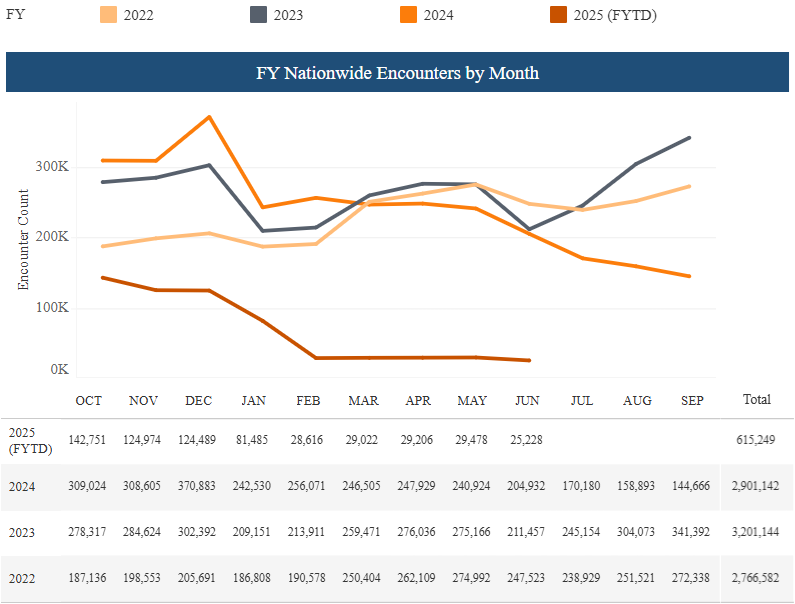 |
To put that figure into context, June’s encounter total wasn’t just lower than May’s already low total (29,478); it’s the lowest monthly total in the last four fiscal years, and the second-lowest monthly total ever in recorded history.
Second only to April 2017, that is.
According to DHS’s Office of Homeland Security Statistics (OHSS), in April 2017 — three months into Trump’s first term — CBP encountered 24,220 inadmissible applicants for admission, or just 4.3 percent fewer than last month.
But as I’ll explain below, there’s a big difference between those low April 2017 CBP encounter numbers and the low encounter numbers in June.
In the interim, June’s CBP encounter total was 14.4 percent lower than in May (29,478), 85.6 percent lower than in June 2024 (240,924), and 88 percent lower than in June 2023 (275,166).
The obvious reason for the overall encounter decline in June compared to the same months in 2024 and 2023 was Trump’s decision on day one to end the Biden administration’s legally questionable CHNV Parole and CBP One app programs, under which more than 1.4 million aliens with no visas and no right to enter the country were waved through the ports of entry.
Not only were those programs legally questionable — both were also riddled with fraud.
In fact, there were so many fraud concerns with CHNV Parole that the last administration paused it in the summer of 2024, and CBP One was so prone to deception that more than 1,700 different individuals claimed as their intended destinations just seven U.S. addresses.
Given the U.S. government’s inability to vet any alien who comes here without first going through visa processing abroad, closing those programs not only makes the country safer, but it also frees up OFO officers to more closely screen travelers with visas for contraband and criminal and security threats.
The smugglers may not be happy about that additional scrutiny, but Americans plainly should be.
Border Patrol Apprehensions
There is one CBP encounter category, however, in which last month was second to none, and that’s Border Patrol Southwest border apprehensions.
In June, agents at the U.S.-Mexico line nabbed just 6,072 illegal entrants, 30 percent fewer than in May (8,723), 98.2 percent fewer than in June 2024 (83,532), 94 percent fewer than in June 2023 (99,538), 96.8 percent fewer than in June 2022 (192,399) — and 45.5 percent fewer than in that “low-water mark” month of April 2017 (11,127).
The Southwest border is 1,954 miles long, which means that last month, on average, agents apprehended one alien per mile every 10 days. Given that there are about 17,000 agents along the Southwest border, each agent made on average just .357 apprehensions last month.
Given how wide and desolate the border is in most places, that statistic is nothing more than astounding, but more importantly, all those agents who are now freed up from having to round up, transport, process, and care for large numbers of illegal aliens (the norm under the last administration) can now focus on stopping illicit drugs, other contraband, and any illegal migrants actively evading apprehension.
Would it surprise you to learn that agents at border-proximate checkpoints seized 173 pounds of fentanyl last month, or roughly 37 percent more than they had in November (126 pounds), when there were more than seven times as many apprehensions (46,612)?
Or that June’s checkpoint fentanyl haul was nearly three times as large as in October (61 pounds), when agents at the Southwest border were making more than 56,500 apprehensions?
Given the fentanyl overdose epidemic that has ravaged the United States in recent years, it’s not an overstatement to say that increased security at the Southwest border is saving lives.
Border security was a major issue in the lead-up to the 2024 elections, and while 70 percent of U.S. voters in the latest Harvard/Harris poll support “closing the border with added security and policies that discourage illegal crossings”, it lacks the urgency it had in late 2024 — largely because today, the border is more secure now than it has ever been.


