CIS Scholar’s Study of Cultural Persistence Published in Atlantic Economic Journal
- External Source
admin
- 0
- 4 minutes read
Numerous studies from the fields of economics, history, political science, and sociology show that the cultural traits brought by immigrants do not always disappear into a melting pot. Often they persist into the second generation and beyond. I’m pleased to have made another small contribution to this literature. “Cultural Preference for Redistribution in the United States: An Epidemiological Approach” was published this month by the peer-reviewed Atlantic Economic Journal.
My paper takes inspiration from a 2011 study of immigrants living in European countries. That study found that both immigrants and their children retain preferences for economic redistribution reminiscent of their ancestral countries. My own paper focuses on the U.S., which allows for two additional lessons. First, evidence of a persistent cultural preference for redistribution on a different continent suggests the phenomenon is widespread, rather than limited to modern Europe. Second, the much longer history of immigration in the U.S. provides a particularly stringent test. If ancestral cultural differences persist even among groups who have lived for many generations in the same country together, and who are now highly integrated socially and economically — as, say, German Americans and Irish Americans are — then assimilation clearly has its limits.
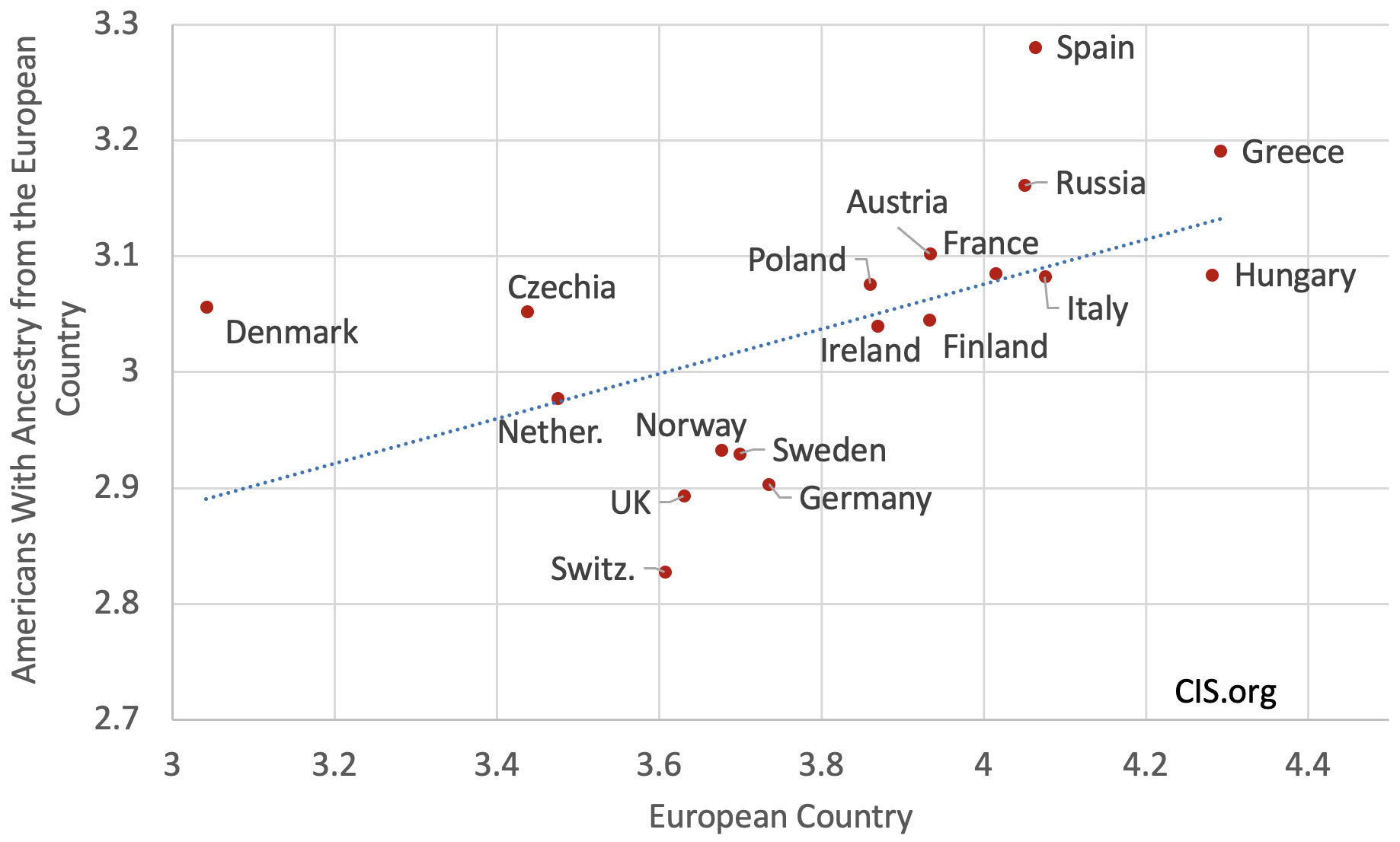
Figure 1 from my paper demonstrates that redistribution preferences are indeed persistent in the U.S. Displayed along the horizontal axis are the average redistribution preferences in modern European countries, while the vertical axis shows the redistribution preferences of Americans with corresponding ancestries from those countries. The ancestors of most of these Americans first came to the U.S. many generations ago — in some cases before the founding of the nation.
Figure 1: Redistribution Preferences in Europe and America |
 |
|
Source: Richwine, “Cultural Preference for Redistribution in the United States”. |
Remarkably, the relative ordering of countries on the horizontal axis is similar to the ordering of American ancestral groups on the vertical axis. For example, Russia has a greater preference for redistribution than Ireland, which in turn has a greater preference than the UK. At the same time, Russian-Americans prefer more redistribution than Irish-Americans, who prefer more than British-Americans. The paper goes on to examine whether the relationship still holds after controlling for factors such as age, sex, income, education, and marital status. It does.
The clear implication is that immigrants bring their preference for redistribution with them from their home countries and then transmit that preference over several generations. The finding is relevant in part because the taxes needed to finance redistribution tend to reduce investment and innovation. Immigrants with a strong preference for redistribution are therefore unlikely to be compatible with a growth-oriented economy over the long term. The finding is even more important in a broader sense, however, because it affirms that cultural differences can persist in consequential but non-obvious ways. Even as immigrants achieve the basics of integration in the U.S., such as learning English, they may retain distinctive values that impact their new country for decades to come.


