To Fight Terrorism, Trump Should Follow Ike’s Example
- External Source
admin
- 0
- 13 minutes read

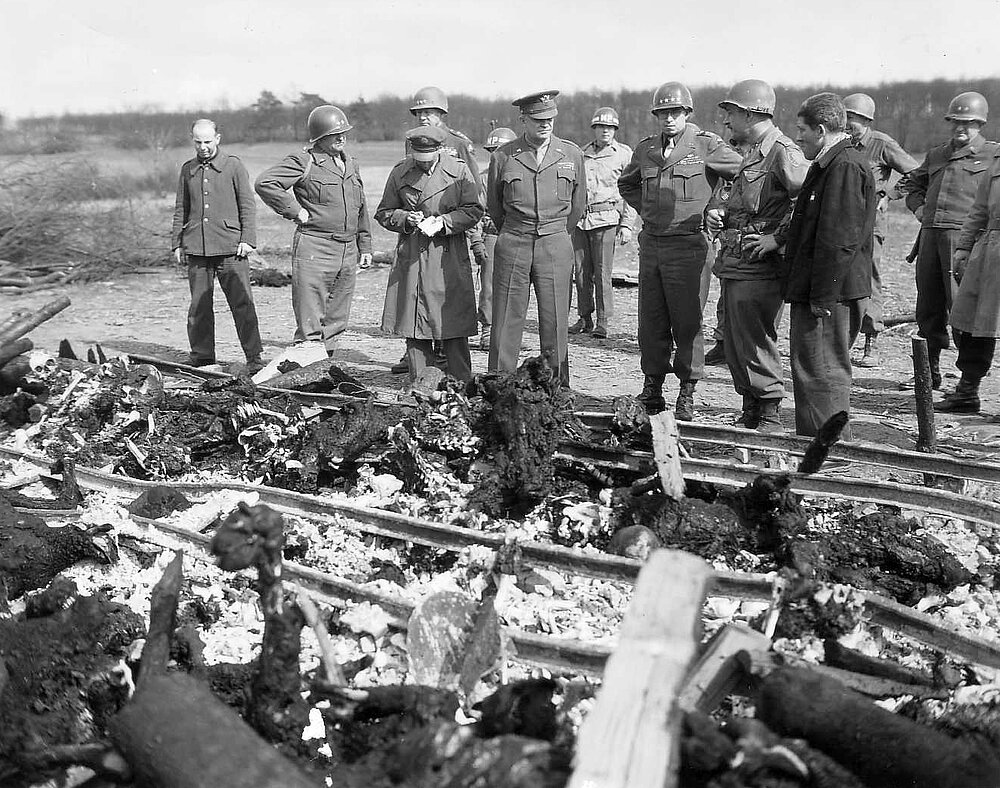
Gen. Eisenhower views the remains of people murdered by the SS at Ohrdruf Concentration Camp in 1945.
A January 14 commentary by Daniel Flesch in RealClear Politics details a number of terror plots planned or carried out in the United States in the name of “intifada” since the October 7, 2023, Hamas attacks on southwest Israel. A few of those cases are unfamiliar, even to me. That’s likely because the media hasn’t covered them and the Biden-Harris administration won’t talk about them. That’s a critical mistake because it lulls the public into a false sense of security and could lead other misguided people to fall into the thrall of radicalism and plan similar actions. To rectify this, President-elect Trump should take a page from one of his predecessors, Dwight D. Eisenhower.
The October 7 Attacks, and Their Aftermath. Most of you likely need little background on the October 7 attacks, but here’s how Secretary of State Antony Blinken recounted the events of that day one year later, last October:
On October 7, 2023, more than 1,200 men, women and children, including 46 Americans and citizens of more than 30 countries, were slaughtered by Hamas — the largest massacre of Jews since the Holocaust. Girls and women were sexually assaulted. The depravity of Hamas’s crimes is almost unspeakable.
Hamas also took 254 people hostage that day, including 12 Americans. Four of those Americans — Hersh Goldberg-Polin, Itay Chen, Judy Weinstein, and Gad Haggai — were murdered by Hamas. Four were released through an agreement the United States negotiated last November, but four remain in captivity in Gaza: Edan Alexander, Keith Siegel, Sagui Dekel-Chen, and Omer Neutra. There are also an estimated 97 other hostages who remain held in Gaza today. They include men, women, young boys, young girls, two babies, and elderly people from more than 25 nations.
When Americans were taken hostage abroad in the past, the White House brought — or threatened to bring — the weight of the U.S. military to bear, with mixed results.
The Biden-Harris administration opted to take a different tack, seeking a negotiated solution to the hostage crisis while urging the Israeli Defense Forces (IDF) to curb its incursions into Hamas-controlled Gaza.
The IDF didn’t comply with many of those White House entreaties, but in any event the administration received mixed to negative grades from the electorate on its response.
For example, in a George Washington University Society of Presidential Pollsters survey completed by HarrisX in September, just 38 percent of likely voters approved on the administration’s handling of the conflict. Were it not for immigration and inflation — the two thorniest problems for the Biden-Harris administration — it would have been the president’s worst-performing issue.
Even then it was close, with a mere 37 percent of likely voters in that poll approving of the way Biden was tackling inflation and dealing with immigration, respectively.
The war in Gaza triggered an untold number of protests on U.S. streets and college campuses, and in a surprising twist (to me, at least), many were openly in support of Hamas, with an equally untold number of protestors calling for “intifada”.
“Intifada”. Britannica — the most objective source I can find — defines “intifada” as: “either of two popular uprisings of Palestinians in the West Bank and Gaza Strip aimed at ending Israel’s occupation of those territories and creating an independent Palestinian state”.
“The first intifada”, it explains, “began in December 1987 and ended in September 1993 with the signing of the first Oslo Accords, which provided a framework for peace negotiations between Israel and the Palestinians”.
The second intifada, referred to as the “Al-Aqsa intifada”, started in September 2000. It didn’t have a fixed ending point, but as Britannica notes, “most analysts agree that it had run its course by late 2005”. All told, the two “resulted in the death of more than 5,000 Palestinians and some 1,400 Israelis”.
In his piece at RealClearPolitics, Flesch explains that, prior to the October 7 attacks, “the second intifada was the most traumatic period in Israeli history. In its first full year, Palestinian suicide bombers targeted buses, pizza shops, nightclubs, and other ‘soft’ targets, killing over 100 civilians, including Americans”.
Those who remember September 11, 2001, would likely agree on the unacceptability of promoting suicide attacks. Of course, many of those protesting on college campuses weren’t alive when the World Trade Center and Pentagon were attacked and Flight 93 downed, so 9/11 may have the same salience to them as Pearl Harbor does to the rest of us.
Understanding Terrorist Intentions. The easiest way to understand terrorism is by contrasting it with common criminality.
A criminal commits a criminal act to achieve the goal of that act. Bank robbers want money, those who engage in assault want to injure another, murderers want their victims dead.
Terrorists’ goals are different, however. They launch attacks either to pressure a civilian populace and/or government into action or inaction due to fear, or (alternatively and axiomatically) to trigger a response the terrorist can use to undermine the enemy and claim the righteousness of the terrorist’s cause.
Osama bin Laden’s own writings offer an example of the former goal. In his first and second fatwas, the then-leader of al Qaeda contended his cause was forcing U.S. troops out of Saudi Arabia, not just by engaging in guerilla actions against those troops, but also by attacking American civilians and troops anywhere in the world.
The latter goal is likely best described by researchers who published a piece, “POV: The Israeli-Palestinian Conflict and the Psychology of Trauma”, in BU Today last January: “Although terrorists rarely achieve their political aims, they often succeed at one goal: forcing the enemy to overreact. Terrorists try to provoke a disproportionate response, hoping to win sympathy and radicalize a new generation of victimized youth.”
Radicalization in the United States. The researchers in question were referring to “victimized youth” in Gaza and Israel, respectively, but as the college protests in America (in particular) demonstrate, the October 7 attacks apparently also had an impact on self-described victimized youth here, as well.
Personally, I don’t buy the demonstrators’ arguments, and won’t give them currency by repeating the specifics, but thus far they have not been disabused from believing them.
That may be fine in the abstract given that people can believe whatever they want, but as Flesch makes clear, the bigger issue is that individuals in this country — including aliens — are becoming radicalized and plotting terrorist attacks here:
In a disturbing development this past November, police and the FBI raided the home of two Palestinian-American sisters at George Mason University (GMU) in Virginia and found rifles, ammunition, and an explosive device, along with signs that read “Death to the Jews” and “Death to America” and the flags of Hamas and Hezbollah, both U.S.-designated terror organizations. The sisters, leaders in their campus’s Students for Justice in Palestine chapter, previously participated in an act of vandalism when they defaced the student center with the threats of a “student intifada.”
In December, the FBI arrested an Egyptian national and GMU student for plotting an attack on the Israeli consulate in New York City because the “building represented the ‘Yahud,’” Arabic for “Jew.”
…
On Oct. 9, the FBI arrested an Afghan national in Oklahoma City for plotting an ISIS-inspired mass casualty attack on election day. On Oct. 26, an illegal migrant shot a Jewish man in a predominantly Jewish neighborhood in Chicago who was walking to synagogue and then shouted “Allahu Akbar” just before exchanging gunfire with police.
My colleague Todd Bensman and I have written about some of these cases, Bensman most recently in a post about Abdullah Ezzeldin Taha Mohamed Hassan, the Egyptian national referenced, and in an extensive expose on Mauritanian national Sidi Mohammad Abdallahi, who shot a 39-year-old Jewish pedestrian on his way to synagogue in Chicago.
Keeping alien terrorists out of the United States is key, but it won’t ensure that aliens aren’t radicalized here, as allegedly happened in the case of Nasir Ahmad Tawhedi — the Afghan national living in Oklahoma City whom Flesch refers to who has been arrested for plotting an election day attack.
When even former servicemembers who are native-born, like Shamsud-Din Jabbar, who killed 15 and injured 57 others in a truck and gun attack on New Year’s in New Orleans, are proclaiming support for ISIS and protesters are demanding intifada, there’s a problem.
The Ike Example. When Eisenhower was the Supreme Commander of the Allied Expeditionary Force in Europe in April 1945, troops from the 89th Infantry Division liberated Ohrdruf Concentration Camp in Thuringia, Germany, and were shocked and horrified at what they found. Ike went to see it for himself.
As the National Park Service explains: “Eisenhower knew that history was bound to repeat itself if not properly addressed, and felt it was his responsibility to ensure that the horrors of the Holocaust were witnessed throughout the world.”
He ordered that everything be photographed, directed other troops to come and see the carnage, and insisted that “more reporters, dignitaries, and members of Congress bear witness to the same scenes he had experienced”. Elsewhere, too, German civilians were forced to see what had been done in their name, either in person by visiting death camps or watching the footage from them.
Some things are too shocking to be true, until you see them and they are.
Every act of barbarity is unique, and it would disserve the victims of both Ohrdruf and October 7 to say that one had suffered more than the other. Perhaps we have learned enough to see future architects of mass genocide coming, but we never know when deluded and/or stupid people will become radicalized terrorists and strike.
It’s likely too late for Trump to go to Kibbutz Be’eri in Israel where 102 were killed on October 7 with reporters, congressmen, and dignitaries in tow to see the horrors. The dead are buried and the residents are rebuilding.
But he can meet the survivors and tell their stories to the world, and make clear what intifada really means and looks like. The president has his own press corps and is gifted with the biggest megaphone in the world. Biden should have used it, but nobody works the media like Trump.
Many of the societal ills that have blossomed of late germinated in a vacuum of leadership. When people aren’t reminded of what’s true and not, what’s right and wrong, they lose their bearings. Clarity in leadership may not keep campus radicals from championing intifada and deter future terrorist attacks, but the alternative plainly isn’t working.


