Trump Dares to Send Criminal Aliens Back to Their New Home, Down by the (Guantanamo) Bay
- External Source
admin
- 0
- 27 minutes read

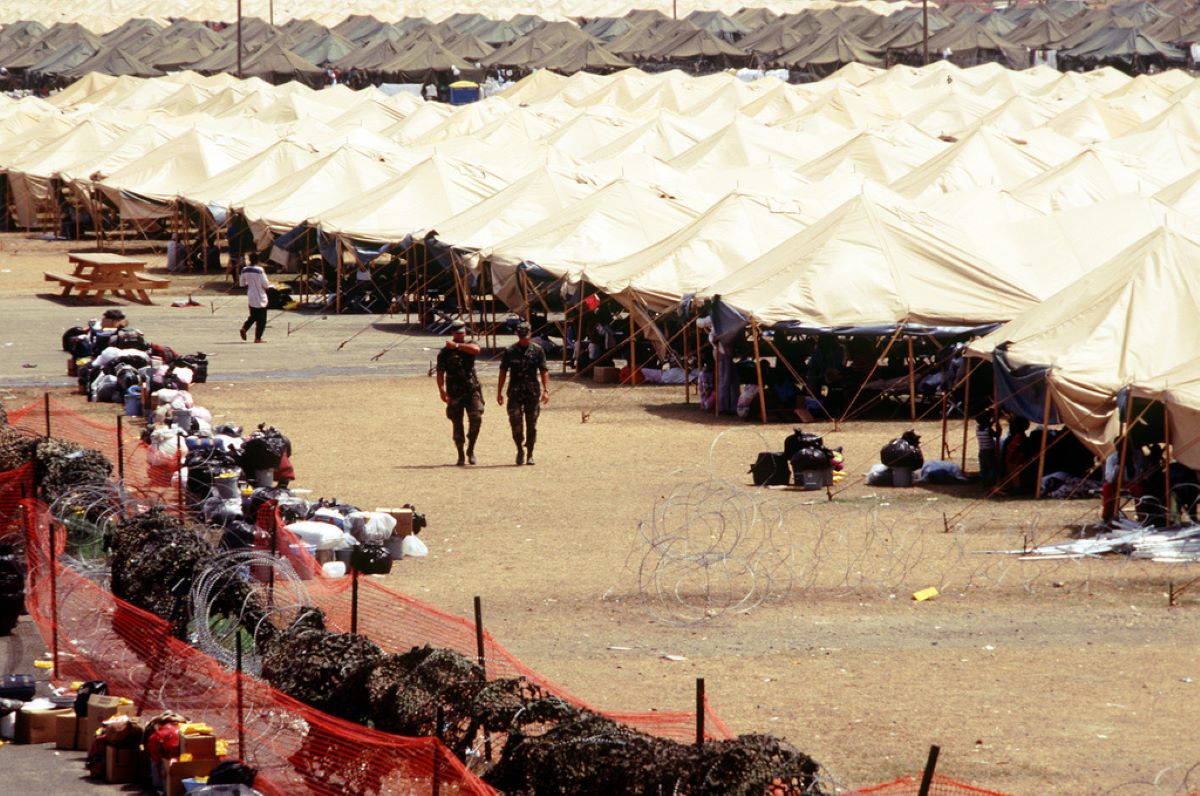
Migrant detention facilities at Guantanamo Bay in 1994.
As any kids know who have sung along to Raffi’s classic children’s song “Down by the Bay”, don’t go back to your home down by the bay, because your mother will say . . .
Well, open-borders advocates have taken on the role of mom, urging the Trump administration not to send, in President Trump’s words, “the worst criminal illegal aliens”, back to their new homes at the U.S. naval station down by the (Guantanamo) Bay in Cuba. (See my colleague Andrew Arthur’s post yesterday on Guantanamo announcement.)
Hamed Aleaziz and Carol Rosenberg report in the New York Times that Lucas Guttentag, “a Justice Department official in the Biden administration who once led the lawsuit over Haitian refugees being held at” Guantanamo, reacted to the news by proclaiming that “Guantánamo is a black hole designed to escape scrutiny and with a dark history of inhumane conditions”, and that Vincent Warren, executive director of the Center for Constitutional Rights, concluded that “Trump’s order sent a dark message that “migrants and asylum seekers are being cast as the new terrorist threat, deserving to be discarded in an island prison, removed from legal and social services and supports”.
What is going on here? President Trump issued a memo to the secretaries of Defense and Homeland Security titled “Expanding Migrant Operations Center at Naval Station Guantanamo Bay to Full Capacity”, stating that:
I hereby direct the Secretary of Defense and the Secretary of Homeland Security to take all appropriate actions to expand the Migrant Operations Center at Naval Station Guantanamo Bay to full capacity to provide additional detention space for high-priority criminal aliens unlawfully present in the [U.S.], and to address attendant immigration enforcement needs identified by the Department of Defense [DOD] and the Department of Homeland Security [DHS].
This memorandum is issued in order to halt the border invasion, dismantle criminal cartels, and restore national sovereignty.
President Trump stated that “We have 30,000 beds in Guantánamo to detain the worst criminal illegal aliens threatening the American people. … Some of them are so bad we don’t even trust the countries to hold them, because we don’t want them coming back, so we’re going to send them out to Guantánamo.” He added that this would “double our [immigration detention] capacity immediately” and that Guantánamo is a “tough place to get out of”.
Shocking, you say! Well, as the U.S. General Accounting Office (GAO, since rebranded as the Government Accountability Office) noted in 1995, President Bill Clinton used Guantanamo to hold as many as 45,000 Cubans and Haitians in 1994. And as Aleaziz and Rosenberg note:
-
Successive administrations have prepared fields [at Guantanamo] to accommodate tens of thousands of migrants in a sprawling tent city. The infrastructure was set up starting in the mid-2000s to shelter Cubans and others from the region who had been intercepted while fleeing their country.
-
Starting with the George W. Bush administration, the government created a new footprint for a future humanitarian relief operation on the mostly empty side of the base.
How bad were conditions at Guantanamo during the time of detainer-in-chief Bill Clinton? GAO concluded that:
-
[O]ur review at the Guantanamo Bay camps indicated that living conditions were adequate. … [T]he U.S. Atlantic Command had developed standards for safe haven conditions based on inspection guidelines of the United Nations High Commissioner for Refugees (UNHCR) and standard military regulations and manuals’ requirements. The Command developed a camp construction model for migrant operations based on a population of 10,000 that could be adapted for population changes and issued corresponding operational guidelines. …
We found that conditions generally met or exceeded Atlantic Command standards and UNHCR inspection guidelines. For example, minimal UNHCR inspection guidelines include 3.5 square meters of living space per migrant. Using this as guidance, the Command recommended using medium-sized tents to house up to 15 Cubans. We found no indication that these tents housed more than 15 persons.
Camp conditions have improved since the influx of Cubans in the summer of 1994, due to decreasing population density and a Defense Department “Quality of Life” facilities upgrade. In late August 1994, thousands of people were arriving daily at the Guantanamo Bay camps. Together with about 12,000 Haitians, the camps’ population totaled about 45,000 in September 1994. At that time, living conditions were marginal, according to Atlantic Command officials, as [DOD’s Joint Task Force-160] was erecting tents and installing portable toilets as quickly as people arrived.
-
In addition to adequate shelter, camp residents receive breakfast, a hot dinner prepared by Cuban cooks, and Meals Ready to Eat … for lunch. Cubans with whom we spoke said that the food was better than when they first arrived, when they mostly received rice. They also receive medical treatment at camp clinics and in military medical and surgical units as necessary. Recreational activities include baseball, basketball, pool, ping-pong, movies, music, arts and crafts, and libraries. In addition, adults can attend English and vocational classes coordinated by World Relief. Most children have left the camps, but the few remaining receive basic schooling. …
Security is professional but not overtly oppressive. Camp residents are relatively free to move around within camp areas. When they first arrived, the Cubans were restricted to smaller areas behind razor concertina wire.
“[B]aseball, basketball, pool, ping-pong, movies, music, arts and crafts, and libraries”? Doesn’t seem so bad to me. As I have written, on March 28, 2012, when I was chief counsel for the House Judiciary Committee’s Subcommittee on Immigration Policy and Enforcement, the subcommittee held a hearing on the then-new DHS immigration detention standards. We titled the hearing “Holiday on ICE: The New Department of Homeland Security Immigration Detention Standards”. My boss, Judiciary Committee Chairman Lamar Smith (R-Texas), said in his opening statement that:
-
This hearing is entitled, ‘‘Holiday on ICE,’’ because ICE has decided to upgrade accommodations for detained illegal and criminal immigrants. While we would all like to be upgraded, we do not have the luxury of billing American taxpayers or making Federal law enforcement agencies our concierge.
-
Under th[e Obama] Administration, detention looks more like recess. While funds for American students’ physical education classes are being cut, the new detention standards expand recreation for illegal immigrants. For instance, illegal and criminal immigrants in ICE custody will have options such as soccer, volleyball, and basketball. It would be nice if all American students got those options.
-
Among the new amenities, the Karnes City facility contains a library with free Internet access, cable TV, an indoor gym with basketball courts, soccer fields, and sand, and that is for beach volleyball. Instead of guards, unarmed ‘‘resident advisors’’ patrol the grounds.
I guess beach volleyball would be easier to set up at Guantanamo Bay, since DHS won’t have to airlift in sand.
Not all present at the hearing shared Rep. Smith’s perspective, or his sense of humor. John Conyers (D-Mich.), the committee’s ranking Democrat, sent Smith a letter the day prior to the hearing stating that: “I hope we agree that the manner in which we treat immigrants in our detention facilities is not a laughing matter. I urge you to reconsider the title of tomorrow’s hearing and to instead use a title that shows greater respect for the issue and for the people in our custody and care.” Erin Gloria Ryan gave her take as to Mr. Smith’s views in Jezebel: “Because being detained by [ICE] is like going to Disneyland, except instead of going on any of the rides, Mickey Mouse punches you in the face while Goofy takes pictures and then Donald Duck strip searches you.”
However, Rep. Steve King (R-Iowa) pointed out at the hearing that “All [detainees] need to do to avoid that ‘holiday on ICE’ is put themselves back in the condition they were in before, which is go to their home country,” querying “[i]s it true that some of the inmates control the keys to their own cells”, unlike convicted criminals serving their sentences? Indeed, they do. As Michael Vastine, visiting director of clinical and experiential education at Stetson University’s College of Law, has written, “Asylum seekers hold the keys to their own cell. If they give up on their case, they will be deported and achieve freedom.”
But, isn’t the idea of detention camps for illegal and criminal aliens extreme? Well, tell that to the Select Commission on Immigration and Refugee Policy, established by Congress in 1978. President Jimmy Carter selected the Rev. Theodore Hesburgh, C.S.C., the president of the University of Notre Dame and former chairman of the U.S. Commission on Civil Rights, to chair the Commission.
Daniel Tichenor, Philip H. Knight Chair of Social Science at the University of Oregon and director of the Wayne Morse Center’s Program for Democratic Governance, writes in his magisterial book Dividing Lines: The Politics of Immigration Control in America that:
-
The … [C]ommission would … profoundly shape immigration policy in the 1980s.
-
[The Commission] offered an influential narrative in 1981 that legitimated expansive legal immigration, refugee admissions, and alien rights, while assailing illegal immigration for its deleterious effects on public health, social equality, and the rule of law.
-
[Father Hesburgh was] committed to elevating ideas and policy proposals forceful enough to transcend partisan and special interests. [The Commission’s] composition included four public members, four Cabinet secretaries, and eight congressional members, many of whom belonged to ethnic and racial groups … once described as inferior immigrant stock … includ[ing] a Cuban American AFL-CIO official, a Japanese American assistant to Los Angeles mayor Tom Bradley, and a Mexican American judge.
-
[Commission members] stressed the importance of racial nondiscrimination and other civil-rights values in formulating immigration policy. … [C]ommissioners like Rose Ochi, whose Japanese American parents were interned during World War II, Judge Cruz Reynosa, whose father was deported in one of the mass expulsions of Mexicans during the 1930s, and Hesburgh … frequently emphasized the importance of racial equality and alien rights in national immigration policy.
-
Members of Congress reverently and frequently cited [the Commission’s] research and recommendations in subsequent legislative debates.
-
[A]dherence to notions of racial justice and civil rights values was a theme that deeply informed [the Commission’s] pro-immigration policy paradigm.
-
The immigration reforms adopted in 1986 and 1990 largely codified the central ideas advanced by the Hesburgh Commission … . The social knowledge and policy alternatives endorsed by [the Commission] … enjoyed special intellectual and bipartisan credibility in the policymaking process.
In 1964, President Lyndon Johnson had awarded Father Hesburgh the Presidential Medal of Freedom, the nation’s highest civilian honor “presented to individuals who have made exemplary contributions to the prosperity, values, or security of the United States, world peace, or other significant societal, public or private endeavors”. Legislation was enacted in 1999 awarding Father Hesburgh the Congressional Gold Medal, stating, among other things, that:
-
Father … Hesburgh … has made outstanding and enduring contributions to American society through his activities in civil rights, higher education, the Catholic Church, the Nation, and the global community[.]
-
Father Hesburgh served from 1979 to 1981 as chairperson of the Select Commission on Immigration and Refugee Policy, which made recommendations that served as the basis of congressional reform legislation enacted 5 years later[.]
Almost 70 percent (292) of all members of the U.S. House of Representatives co-sponsored the legislation and the House passed it by voice vote. The Senate passed it by unanimous consent.
During House floor consideration, U.S. Rep. Maxine Waters (D-Calif.) stated that:
-
I rise in support of bestowing the Congressional Gold Medal of Honor to a very worthy and outstanding American.
-
Justice has been the focus of many of [Father Hesburgh’s] outside involvements. He was a charter member of the U.S. Commission on Civil Rights, created in 1957, and he chaired the Commission from 1969 to 1972, when President Nixon replaced him as chairman for his criticism of the administration’s civil rights record.
U.S. Rep. Tim Roemer (D-Ind.) stated that:
[T]he most proud times that I have spent with [Father Hesburgh] at lunch and dinner he has talked so passionately about his charter membership on the U.S. Commission on Civil Rights and how he fought so diligently in the 1960s, with the Kennedy and the Johnson administration, for the passage of the historic 1964 Civil Rights Act. That is something that Father Hesburgh continues to fight hard for and feels passionately about those civil rights for each and every American.
Father Hesburgh, through fighting for social justice, has always been amplifying the voice of the homeless, has always been advocating the concern of the poor and has always been trying to put a voice out there for those that are voiceless and poor and not able to lobby the government of the United States.
Oh, I almost forgot the Commission’s recommendation:
-
[A]n interagency body [should] be established to develop procedures, including contingency plans for opening and managing federal processing centers, for handling possible mass asylum emergencies. [Emphasis omitted.]
-
[T]his planning body [should] develop contingency plans for opening and managing federal asylum processing centers, where asylum applicants would stay while their applications were processed quickly and uniformly.
The Commission explained that among the “important benefits” of these “processing centers”:
-
Ineligible asylum applicants would not be released into communities where they might later evade U.S. efforts to deport them or create costs for local governments.
-
A deterrent would be provided for those who might see an asylum claim as a means of circumventing U.S. immigration law. Applicants would not be able to join their families or obtain work while at the processing center.
-
Law enforcement problems, which might arise as a result of a sudden influx of potential asylees, could be minimized.
The Commission passed the recommendation by a vote of 12-3 with one absence. I guess the Hesburgh Commission didn’t realize how Trumpian it was!
Could one benefit to the Trump administration of detaining aliens at Guantanamo Bay be that it will curb their ability to make (more often than not) bogus or meritless claims for asylum and withholding of removal?
As to asylum, the Immigration and Nationality Act (INA) provides that:
Any alien who is physically present in the [U.S.] or who arrives in the [U.S.] (whether or not at a designated port of arrival and including an alien who is brought to the [U.S.] after having been interdicted in international or [U.S.] waters), irrespective of such alien’s status, may apply for asylum.
The provision also bars certain criminal and other aliens from asylum eligibility.
As to withholding of removal, the INA provides that:
[T]he Attorney General [read to mean the Secretary of Homeland Security since the creation of DHS] may not remove an alien to a country if … decid[ing] that the alien’s life or freedom would be threatened [essentially, more likely than not that they would be persecuted] in that country because of the alien’s race, religion, nationality, membership in a particular social group, or political opinion.
The provision also bars certain criminal and other aliens from withholding eligibility.
In 1993, the Supreme Court ruled in Sale v. Haitian Ctrs. Council that withholding does not “appl[y] to action taken by the Coast Guard on the high seas” (outside the territorial waters of the U.S.), and made clear that it would reach the same conclusion if presented with a case regarding asylum. The Court concluded that withholding only applies to actions taken where deportation or exclusion proceedings can be conducted, i.e. within the U.S.: “The reference to the Attorney General … suggests that [withholding] applies only to the Attorney General’s normal responsibilities under the INA[, t]he most relevant … [being] deportation and exclusion hearings in which requests for asylum or for withholding … are ordinarily advanced.” Further:
Since there is no provision in the [INA] for the conduct of such [asylum or withholding] proceedings outside the [U.S.] and since … the INA obviously contemplate[s] that such proceedings would be held in the country, we cannot reasonably construe [the withholding provision] to limit … actions in geographic areas where … such proceedings [are not authorized]. Part V of the INA contains no reference to a possible extraterritorial application.
The Court’s conclusion seemingly still stands because these proceedings (now based on grounds of deportability or inadmissibility) are still authorized to take place only within the U.S.
The Supreme Court also relied on “the presumption that Acts of Congress do not ordinarily apply outside our borders”, concluding that there was not “a scintilla of evidence” to be found in the legislative history of the “Refugee Act of 1980” (which amended the withholding provision) that Congress “intended to provide for the statute’s extraterritorial application”, noting that “It would have been extraordinary for Congress to make such an important change in the law without any mention of that possible effect.”
The Court concluded that “all available evidence … leads unerringly to the conclusion that [withholding] applies in only one context: the domestic procedures by which the attorney general determines whether deportable and excludable aliens may remain in the [U.S.].”
What does any of this have to do with Guantanamo Bay? Isn’t it considered part of the United States? No. In 1995, the 11th Circuit concluded in Cuban American Bar Ass’n, Inc. v. Christopher that:
-
The district court here erred in concluding that Guantanamo Bay was a “[U.S.] territory.”… We disagree that “control and jurisdiction” is equivalent to sovereignty. See Agreement for the Lease to the United States of Lands in Cuba for Coaling and Naval Stations, Feb. 26, 1903 … (distinguishing between sovereignty of the Republic of Cuba over the leased land and the “control and jurisdiction” granted the [U.S.]). … [The 11th Circuit then cited] United States v. Spelar … ([in which the Supreme Court in 1949] constru[ed] the Federal Tort Claims Act not to apply to an American military air base in Newfoundland because the lease between Newfoundland and the [U.S.] “effected no transfer of sovereignty with respect to the military bases concerned”).
-
[W]e … reject the argument that our leased military bases abroad which continue under the sovereignty of foreign nations, hostile or friendly, are “functional[ly] equivalent” to being land borders or ports of entry of the [U.S.] or otherwise within the [U.S.]. Therefore, any statutory … claim made by the individual Cuban plaintiffs and the individual Haitian migrants must be based upon an extraterritorial application of that statute.
Now, before anyone reads more into these cases than is actually there, keep in mind that Sale and Cuban American Bar Ass’n involved aliens interdicted on the high seas, not aliens transferred from the United States to Guantanamo Bay. Thus, I would presume that the asylum cases of aliens who apply for asylum before they are transferred to Guantanamo will still go forward even after their transfers. And I presume that DHS cannot transfer aliens out of the U.S. and then claim that the aliens are barred from eligibility for withholding because they are not present in the U.S.
And there is always the Convention Against Torture and Other Cruel, Inhuman or Degrading Treatment or Punishment (CAT). In passing implementing legislation, Congress provides that:
It shall be the policy of the [U.S.] not to expel, extradite, or otherwise effect the involuntary return of any person to a country in which there are substantial grounds for believing the person would be in danger of being subjected to torture, regardless of whether the person is physically present in the [U.S.]. [Emphasis added.]
So, for purposes of CAT relief, contentions that aliens not present in the United States are not eligible are not availing. Additionally, the implementing legislation is widely understood as allowing any criminal or terrorist aliens, no matter how heinous their acts, to receive relief. This is despite the fact that the legislation states that “[t]o the maximum extent consistent with the obligations of the [U.S.] under [CAT] … the [implementing] regulations … shall exclude from the protection of such regulations [criminal and other] aliens [ineligible for withholding of removal].”
So, while it is not certain what the impact of aliens’ transfer to Guantanamo will have on asylum and withholding rights, it is clear, as Aleaziz and Rosenberg write, that “Adding 30,000 beds would dramatically expand the government’s detention capacity.”


