New United States Population Projections
- External Source
admin
- 0
- 38 minutes read
Immigration will be the key factor determining whether populations across the developed world stabilize or continue to increase over the coming century. New policy-based population projections illustrate this for the United States. Expansive immigration policies could increase the U.S. population by hundreds of millions by 2100, while more restrictive policies could stabilise America’s population or even lead to population reduction. Because larger populations increase carbon emissions, habitat loss, traffic congestion, and other negative environmental impacts, American environmentalists have strong reasons to support lower immigration levels. Reducing immigration could stabilize the U.S. population and encourage population stabilization in our major sender countries, contributing significantly to global ecological sustainability. For the U.S., there is no plausible high-immigration path to a stable or sustainable population.
Among the findings:
- According to the U.S. Census Bureau, immigration, not fertility, is the main driver of continued U.S. population growth.
- New population projections show continuation of status quo net immigration levels of 1.5 million annually will lead to constant population growth throughout the century and a population almost 100 million larger in 2100 (432 million).
- Continuing immigration at the highest levels sustained during the Biden administration — three million net annually — would increase the U.S. population by hundreds of millions (to 615 million by 2100), while an open borders immigration policy could lead to 860 million Americans by 2100, an increase of 255 percent.
- Conversely, following the recommendations of the U.S. Commission on Immigration Reform (commonly known as the Jordan Commission) and reducing net immigration to 300,000 annually would result in a population of 285 million in 2100, a modest 16 percent decrease phased in over 75 years.
- All else being equal, doubling the U.S. population will double citizens’ economic demands and environmental impacts (including carbon emissions, water withdrawals from rivers, and sprawl), while decreasing their numbers will decrease those demands and impacts proportionally.
- Immigration policy decisions thus yield dramatically different demographic and environmental futures and will be among the United States’ most consequential environmental policy choices going forward.
Introduction
Population size is a key factor determining people’s environmental impacts and immigration is a key factor determining the size of human populations. Given that, environmentalists seeking to create sustainable societies have a clear stake in immigration policy. This is particularly true in the developed world, where mass immigration is driving continued population growth (Parr, 2021; Parr, 2023). In many developed countries, decades of below-replacement fertility levels have not led to population stabilization or decline. Instead, governments have increased immigration, resulting in continued population growth in the United States, Canada, Australia, France, the United Kingdom, Sweden, and the Netherlands, among others (United Nations, 2024).
Having ignored population growth in recent decades, some environmentalists take comfort in official projections that show populations peaking later this century and then declining, globally or nationally. For example, the United Nations’ “World Population Prospects 2024” predicts peak global population by the mid-2080s, while the U.S. Census Bureau’s 2023 “main series” projection has the U.S. population peaking in the late 2070s. This complacency is misguided for two reasons.
First, these projected trends assume policy changes that may or may not happen. The UN projections assume greatly expanding contraceptive availability and big improvements in educational opportunities for girls in the developing world, particularly in Sub-Saharan Africa (Kebede et al., 2019; Götmark and Andersson, 2022). The U.S. Census Bureau’s projections assume large decreases in net migration into the U.S. from current levels (Knapp and Lu, 2022; U.S. Census Bureau, 2023b). There is no consensus on these policy changes and indeed significant resistance to them. African patriarchs want their women to continue bearing large families, while American capitalists want to keep their workers weak and ethnically divided.
Second, stabilising global and national populations at current levels appears insufficient to avoid continued ecological degradation and potential environmental catastrophe. Indications are that a global population of eight billion people is several times larger than Earth can sustain over the long term, at least at the levels of comfort and convenience experienced in prosperous industrial democracies and desired in poorer nations (Lianos and Pseiridis, 2016; Dasgupta, 2019; Tucker, 2019). A population of 340 million in the U.S. may be hundreds of millions more than can share the American landscape without crowding other species out of existence or taking more than our fair share of global resources (Pimentel and Pimentel, 2006; Rosenberg et al., 2019).
There is no lack of schemes for solving global environmental problems without addressing overpopulation. Research into projects to geoengineer Earth’s atmosphere and oceans, to allow continued economic and demographic growth, is currently underway, despite the obvious dangers (Stephens et al., 2023). Two recent studies assert humanity’s ability to feed 10 billion people; all we need to do is completely reinvent global agriculture (Gerten et al., 2020; O’Neill et al., 2018). But whatever might be possible hypothetically in the future, a warming atmosphere, melting tundra, burning forests, shrinking and dying rivers, acidifying oceans, bleaching corals, and dwindling wildlife all testify to humanity’s excessive numbers right now (Ripple et al., 2020; Richardson et al., 2023). While “End Population Growth!” was the right slogan in 1970, with more than twice as many people alive today, living much more luxuriously on average, gradually and humanely shrinking human numbers seems the prudent course of action (Götmark et al., 2021; Crist et al., 2022).
The United States is headed in the opposite direction, however, and immigration policy is the major reason. Understanding the impact of immigration on future population numbers can help clarify our economic and environmental policy choices going forward. This analysis seeks to facilitate such understanding by building on recent U.S. Census Bureau projections to make explicit where future immigration policy choices may lead.
Recent Census Bureau Projections
In 2023, the U.S. Census Bureau provided their most recent population projections for the United States (U.S. Census Bureau, 2023a). They used a standard cohort-component method; for details, see “Methodology, Assumptions, and Inputs for the 2023 National Population Projections” (U.S. Census Bureau, 2023b). The Census Bureau’s main projection series set the nation’s total fertility rate (TFR) between 1.63 and 1.54 from 2025 to 2100, slowly decreasing over the entire period. Average life expectancy varied between 76 and 86 years for men and 81 and 88 years for women, slowly increasing over the entire period. Net annual migration levels varied between 853,000 and 976,000, peaking in 2079 and decreasing slightly thereafter.
These projections garnered the most attention for predicting that the U.S. population would peak in the late 2070s and then start to decrease, a first for a Census Bureau main projection. This became “Census Bureau Says U.S. Population to Decline” in headlines and TV news stories around the country, fitting in nicely with recent concerns about falling national fertility levels (Bahrampour, 2023; Schoichet, 2023). Reports downplayed that this decline was predicted to occur more than 50 years in the future and that the expected U.S. population in 2100 was tens of millions larger than it is now. Some reporters framed their stories as America “running out of people” or, especially in the business press, “running out of workers” (Wise, 2023). Also often highlighted was population ageing.
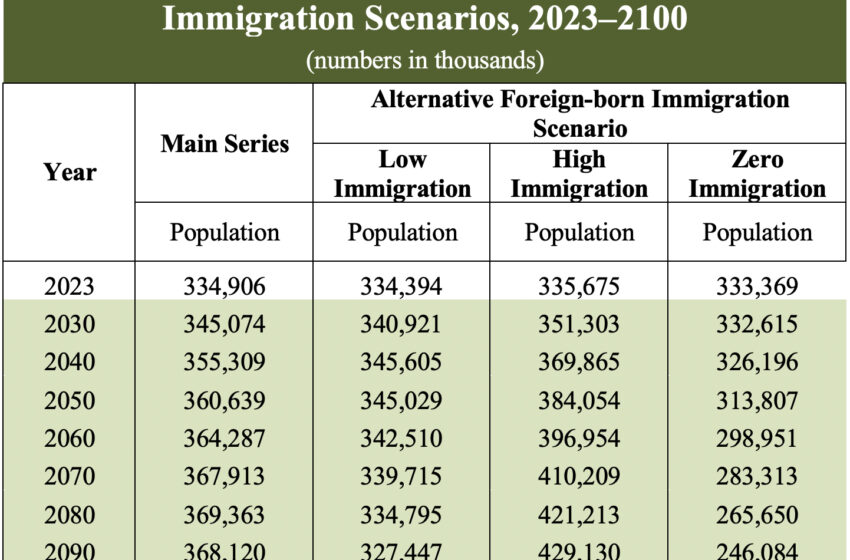
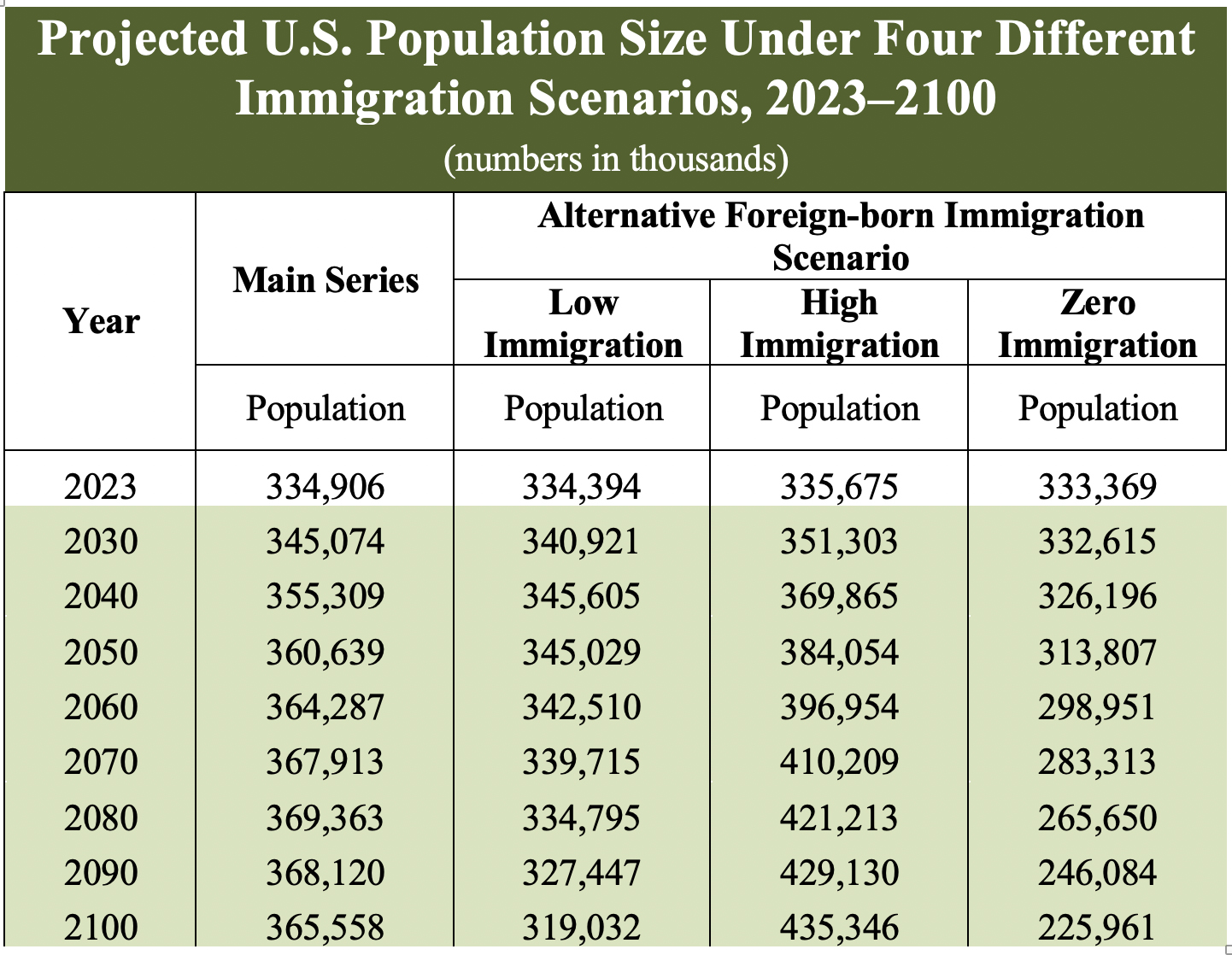
The Census Bureau also provided projections under “zero”, “low” and “high” immigration scenarios, along with their most likely “main series” projection (see table below). These alternative scenarios were largely ignored by reporters. Net migration under the main series averages 939,000 annually over the projection period. Net migration under the low and high immigration scenarios averages 543,000 annually and 1.534 million annually, respectively. The “zero” migration scenario actually models an average -249,000 annual net negative migration, since it combines continued emigration out of the country with no immigration whatsoever (a highly unlikely scenario). These four immigration scenarios yielded populations of 226 million, 319 million, 366 million, and 435 million in 2100 (U.S. Census Bureau, 2023a).
Source: U.S. Census Bureau, “2023 population projections for the nation by age, sex, race, Hispanic origin and nativity”, Table A (modified). |
On the positive side, these alternative projections did show readers who dug deeply enough that immigration levels will make a big difference in future U.S. population numbers, especially since the Census Bureau projected all the way out to 2100, something it had not done since 2000. The difference between expected populations in 2100 for the low and high projections was 116 million (319 million vs. 435 million). In a press release, the Census Bureau stated explicitly: “In each of the projection scenarios except for the zero-immigration scenario, immigration is projected to become the largest contributor to population growth.” And: “Different levels of immigration between the present and 2100 could change the projection of the population in that year by as much as 209 million people, with the projected total population ranging anywhere from 226 to 435 million” (US Census Bureau, 2023c).
A problem with the Census Bureau projections, however, is that they do not accurately capture the range of immigration policy choices facing the United States today. Just in the past five years, net immigration into the United States has varied more widely and across a much higher range, from 750,000 in the last year of the Trump administration (2020) to approximately three million in Joe Biden’s penultimate full year as president (2023) (Knapp and Lu, 2022; Camarota and Ziegler, 2024). This is a variance of 2.25 million, compared to a variance of 1.1 million between the Census Bureau’s low and high projections. Such a failure to consider the full range of immigration policy options is common in national statistical bureaus’ population projections, which have been slow to accommodate recent large increases in immigration (Cafaro and Dérer, 2019).1
In an effort to correct this failure, we created a population projection tool to model the full range of immigration choices facing American policy-makers. This tool replicates the cohort-component method used by the Census Bureau, utilising a single-cohort model. It uses initial population data from the Census Bureau as of July 2024 and migration, fertility, and mortality data from the 2023 Census Bureau projections. We set the tool to default to the Census Bureau’s 2023 main series projection values for total fertility rate, life expectancy, and net migration between 2025 and 2100, all of which can then be varied to create new projections.
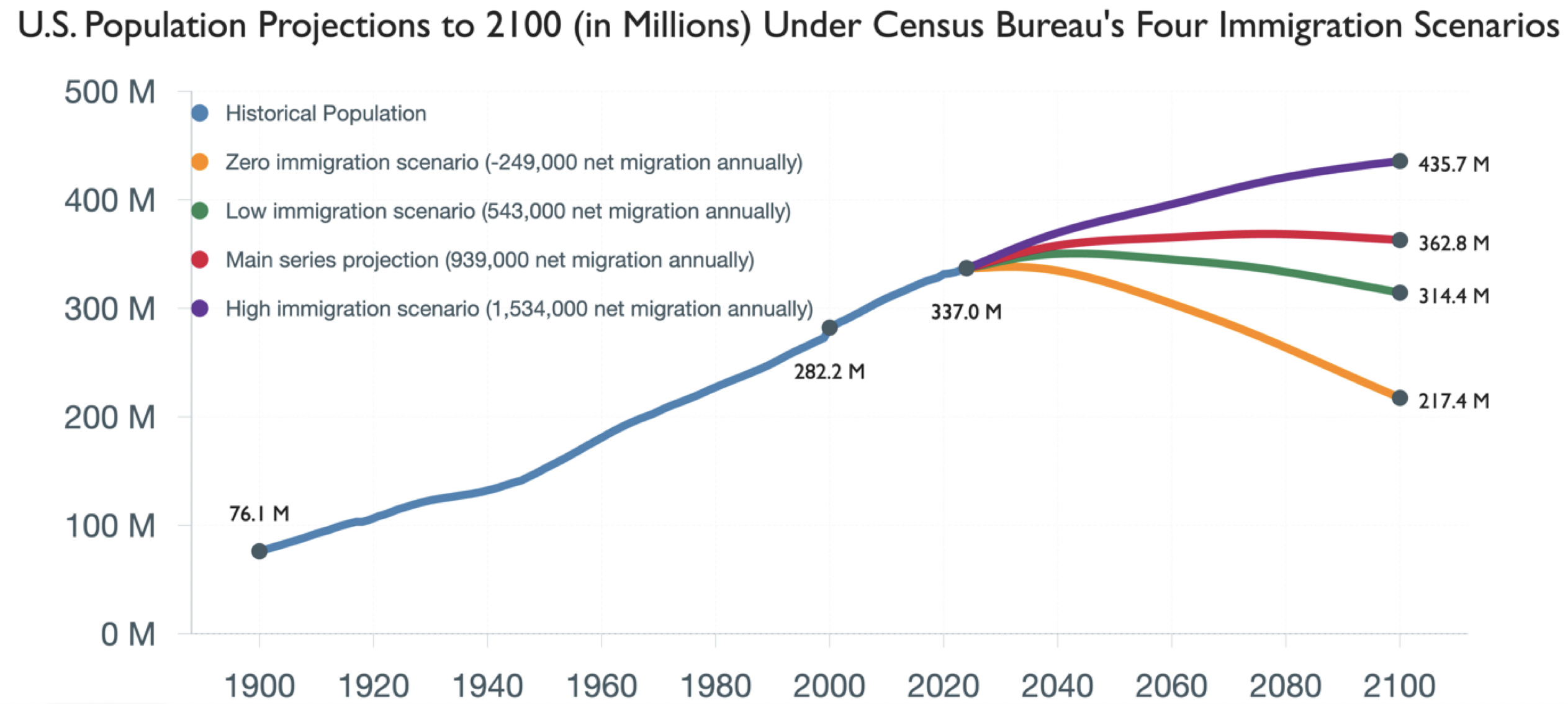
Using these default parameters from the main series, this “reverse engineered” projection tool generates a U.S. population in 2100 of 362.8 million, less than 1 percent different than the Census Bureau’s main series projection of 366 million (U.S. Census Bureau, 2023a). Most of this difference appears to be a function of using a more up-to-date base population. Rerunning the Census Bureau’s four immigration scenarios from 2023 using this tool generates the projections in Figure 1.
Figure 1. |
Source: U.S. Census Bureau, “2023 population projections for the nation by age, sex, race, Hispanic origin and nativity” and own calculations. |
Note that the range between the populations in 2100 under the high immigration and low immigration scenarios is only 121.3 million. Adding the zero-migration projection increases the range to 218.3 million, but this is a highly unlikely scenario that doesn’t increase the range of plausible policy options.
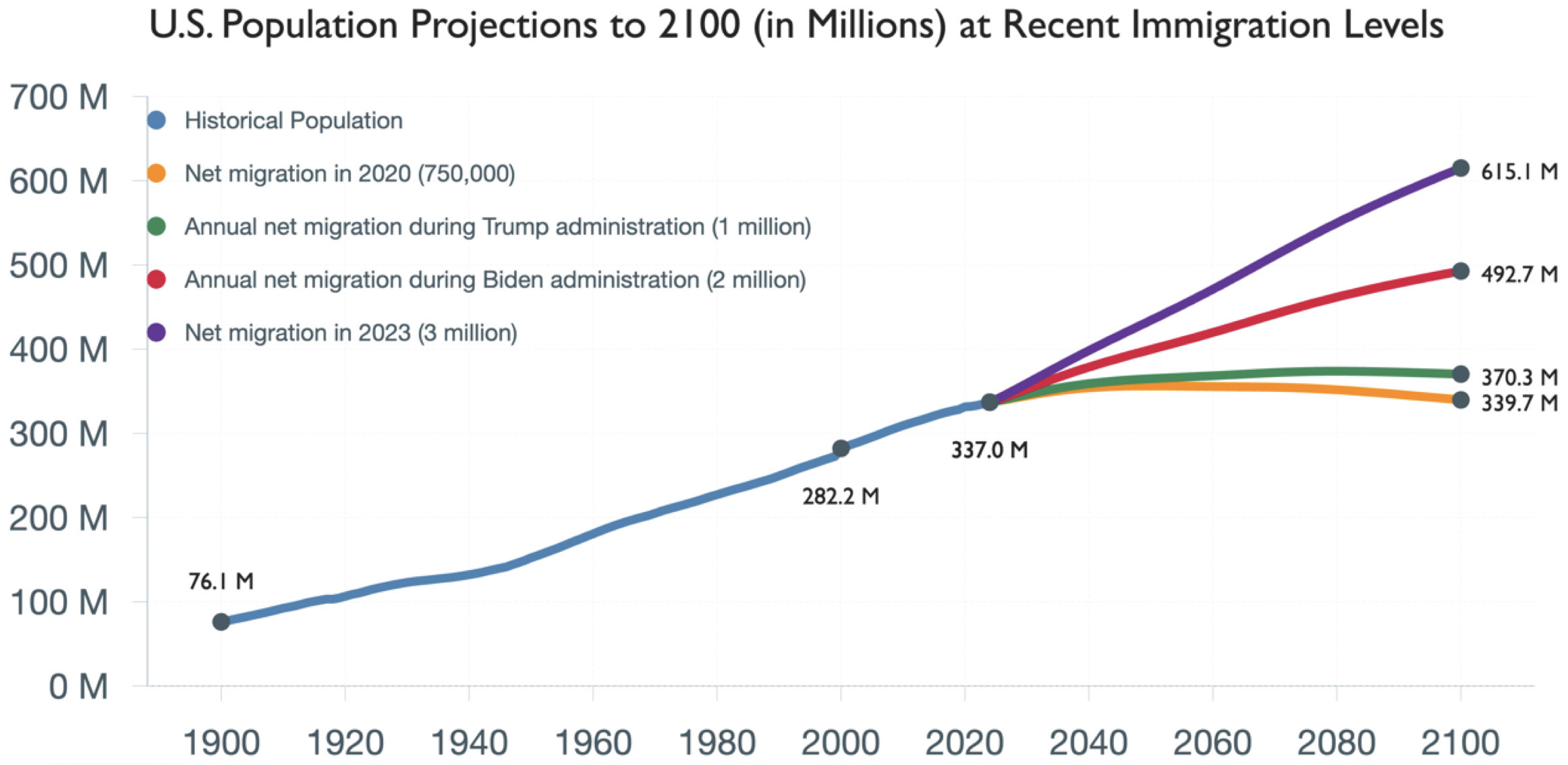
By comparison, projecting out scenarios based on the actual figures for net migration in 2020 and 2023, 750,000 and three million respectively, leads to a difference of 275.4 million in 2100 (see Figure 2). In the high immigration scenario, the U.S. population balloons to 615.1 million by 2100, while in the low immigration scenario population rises at first and then declines slowly over the second half of the century to 339.7 million — essentially today’s number. Even comparing two scenarios for estimated average annual net migration under the Trump and Biden administrations — approximately one million and two million, respectively (Camarota and Ziegler, 2023) — we still see a 122.4 million difference between projected populations in 2100 (492.7 million vs. 370.3 million). Both generate continued U.S. population growth, but one scenario leads to 4.5 times as much growth as the other, and a population that would still be rapidly growing at the end of the century.
Figure 2. |
Source: U.S. Census Bureau, “2023 population projections for the nation by age, sex, race, Hispanic origin and nativity” and own calculations. |
As the Census Bureau itself emphasised, with historically low fertility rates unlikely to rebound to previous levels, immigration policy likely will be the main determinant of whether the U.S. population will continue growing in the twenty-first century and by how much (U.S. Census Bureau 2023a, 2023c). For those who believe achieving sustainability depends on ending or reversing population growth, wading into immigration policy thus appears unavoidable.
Recent Immigration Policy
Recent variations in immigration levels have been caused by a wide range of immigration policy changes. Legal immigration under congressionally mandated programs has stayed relatively stable at around 1.1 to 1.2 million annually, not just during the Trump and Biden administrations, but since the last major increases in legal immigration levels in the early 1990s. What changed dramatically during the past decade have been four things: decreased (Trump) and then increased (Biden) tolerance for illegal immigration; the Covid pandemic; an immense surge in political asylum applications; and new “temporary” parole programs bringing in several million citizens from distressed states in Latin America (Camarota and Ziegler, 2024).
In 2017, the Trump administration became the first Republican administration since the 1950s to seriously attempt to reduce illegal immigration. Efforts included the “Remain in Mexico” policy, under which asylum applicants entering the U.S. illegally were returned to Mexico to await adjudication of their claims; increased enforcement of employer violations of worker visa programs; a temporary suspension of foreign aid to several Central American countries to compel them to cooperate with repatriation efforts; and more (Bolter et al., 2022). These endeavours garnered mixed success, yet they did reinforce the ideas that limiting immigration is necessary and that immigration limits should be enforced (Kaba, 2019). Illegal immigration into the U.S. decreased marginally during Trump’s first term, while legal immigration levels remained steady. Covid-19 did more to reduce overall immigration levels, however, with 2020 recording some of the lowest numbers seen in decades (Knapp and Lu, 2022).
In response, in 2020 the Biden team went further than any modern American administration in relaxing (some would say undermining) immigration enforcement. At least 850,000 visitors overstayed their visas and remained in the U.S. illegally in 2022 (U.S. Department of Homeland Security, 2023). Nearly 1.4 million prima facie inadmissible migrants were released by federal officials into the country in fiscal year 2023, many after filing bogus political asylum claims (Arthur, 2023). During the administration’s first three years, two million people from faltering and failed states were “paroled” into the U.S. under special programs originally designed to accommodate a few hundred people (Arthur, 2024). More recently, after a public outcry and with an impending presidential election, these numbers were brought down. But they represented an unprecedented increase in illegal and quasi-legal immigration which, added to stable levels of legal immigration, led to the highest absolute net migration levels in U.S. history.2
What can we conclude from the policy actions taken in the past eight years and the public’s response? First, Donald Trump’s re-election dramatically shows that most Americans believe that citizens, through their elected government, should set and enforce limits to immigration. But significant minorities on the cosmopolitan left (Dummett, 2024) and libertarian right (Kukathas, 2021) disagree. There really is a constituency for “open borders”. Second, according to recent polls, a majority of Americans have come to believe that current immigration levels should be reduced. Most of the rest think current levels are acceptable, while only a small minority believe they should be expanded (Jones, 2024). Third and crucially, these proportions are largely reversed among the political and business elites who actually run the country. Many important decision-makers support continued high levels of immigration or even more expansive policies. That is why immigration levels stay high and tend to go higher. As political scientists Gilens and Page (2014) have demonstrated for a wide variety of policy issues, when public opinion conflicts with the economic interests of the wealthy, the latter almost always win out in American politics.
In sum, there are wide divergences in the immigration policies proposed and implemented within the United States. Policy analysts should grapple with the full range of policy proposals, including their demographic and environmental implications. The goal of official population projections should be to clarify those implications for informed citizens, although they often fail to do so (Cafaro and Dérer, 2019; O’Sullivan, 2020).
New Policy-Based Population Projections
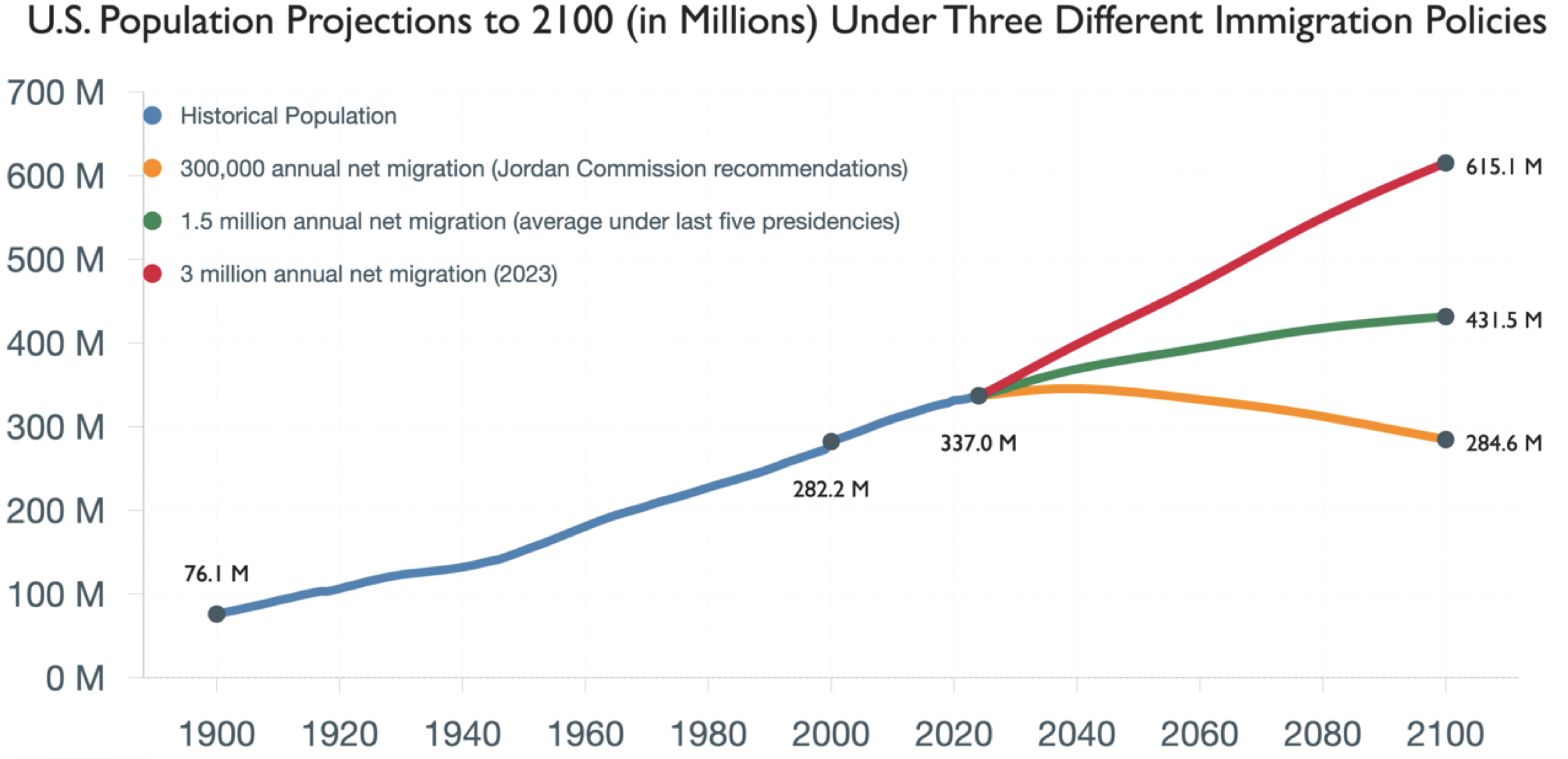
Let’s look at three scenarios that begin to capture the actual immigration policy choices facing the United States today. Using the Census Bureau’s (2023b) methodology, we first graph a rough “status quo” scenario of 1.5 million annual net migration, the average over the eight administrations of the past five U.S. presidents, from 1992 to the present. Projected forward, this immigration level leads to substantial population growth throughout this century (Figure 3). We then compare this scenario to one based on the immigration levels recommended by the U.S. Commission on Immigration Reform (1997; commonly known as the Jordan Commission) and endorsed by President Clinton (300,000 annual net) and to the highest annual net immigration level under the Biden administration (approximately three million). The Jordan Commission recommendations would reduce immigration levels substantially, while leaving some room for bringing in exceptional workers, genuine political refugees, and spousal reunification. The Biden administration’s numbers for 2023 stand as the high-water mark for immigration permissiveness, providing an empirically grounded high-migration comparison to the status quo scenario.
Figure 3. |
Source: U.S. Census Bureau, “2023 population projections for the nation by age, sex, race, Hispanic origin and nativity” and own calculations. |
These three policy scenarios are all plausible. But they put the United States on three very different population trajectories: rapid growth, gradual growth, or gradual decline. They differ in their 2100 population projections by 330.5 million — very close to the entire U.S. population today. Once again, we see that immigration policy is population policy in the United States, as it is throughout most of the developed world. The environmental difference between a population of 615 million or 285 million in 2100 would be immense, impacting everything from carbon emissions to urban sprawl, air pollution to water withdrawals from our rivers and streams, habitat preservation for endangered species to housing costs, and traffic jams for American citizens (Cafaro, 2015; Kolankiewicz et al., 2016).
All else being equal, we can assume that 615 million Americans will make more than twice the economic demands and inflict more than twice as much ecological damage as 285 million Americans. Furthermore, these populations would continue increasing or decreasing after 2100, if their respective immigration, fertility, and mortality trends continue. This in turn would move Americans even further away from or further toward ecological sustainability. Under a post-2100 continuation of the high immigration scenario, the U.S. population of 337 million in 2024 would double in a hundred years, increasing to 674 million by 2124.
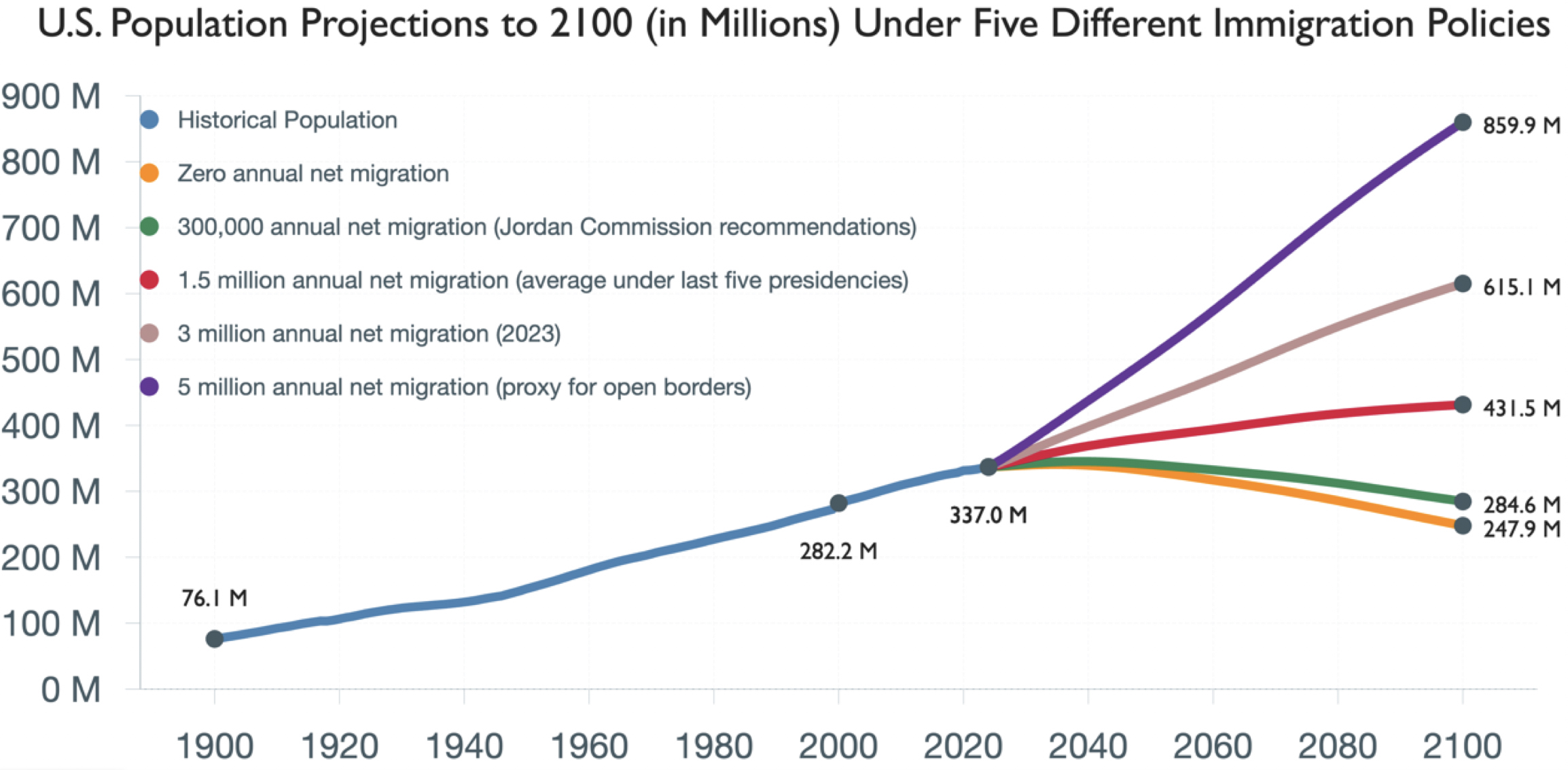
As wide-ranging as they are, these three scenarios do not exhaust the full range of potential immigration policy scenarios possible in the United States. Figure 4 graphs two new scenarios: a zero annual net migration scenario and a five million annual net migration scenario. Zero net migration represents even greater immigration curtailment than the Jordan Commission’s recommendations; it is supported by a substantial minority of Americans, such as those who argue for an “immigration pause” while the country assimilates the large waves of recent immigrants (Krikorian, 2021; Beck, 2021). Including zero net migration also has the virtue of clarifying migration’s contribution to population growth under all other scenarios (subtract the population under the zero net migration scenario from that under other scenarios, at whatever year, and you will see net migration’s contribution to the total population under that scenario).
At the other end of the spectrum, a minority of Americans support letting anyone immigrate into the country who wants to do so, or at least anyone without a serious criminal history. Polls routinely show an immense pent-up demand for emigration from the developing world. In 2021, Gallup estimated nearly 900 million adults in low- and middle-income countries wished to emigrate permanently from their home countries, with 160 million of them having the U.S. as their preferred destination (Pugliese and Ray, 2023). So the supply is there — as is the demand from corporate interests for cheap and docile labor. For many years, the Wall Street Journal editorial page has advocated for a simple, five-word amendment to the U.S. Constitution: “There shall be open borders.”
An open-borders immigration policy is difficult to model. Presumably, it would lead to large yet widely fluctuating numbers from year to year. In Figure 4 below, five million annual net migration stands in as a rough proxy for open borders. How long such a policy could actually continue before devolving into chaos is an open question. Nevertheless, it is espoused by millions of Americans, both on the left and the right. So it is worth considering what a de facto open borders policy might entail.
Figure 4. |
Source: U.S. Census Bureau, “2023 population projections for the nation by age, sex, race, Hispanic origin and nativity” and own calculations. |
Projecting this spectrum of policy choices shows once again the immense demographic importance of immigration policy. Populations in 2100 range from 859.9 million under the open-borders scenario, an increase of 522.9 million over 2024 (> 255%), to 247.9 million under zero annual net migration, a decrease of 89.1 million (< 24%). The total U.S. population in 2100 ranges over 612 million between the highest and lowest scenarios.
Even restricting ourselves to comparing population increase under the status quo scenario (1.5 million annual net migration) and the net zero scenario, we see that continuing immigration at the levels of the past 30 years could add 183.6 million people to the U.S. population by 2100. That’s equal to the entire U.S. population in 1962. All of this shows the power of relatively small differences in annual net migration to cause huge differences in the U.S. population in less than 100 years. As long-time population activist Al Bartlett often claimed, one of people’s biggest intellectual liabilities is our inability to appreciate the power of exponential growth.
Discussion
Considering these population projections, a case can be made that immigration policy choices will be more consequential than any other environmental policy decisions in the U.S. going forward. Energy policy, agricultural policy, transportation policy — all will still be important in determining Americans’ environmental impacts. But energy demands, food demands, and transportation demands will be determined in substantial part by the number of Americans (Foreman and Carroll, 2014). It seems clear that serious environmentalists cannot ignore immigration policies that will greatly scale up Americans’ total environmental impacts, both nationally and globally. Given immigration’s demographic importance, the same point appears to hold across much of the developed world. Even if we wind up endorsing continued high levels of immigration, for humanitarian or economic reasons, we should recognize its environmental costs (Hardin, 1995; Cafaro, 2015).
Fewer people is the environmental gift that keeps on giving (Attenborough, 2011). Specific technological fixes or policy changes may limit carbon emissions, decrease water use, curb overhunting, or reduce plastics pollution. But smaller populations help with all our environmental problems: every single one, simultaneously, and without any adverse environmental countereffects (Crist et al., 2022).3 Declining populations certainly pose economic challenges, but these challenges seem manageable, particularly compared to runaway climate change or other global environmental disasters (Götmark et al., 2018; Lianos et al., 2023). Meanwhile, growing populations reduce the positive impact of any technological fixes we manage to deploy.
If avoiding ecological catastrophe is the primary economic challenge of the twenty-first century, the unremitting deluge of bad environmental news from around the world is powerful evidence of the need to end human population growth as soon as possible (Bradshaw et al., 2021; Rees, 2023). It should not be necessary to defend the obvious fact that more people increase human economic demands and environmental impacts, while fewer people decrease them. This has already been fully proven by massive, multi-author research into climate change (IPCC, 2022), biodiversity loss (IPBES, 2019) and comprehensive ecological degradation (Reid et al., 2005). This analysis does not attempt to quantify those demands and impacts under different U.S. demographic scenarios, although two previous publications did this for the European Union, focusing on greenhouse gas emissions and biodiversity preservation (Cafaro and Dérer, 2019; Cafaro and Götmark, 2019). Given the complexity of human environmental impacts and the uncertainty of future trends in energy and materials use, transportation modes and agricultural techniques, such speculations are somewhat uncertain.
This uncertainty can bolster status quo bias — but the demographic status quo is leading to continued population growth and potential ecological disaster. So let me suggest two reasonable assumptions to guide Americans’ immigration policy choices. First, that future citizens will make substantial per capita environmental demands on the Earth, just as we do, regardless of fantasies of “full decarbonization”, “dematerialization”, and the like (Asafu-Adjaye et al., 2015). Second, that going forward, twice as many people will generate approximately twice as many demands as half their number would have. Deviations from these assumptions seem to me unwarranted, mere special pleading by those committed to high levels of immigration for ideological or self-interested reasons that preclude an honest reckoning with ecological limits.
To be clear, limiting human numbers is no environmental panacea. Efforts to stabilize or reduce populations should be part of comprehensive strategies to create sustainable societies, with economies based on reasonable comfort and security rather than ever-increasing wealth and consumption (Daly and Farley, 2010). Creating such societies will need to include reining in the power of large corporations, phasing out dangerous technologies and deploying more benign ones, setting aside more habitat and resources for other species, and decreasing excessive consumption among the wealthy (Crist, 2019; Rees, 2020). Population stabilization complements these other measures. It is not a substitute for them.
Sustainable societies need to take limits seriously. That necessarily includes limiting human numbers, along with our associated economic activity. In an overcrowded world, that goal in turn requires limiting immigration. Not only is reducing immigration key to ending population growth in the United States and many other developed nations, it will help incentivize developing nations to provide affordable and accessible family planning to their own members (O’Sullivan, 2020).
Conclusion
At the most recent UN climate conference in Baku, Azerbaijan, there was much talk about the outsized role developed nations have played in causing global climate change and our responsibility to take the lead in responding to ecological overshoot. And rightly so. But if we are to share the world’s resources more fairly and show the way forward by creating prosperous yet sustainable societies, developed nations must limit and perhaps in some cases reduce our populations (among other measures, to be sure). The path to doing so is open. For two or three generations, citizens in the developed world have freely chosen to have the small families that would have allowed national populations to decrease gradually and relatively painlessly — while many of their governments have greatly increased immigration, leading instead to continued population growth.
Such high immigration levels are broadly unpopular, as shown most strikingly in 2016 by Brexit and the election of Donald Trump as U.S. president and by his re-election in 2024. The threat of ecological collapse should lead more of us on the political left to join our fellow citizens on the right and accept reductions in immigration. The most plausible and ethical path toward stabilizing populations in the United States and throughout the developed world involves accepting historically low fertility rates, rather than fighting them, while also ending mass immigration. This appears to be the way forward to create flourishing societies that are both just and ecologically sustainable.
References
Asafu-Adjaye J. et al. 2015. An Ecomodernist Manifesto. Berkeley, Calif.: Breakthrough Institute.
Arthur, A., 2023. “Biden funneled nearly 1.4 million illegal aliens into the U.S. — in FY 2023 alone”. Washington, D.C.: Center for Immigration Studies.
Arthur, A., 2024. “Biden has paroled in two million-plus inadmissible aliens”. Washington, D.C.: Center for Immigration Studies.
Attenborough, D. 2011. “Impact of population growth on the planet”. London: Lecture to the Royal Society for the Encouragement of Arts, Manufactures and Commerce.
Bahrampour, T. 2023. “U.S. population will start decline before 2100, census data show”. Washington Post, November 9.
Beck, R. 2021. Back of the Hiring Line: A 200-Year History of Immigration Surges, Employer Bias, and Depression of Black Wealth. Washington, D.C.: NumbersUSA Education & Research Foundation.
Bolter, J., E. Israel and S. Pierce. 2022. Four Years of Profound Change: Immigration Policy During the Trump Presidency. Washington, D.C.: Migration Policy Institute.
Bradshaw, C. et al. 2021. “Underestimating the challenges of avoiding a ghastly future”. Frontiers of Conservation Science 1 (615419).
Cafaro, P. 2015. How Many Is Too Many? The Progressive Argument For Reducing Immigration Into The United States. Chicago: University of Chicago Press.
Cafaro, P. and P. Dérer. 2019. “Policy-Based Population Projections For The European Union: A Complementary Approach”. Comparative Population Studies, 44: 171–200.
Cafaro, P. and F. Götmark. 2019. “The potential environmental impacts of EU immigration policy: Future population numbers, greenhouse gas emissions and biodiversity preservation”. Journal of Population and Sustainability 4: 71–101.
Camarota, S. and K. Ziegler. 2023. “In October 2023, the foreign-born share was the highest in history”. Washington, D.C.: Center for Immigration Studies.
Camarota, S. and K. Ziegler. 2024. “Foreign-born population grew by 5.1 million in the last two years”. Washington, D.C.: Center for Immigration Studies.
Crist, E. 2019. Abundant Earth: Toward An Ecological Civilization. Chicago: University of Chicago Press.
Crist, E. 2022. “Scientists’ warning on population”. Science of the Total Environment 845: 157166.
Daly, H. and J. Farley. 2010. Ecological Economics: Principles and Applications. Second edition. Washington, D.C.: Island Press.
Dasgupta, P. 2019. Time and the Generations: Population Ethics for a Diminishing Planet. New York: Columbia University Press.
Dummett, M. 2024. On Immigration and Refugees. London: Routledge.
Federal Statistical Office of Germany. 2015. Germany’s population by 2060: results of the 13th coordinated population projection.
Foreman, D. and L. Carroll. 2014. Man Swarm: How Overpopulation Is Killing The Wild World. Live True Books.
Gerten, D. et al. 2020. “Feeding ten billion people is possible within four terrestrial planetary boundaries”. Nature Sustainability 3: 200–208.
Gilens, M. and B. Page. 2014. “Testing theories of American politics: Elites, interest groups, and average citizens”. Perspectives on Politics 12: 564–581.
Götmark, F., P. Cafaro and J. O’Sullivan. 2018. “Aging human populations: Good for us, good for the earth”. Trends in Ecology and Evolution 33: 851–862.
Götmark, F., J. O’Sullivan and P. Cafaro. 2021. “Discussing population concepts: overpopulation is a necessary word and an inconvenient truth”. Indian Journal of Population and Development 1: 51–60.
Götmark, F. and M. Andersson. 2022. “Achieving sustainable population: Fertility decline in many developing countries follows modern contraception, not economic growth”. Sustainable Development, 31: 1606–1617.
Hardin, G. 1995. Living within limits: ecology, economics, and population taboos. New York: Oxford University Press.
Intergovernmental Panel on Biodiversity and Ecosystem Services (IPBES). 2019. Summary for Policymakers: Global Assessment Report on Biodiversity and Ecosystem Services. IPBES Secretariat.
Intergovernmental Panel on Climate Change (IPCC). 2022. Climate Change 2022: Mitigation of Climate Change. Contribution of Working Group III to the Sixth Assessment Report. IPCC Secretariat.
Jones, J. 2024. “Sharply more Americans want to curb immigration to U.S.”. Washington, D.C.: Gallup.
Kaba, A. 2019. “United States Immigration Policies In The Trump Era”. Sociology Mind 9: 316– 349.
Kebede, E., A. Goujon and W. Lutz. 2019. “Stalls in Africa’s fertility decline partly result from disruptions in female education”. Proceedings of the U.S. National Academy of Sciences 116: 2891–2896.
Knapp, A. and T. Lu. 2022. “Net Migration Between the United States and Abroad in 2022 Reaches Highest Level Since 2017”. Washington, D.C.: U.S. Census Bureau.
Kolankiewicz, L., P. Cafaro and W. Staples III. 2016. United States Immigration Policy: Environmental Impact Statement. Washington, D.C.: Progressives for Immigration Reform.
Krikorian. M. 2021. “The Pause That Refreshed”. Washington, D.C.: Center for Immigration Studies.
Kukathas, C. 2021. Immigration and Freedom. Princeton: Princeton University Press.
Lianos, T. and A. Pseiridis. 2016. “Sustainable welfare and optimum population size”. Environmental Development and Sustainability 18: 1679–1699.
Lianos, T., A. Pseiridis and N. Tsounis. 2023. “Declining population and GDP growth”. Humanities and Social Sciences Communications 10(725).
O’Neill, D. et al. 2018. “A good life for all within planetary boundaries”. Nature Sustainability 88: 88–95.
O’Sullivan, J. 2020. “The social and environmental influences of population growth rate and demographic pressure deserve greater attention in ecological economics”. Ecological Economics, 172(106648).
Parr, N. 2021. “A new measure of fertility replacement level in the presence of positive net immigration”. European Journal of Population, 37: 243–262.
Parr, N. 2023. “Immigration and the prospects for long-run population decreases in European countries”. Vienna Yearbook of Population Research 21:1–29.
Pimentel, D. and M. Pimentel. 2006. “Global environmental resources versus world population growth”. Ecological Economics 59: 195–198.
Pugliese, A. and J. Ray, J. 2023. “Nearly 900 million worldwide wanted to migrate in 2021”. Washington, D.C.: Gallup.
Rees, W. 2020. “Ecological economics for humanity’s plague phase”. Ecological Economics 169 (106519).
Rees, W. 2023. “The human ecology of overshoot: Why a major “population correction” is inevitable”. World 4: 509–527.
Reid, W. et al. 2005. The Millennium Ecosystem Assessment: Ecosystems and Human Well-being. Washington, D.C.: Island Press.
Richardson, K. et al., 2023. “Earth beyond six of nine planetary boundaries”. Science Advances, 9 (eadh2458).
Ripple, W. et al. 2020. “World scientists’ warning of a climate emergency”. BioScience 70: 8–12.
Rosenberg, K. et al. 2019. “Decline of the North American avifauna”. Science 366: 120–124.
Schoichet, C. 2023. “New Census projections reveal when the U.S. population may start declining”. CNN.com, November 9.
Stephens, J., P. Kashwan, D. McLaren, and K. Surprise. 2023. “The dangers of mainstreaming solar geoengineering: A critique of the National Academies report”. Environmental Politics, 32: 157–166.
Tucker, C. 2019. A Planet of 3 Billion. Washington, D.C.: Atlas Observatory Press.
United Nations. 2024. World Population Prospects 2024: Summary of Results. UN Department of Economic and Social Affairs, Population Division.
U.S. Census Bureau, 2023a. “2023 population projections for the nation by age, sex, race, Hispanic origin and nativity”. Washington, D.C.
U.S. Census Bureau, 2023b. “Methodology, assumptions, and Inputs for the 2023 national population projections”. Washington, D.C.
U.S. Census Bureau, 2023c. “U.S. population projected to begin declining in second half of century: press release”. Washington, D.C.
U.S. Commission on Immigration Reform. 1997. Becoming An American: Immigration and Immigrant Policy. Washington, D.C.
U.S. Department of Homeland Security, 2023. “Fiscal year 2022 entry/exit overstay report”. Washington, D.C.
Wise, J. 2023. “America’s population could use a boom: Failing to address population decline may exact a heavy toll”. New York Magazine, January 3.
End Notes
1 As another example of this failure to consider the full range of immigration policy options, in 2015 Destatis, Germany’s national statistical bureau, came out with population projections that considered two annual net migration scenarios, 100,000 and 200,000 (Federal Statistical Office of Germany, 2015). These two immigration scenarios hardly accounted for the range of policy choices facing a country where annual net immigration had averaged 259,000 over the previous twenty years and varied widely (from – 56,000 in 2008 to 1.2 million in 2015) and where there was widespread support both for greatly increasing immigration (Social Democrats, Die Grünen) and greatly decreasing it (Christian Democratic Union, Alternative für Deutschland).
2 Legal and illegal immigration have become blurred categories in recent years in the United States, as Democratic administrations have become increasingly comfortable allowing illegal immigration and promoting new immigration pathways outside congressional mandates. ‘Quasi-legal’ seems like a useful term to capture some of what is happening; President Biden’s massive parole programs, for example, which extended far beyond Congress’ original intent and are subject to ongoing litigation.
3 The comprehensive environmental benefits of smaller populations contrasts with solar geoengineering and increased use of nuclear power, two common technological fixes proposed to deal with climate change. Even if they succeed in their particular goals — a big if — they will have significant environmental costs. Furthermore, even if their overall benefits exceed their overall costs, by prolonging the endless growth economy they increase the likelihood and potential severity of a global ecological crash.


