History of the ‘Sensitive Areas’ Policies and What Is in Place Now
- External Source
admin
- 0
- 21 minutes read

The origins of “sensitive area” policies within modern immigration enforcement activities can be traced back to the early days of the Clinton administration.
- All administrations since the Clinton administration have instructed immigration and customs officers to “exercise good judgment” (or used similar language) when determining whether to request approval for or engage in an enforcement action at a given location. Additionally, all sensitive area policies have allowed officers to engage in enforcement actions at sensitive areas in exigent circumstances.
- ICE data from FY 2018 to FY 2020 shows that ICE exercised its authority to enter sensitive areas sparingly. (Data from other years is not publicly available.) No evidence in this data suggests that ICE conducted large scale or exploratory “raids” at sensitive areas during this timeframe.
- The Biden administration imposed the most restrictive sensitive area policy in DHS or INS history by providing an expansive definition of “protected areas” and imposing the greatest limitations on officer discretion.
- ICE’s new directive requires ERO and HSI leadership to only make “case-by-case” decisions rather than “bright line” rules, but leaves room for these offices to set new policies and procedures governing if, how, or when ICE officers must obtain approval prior to engaging in such actions. It is the only agency-wide policy, however, that does not explicitly require officers to obtain approval from leadership before engaging in a planned action at a protected area.
On January 20, 2025, Acting Department of Homeland Security (DHS) Secretary Benjamine Huffman issued a directive to rescind the Biden administration’s guidelines for ICE and Customs and Border Protection (CBP) policies that restrict enforcement actions in or near “sensitive” areas. That policy, issued in October 2021 by former DHS Secretary Alejandro Mayorkas, was called “Guidelines for Enforcement Actions in or Near Protected Areas”.
DHS’s January 20 directive stated that “officers frequently apply enforcement discretion to balance a variety of interests, including the degree to which any law enforcement action occurs in a sensitive location. Going forward, law enforcement officers should continue to use that discretion along with a healthy dose of common sense.”
Since this announcement, news reports indicate that many schools around the country have issued new plans and policies to protect their students from “raids” and a handful of religious groups filed a legal challenge to the new policy, arguing that it will detract from their membership and attendance. On February 24, U.S. District Court Judge Theodore Chuang granted the religious groups’ request for a preliminary injunction, which will prevent ICE from conducting enforcement actions at their places of worship only while the case is considered on the merits.
To fully comprehend the breadth and nature of the current Trump administration’s sensitive area policy change, however, it’s necessary to understand how sensitive area policies have evolved and been implemented.1
The Clinton Administration
The origins of “sensitive area” policies within modern immigration enforcement activities can be traced back to the early days of the Clinton administration. On May 17, 1993, James A. Puleo, the acting associate commissioner of the Immigration and Naturalization Service (INS, the predecessor agency to DHS) issued a memorandum titled “Enforcement Activities at Schools, Places of Worship, or at funerals or other religious ceremonies” (HQ- 807-P). This memorandum, issued under the Clinton administration, established the first formal guidelines limiting immigration enforcement actions at specific locations.
The memorandum declared that it is the “policy of the Service to attempt to avoid apprehension of persons and to tightly control investigative operations on the premises of schools, places of worship, funerals and other religious ceremonies.” Specifically, the policy set out that operations that were likely to result in arrests at these locations “require advance written approval by the District Director or Chief Patrol Agent”.
To approve an enforcement action in these types of areas, district directors and chief patrol agents were instructed to weigh (1) the availability of alternative measures that could achieve the enforcement objections; (2) the importance of the enforcement objective in the context of INS priorities; (3) measures that could be taken to minimize the impact on the operation of the school or place of worship; and (4) whether the action had been requested or approved by managers of the institution involved.
The policy, however, was not an absolute prohibition against immigration enforcement actions in sensitive areas. It is in this first “sensitive policies” memorandum that we first find leadership direction to officers to “use good judgement”, recognizing that not all situations will allow officers the time and opportunity to request written approval before engaging in an enforcement action. Here, too, that guidance was brief, stating that “some situations will require the officer to proceed; in other instances entry onto the premises will not be appropriate”. To distinguish between the two, the memorandum simply said that officers should “exercise good judgment” when sufficient “exigent circumstances” were present.
But it did require the district director or chief patrol agent to report the event immediately to the appropriate assistant commissioner to “explain the exigency requiring the officer’s action, any steps which were taken to secure supervisory authorization in the absence of written approval … , the seriousness of the suspected violation, whether the facility was in operations … , and other pertinent facts”. INS headquarters was also authorized to direct exceptions in rare, emergency situations “e.g., a mass alien influx or alien registration action”.
The Bush Administration
In 2007, Director of Investigations Marcy M. Forman, serving under former President George W. Bush, emphasized the 1993 policy by issuing a new memorandum to ICE, specifically addressing enforcement actions at schools. But here, the policy explicitly exempted “cases or investigations involving situations where no enforcement activity is contemplated, such as requesting information from school officials, retrieving records, or otherwise routine non-enforcement activity”, or “to terrorism-related investigations, cases of public safety or other cases that can be articulated”. Moreover, only when “time and circumstances permit” were officers required to provide notice to ICE headquarters of an enforcement action at any a sensitive location. Like the 1993 memorandum, this policy instructed officers to exercise “common sense and good judgement” in engaging in such actions.
In 2008, still during the Bush administration, Assistant Secretary Julie L. Myers issued a memorandum to ICE reminding officers that the 1993 INS memorandum (HQ 807-P) was still in effect, “to ensure that our personnel conduct enforcement operations in a manner that is safe and respectful of all persons”. This memorandum, however, did not necessarily expand upon the two sensitive areas policies already in place, stating that the “ICE policies and procedures do not specifically preclude enforcement actions or investigative actions at the aforementioned locations,” and maintained essentially the same exceptions for approval requests, namely situations involving terrorism-related investigations, matters of public safety, or actions where no enforcement activity is involved, “such as requesting information from school officials” or “retrieving records”.
The Obama Administration
The Obama administration, near the end of its first term, issued a formal expansion of the agency’s sensitive areas policy. On October 24, 2011, then-ICE Director John Morton released a new memorandum titled “Enforcement Actions at or Focused on Sensitive Locations” (ICE Policy No. 10029.2). This policy officially superseded ICE’s existing sensitive areas policies, including INS’s 1993 memorandum and the Bush era policies discussed above.
Specifically, Morton’s policy covered a greater range of potential officer actions, now including interviews, searches, and surveillance in addition to arrests or detentions. The locations covered by this policy were also expanded to include sites of funerals, weddings, or other public religious ceremonies; hospitals; and sites during the occurrence of a public demonstration, such as a march, rally, or parade, in addition to schools or places of worship. Again, under Morton’s policy, officers were required to receive prior approval from one of a handful of senior ICE officials for any planned enforcement action at a sensitive location.
But even this broader policy included significant exceptions to the general rule. Morton emphasized that “The Policy is not intended to categorically prohibit lawful enforcement operations when there is an immediate need for enforcement action as outlined below,” (underline in original) and continued to explain that prior approval was not required if the action involved a national security or terrorism matter; there is an imminent risk of death, violence, or physical harm to any person or property; the enforcement action involves the arrest or pursuit of a dangerous felon, terrorist suspect, or individual that presents an imminent danger public safety, or there is an imminent risk of evidence destruction material to an on-going criminal case.
It also clarified that if officers “in the course of a planned or unplanned enforcement action” that was not initiated at a sensitive location but subsequently led to or near one, officers should “conduct themselves in a discrete manner, maintain surveillance if no threat to officer safety exists and immediately consult their supervisor prior to taking other enforcement action(s)”.
The First Trump Administration
When President Trump took office in 2017, ICE and CBP maintained Morton’s October 24, 2011, sensitive areas policy. ICE Policy No. 10029.2 remained in place until the Biden administration took office. Moreover, in 2018, ICE created a mechanism to record enforcement actions that were likely to take place at or near a sensitive location for internal tracking purposes.
Some of the data gathered from this mechanism was included in a 2022 report to Congress, that ICE submitted to comply with the FY 2020 Department of Homeland Security Appropriations Act (P.L. 116-93), detailing all enforcement actions taken in sensitive areas from FY 2018 through FY 2020. This bill requested that ICE provide Congress with a report on all immigration enforcement actions taken during this time at sensitive locations, broken down by: location, type of sensitive location, whether prior approval was given or whether exigent circumstance existed, and number of individuals who were apprehended.
The report to Congress indicated that ICE only initiated 68 actions in or near sensitive areas during these two years of the first Trump administration. Of the 68 enforcement actions detailed in the report, only five were reported as “exigent”, meaning unplanned and likely executed without having received prior approval from leadership. The report also disclaimed that any action marked as a “planned” operation was included as an anticipated operation that may or may not have been ultimately executed. This may be the case because of the limitations of ICE’s recording system, but that was not clearly explained.
The report is also divided by actions taken by ICE’s Enforcement and Removal Operations (ERO) and ICE’s Homeland Security Investigations (HSI), separate divisions within ICE that have some overlapping portfolios. Any operation conducted by ERO (29 in total), rather than HSI, excluded a description of the action taken, perhaps because of recording deficiencies. Congress’s request for this information was made after the actions had taken place.
Of the 34 HSI actions that do have descriptions, 21 were taken to execute federal search warrants. These include nine that were issued to respond to crimes against children, including child pornography, child exploitation, or child assault; seven that were taken to conduct interviews with specific individuals; four that were taken to execute administrative arrests issued for specific individuals; and just one planned action to address visa fraud.1 There is no evidence in this data that shows ICE conducted general or exploratory raids at or near sensitive locations to apprehend unspecified individuals.
The Biden Administration
On October 27, 2021, Secretary Mayorkas issued the above referenced policy titled “Guidelines for Enforcement Actions in or Near Protected Areas”. This policy memorandum marked the most significant expansion of the agency’s sensitive areas policy, referred to in this policy as “protected areas”. The memorandum ordered, in a section titled “Foundational Principle”, that “To the fullest extent possible, we should not take an enforcement action in or near a location that would restrain people’s access to essential services or engagement in essential activities. Such a location is referred to as a “protected area”.
Mayorkas’ memorandum did not provide an exhaustive list or discrete definition of what type of places could be considered “protected areas”, explaining instead that the concept “requires us to understand the activities that take place there, the importance of those activities to the well-being of people and the communities of which they are a part, and the impact an enforcement action would have on people’s willingness to be in the protected area and receive or engage in the essential services or activities that occur there”. Aside from schools, places of worship, and hospitals, additional examples of protected areas under this policy included social service establishments; medical or mental healthcare facilities; places where children gather, including playgrounds and bus stops; homeless shelters; drug or alcohol counseling or treatment facilities; places where there is on ongoing parade or demonstration; places where “a funeral, graveside ceremony, [R]osary, wedding, or other religious or civil ceremonies or observances occur”, regardless of whether they are occurring and that most of these types of events can occur anywhere.
The guidance also clarified that there is “no bright-line definition of what constitutes ‘near,’ and explained that a variety of factors, such as “people’s behavioral patterns in and area the protected area”, can be informative. The fundamental question” to determine whether a location is in or near a protected area is “whether our enforcement action would restrain people from accessing the protected area to receive essential services or engage in essential activities”. Mayorkas wrote that DHS has an “obligation to refrain, to the fullest extent possible, from conducting a law enforcement action in or near a protected area”, that “applies at all times and is not limited by hours or days of operation”.
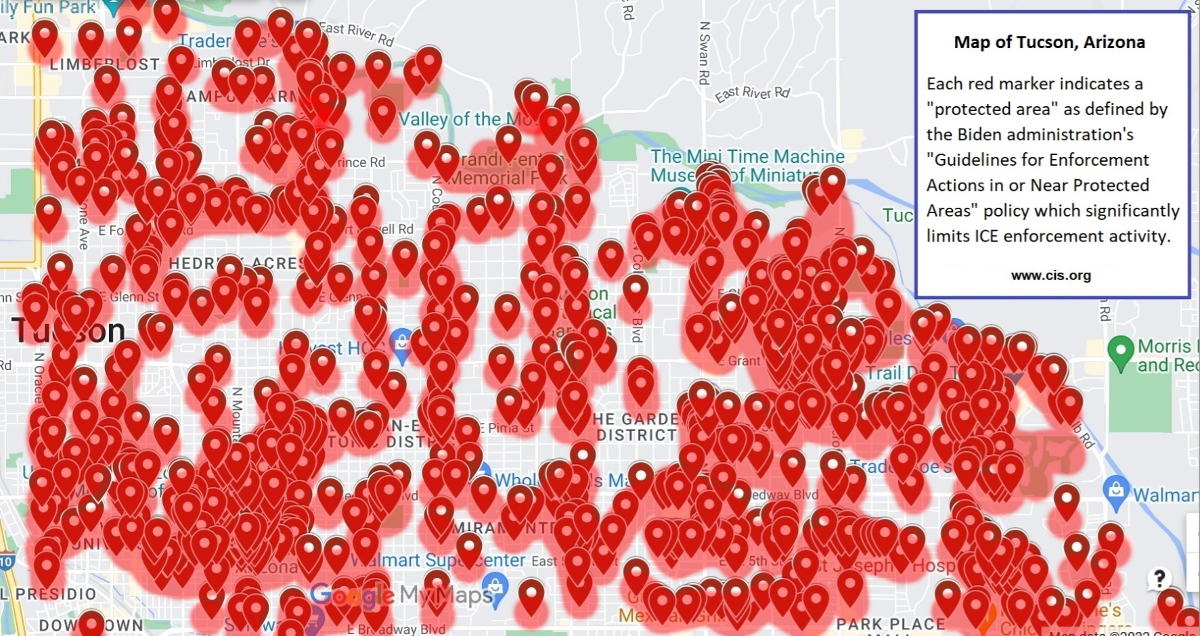
The breadth of this policy cannot be overstated. As my former colleague Jon Feere explained in November 2021, “This new anti-enforcement policy applies to all of ICE’s and CBP’s authorities such as ‘arrests, civil apprehensions, searches, inspections, seizures, service of charging documents or subpoenas, interviews, and immigration enforcement surveillance.’ To be clear: An ICE officer seeking to arrest and remove an alien convicted for sex abuse must now refrain from even conducting surveillance on the criminal if he is anywhere near a schoolyard.” Feere emphasized that “The scope is virtually limitless and undefined, and Mayorkas explains the goal is to limit immigration enforcement’s ‘impact on other people and broader societal interests’. … this policy was written with the perspective that nearly all functions of society are more important than DHS’s immigration enforcement mission.” (See here for a map of Tucson showing most of the city off-limits to ICE under this policy.)
It would be a serious oversight to omit mention of the other, non-sensitive area, policies issued by Secretary Mayorkas when addressing the scope of this policy. When analyzed in conjunction, the memoranda demonstrate the significant restrictions that were imposed on ICE during the Biden administration. Most notable are Mayorkas’s September 30, 2021, policy, “Guidelines for the Enforcement of Civil Immigration Law”, which established “enforcement priorities” that drastically limited who officers could initiate immigration enforcement actions against to only those who are determined to be national security, public safety, or border security threats and an October 12, 2021, memorandum titled “Worksite Enforcement: The Strategy to Protect the American Labor Market, the conditions of the American Worksite, and the Dignity of the Individual” (Policy Statement 065-06), which directed all of DHS to “cease” large scale worksite enforcement operations. It’s not difficult to see how, together, these three policies provided administrative sanctuary to most aliens living in the United States without a lawful immigration status.
What Is in Place Now?
Follow DHS’s January 20 directive and rescission of Mayorkas’s 2021 protected areas policy, ICE Acting Director Caleb Vitello issued a policy memorandum on January 30 titled “Common Sense Enforcement Actions in or Near Protected Areas”. This directive provides the same definition of “protected areas” as was used in 2011, but emphasizes that, “DHS is not issuing bright line rules regarding where immigration laws are permitted to be enforced.” Instead, the memorandum charges assistant field office directors and assistant special agents in charge with the responsibility for making “case-by-case” decisions regarding “whether, where and when” to conduct an immigration enforcement action in or near a protected area and authorizes these ERO and HSI officials to issue further guidance to fill in the gaps.
A DHS spokesperson commented: “This action empowers the brave men and women in CBP and ICE to enforce our immigration laws and catch criminal aliens — including murders and rapists — who have illegally come into our country. Criminals will no longer be able to hide in America’s schools and churches to avoid arrest. The Trump Administration will not tie the hands of our brave law enforcement, and instead trusts them to use common sense.”
So, what has changed? Acting ICE Director Vitello’s January 31, 2025, directive clearly represents a significant — and, in CIS’s opinion, greatly needed — departure from Mayorkas’s restrictive enforcement policies. First, and perhaps most importantly, the memorandum reverted ICE’s definition of sensitive or protected area to DHS’s original, more limited understanding of the term: schools (pre-schools through post-secondary, including colleges, universities, and vocational and trade schools); hospitals; churches, synagogues, mosques, or other institutions of worship; and a site during the occurrence of a public demonstration, such as a march, rally, or parade. No longer will ICE officers have to consider whether an individual could pray the rosary at or near a specific location or whether a business sometimes rents its space to host a wedding.
Second, the new Trump administration policy is clearly designed to defer to, rather than restrict, ERO and HSI leadership discretion. The directive is mostly silent on what sort of guidelines the assistant field office directors and assistant special agents in charge should issue. Unlike the Clinton, Bush, and Biden era policies, the new directive includes no explicit reporting requirement. It also does not require that these offices request approval to engage in an enforcement action at a sensitive or protected area or distinguish between planned or exigent enforcement actions — again, opting to instead defer to the discretion of ICE ERO and HSI leadership.
This is not to say that ERO and HSI cannot or will not, under the new Trump administration policy, create internal procedures for officers to request approval and/or report when such enforcement actions have occurred. But what these policies will look like and whether they will be made public remains to be seen.
Vitello’s memorandum only specifically directs that (1) decisions are to be made on “case-by-case” bases regarding “regarding whether, where, and when to conduct an immigration enforcement action in or near a protected area” and (2) requires both offices to consult the Office of the Principal Legal Advisor (ICE’s attorneys) prior to approving any enforcement action at a site where a public demonstration is underway for guidance on constitutional considerations. Finally, while trusting ERO and HSI leadership’s exercise of “common sense” is not unlike the historic guidelines imposed by the Clinton, Bush, or Obama administrations, which all instructed officers to “exercise good judgement” when determining whether to initiate an enforcement action, Vitello’s policy is significantly more lenient than any of these predecessor policies.
End Notes
1 The federal government has also issued policies covering immigration enforcement actions inside courthouses and actions against victims and witnesses of crimes. This post does not cover these policies.
2 Notably, while ICE did provide Congress with its updated sensitive area policy that was issued in 2021, it omitted any information regarding enforcement actions taken after FY 2020.


