Ohio Lieutenant Governor on His Way to Senate, Replacing J.D. Vance
- External Source
admin
- 0
- 9 minutes read
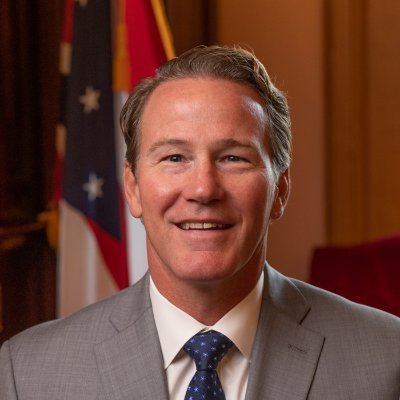
Ohio Gov. Mike DeWine (R) has named the state’s lieutenant governor, Jon Husted, to serve out the remaining senate term of J.D. Vance, who resigned his post on January 10 so that he could assume the office of vice president. Husted has offered thoughtful and nuanced views regarding immigration in the past — including when he was my witness at a February 2015 hearing before the House Committee on Oversight and Government Reform, where I was serving as a staff director.
Jon Husted. The appointee’s inspiring biography is uniquely American:
Jon Husted started his life in a foster home before being adopted by his loving parents, Jim and Judy. He is the oldest of three children and was raised in Northwest Ohio’s Williams County. The small community instilled in him the importance of faith, family, and hard work that serve as the foundation of his public service. He graduated from Montpelier High School and earned both his Bachelor’s and Master’s Degrees from the University of Dayton (UD).
Jon was an All-American defensive back for the Dayton Flyers and a member of UD’s 1989 Division III National Championship Football Team. After receiving his Master’s Degree, Jon remained in the Miami Valley and served as the Vice-President for Economic Development at the Dayton-Area Chamber of Commerce.
He turned to public service in 2000, winning election to an Ohio state House of Representatives seat that he held for six years before entering the state senate in 2008.
From there, he was elected Ohio secretary of state in 2010 and won reelection in 2014. As I will explain below, it was in that position that he testified as my witness. In any event, he was elected lieutenant governor of the Buckeye State in 2018 and has been in that position ever since.
The Springfield Tweet. The presence of large numbers of Haitian migrants in the town of Springfield, Ohio, took on outsized importance in the 2024 presidential election, so in early September Husted decided to head there and check things out.
He’s plainly a quick study, because his September 9 tweet from there is one of the more nuanced and thoughtful take on those migrants that I have seen:
Springfield, Ohio
Haitian Immigrants overwhelming Springfield, Ohio have made the national news. Last week I went there and spent time in the community talking to local residents and officials. Below is a summary of the facts and perspectives that were shared with me during my…
— Jon Husted (@JonHusted) September 9, 2024
One thing that sticks out for me is that — the final paragraph aside — Husted in that tweet is simply stating facts: Language barriers are stymieing assimilation, people are driving without licenses they may not know they need, healthcare providers are bearing costs that the federal government isn’t reimbursing, and the locals are both sympathetic and overwhelmed.
That one line, “Translation services are expensive and the costs of [health] care services are a burden on the taxpayers because they’re either paid for by Medicaid or when uninsured the cost ultimately are born by the community or healthcare providers”, underscores a major issue that has largely been overlooked in the ongoing immigration debate.
Talk to any doctor and they will likely tell you they are overworked in the best of times. Moreover, thanks to our nation’s active malpractice attorney bar, physicians must obtain “informed consent” from their patients before undertaking any course of treatment. That’s a challenge for a doctor who is treating a migrant patient who doesn’t speak English.
In such cases, physicians must get an interpreter, a time-consuming process and a particularly costly one when the patient speaks an unusual language like Haitian Creole. If providers are lucky, Medicaid will pay a portion of the translation cost, but that assumes that the migrant has Medicaid, which many don’t.
In August, Husted also issued a particularly pointed critique of Vice President (and then-Democratic presidential candidate) Kamala Harris’s performance as “border czar”:
Policy Truth 3:
On March 24, 2021, President Biden asked Vice President Harris to lead efforts to address the root causes of migration from Central America. This was significant because Joe Biden rarely held news conferences during his presidency. While he didn’t specifically…— Jon Husted (@JonHusted) August 22, 2024
The Impact of Obama’s Executive Actions on State Elections. Likely the most significant role Husted played with respect to immigration was when, as Ohio secretary of state, he raised concerns that President Obama’s November 2014 “Deferred Action for Parents of Americans and Lawful Permanent Residents” program (DAPA, intended as a sequel to DACA, Deferred Action for Childhood Arrivals) would make it difficult for state elections officials to determine whether voters were citizens.
DAPA was an attempted executive amnesty and Husted, concerned that DAPA recipients — who would be eligible for Social Security numbers — might intentionally or inadvertently register to vote, wrote Obama in January 2015 to ask the president to “provide state elections officials with real-time access to accurate, searchable, electronic databases of noncitizens who have valid Social Security numbers”.
Husted’s request came to the attention of the chairman of the National Security Subcommittee at House Oversight, then-Rep. Ron DeSantis (R-Fla.) — my boss at the time — and on February 15, 2015, the subcommittee held a hearing to find out what was going on, from Husted himself.
The then-secretary of state laid out the difficulties that Ohio would have in ensuring the integrity of his state’s elections process post-DAPA if he could not get his hands on aliens’ Social Security information, explaining:
For an estimated four to five million non-citizens, the President’s executive actions provide access to Social Security numbers and driver’s licenses. These are the same documents that Federal law requires the States to recognize as valid forms of identification for voter registration. Under Federal law, anyone with a valid Social Security number or driver’s license number can register to vote provided they attest they are a U.S. citizen. However, there is no way for us to validate this citizenship Statement since, under [DAPA], undocumented non-citizens will have access to the same documents as U.S. citizens.
This issue becomes especially complicated in States like Ohio, where millions of dollars are spent on third-party voter registration drives where no election official would be present to make clear the eligibility requirements for voting.
While DAPA was quickly enjoined by the courts and then rescinded by the Trump administration in June 2017, Husted’s concerns are as salient as ever given that the Biden-Harris administration paroled more than 2.2 million aliens into the United States over the past four years under its various migrant schemes.
Once those parolees receive employment authorization, they too can receive Social Security numbers. Illegal immigration policies may change, but they often create the same problems.
It remains to be seen whether Jon Husted will be as firm on immigration enforcement as a senator as his predecessor, J.D. Vance, has been. But at least he’s taken the time to study the issues and offer his own thoughtful takes.


