AG Pam Bondi Sues New York Over ‘Green Light Law’ for Illegal Aliens
- External Source
admin
- 0
- 13 minutes read

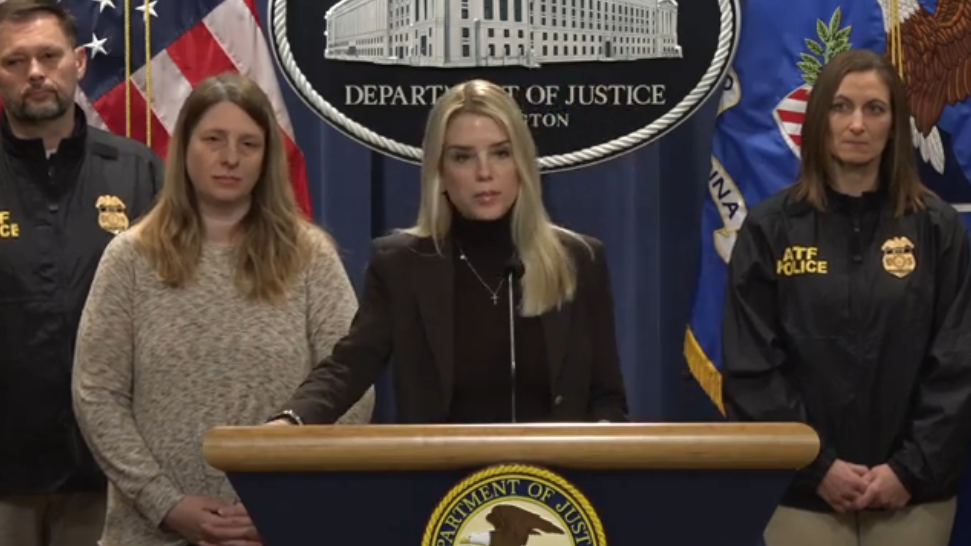
In her first press conference since being confirmed as U.S. Attorney General (AG), Pam Bondi announced that her Department of Justice will be suing the state of New York over its “Driver’s License Access and Privacy Act”, more commonly known as the “Green Light Law”. The suit describes that law as a “frontal assault on the federal immigration laws, and the federal authorities that administer them”, designed to “directly impair” immigration enforcement — which almost definitely was the law’s intent.
September 11, the 9/11 Commission, and the REAL ID Act
To explain the Green Light Law, I must go back to the terrorist attacks of September 11th and the U.S. government’s attempts to ensure that a similar tragedy could never recur.
All 19 of the September 11th hijackers were aliens in the United States in a variety of nonimmigrant statuses, and after Congress convened a “9/11 Commission” to investigate the vulnerabilities that led to those attacks, the commission’s findings — not surprisingly — focused heavily on visa issuance and immigration enforcement.
The most salient of their findings in that regard were on page 385 of the commission’s final report:
When people travel internationally, they usually move through defined channels, or portals. They may seek to acquire a passport. They may apply for a visa. They stop at ticket counters, gates, and exit controls at airports and seaports. Upon arrival, they pass through inspection points. They may transit to another gate to get on an airplane. Once inside the country, they may seek another form of identification and try to enter a government or private facility. They may seek to change immigration status in order to remain.
Each of these checkpoints or portals is a screening — a chance to establish that people are who they say they are and are seeking access for their stated purpose, to intercept identifiable suspects, and to take effective action. [Emphasis added.]
Accordingly, the commission made the following recommendation: “Secure identification should begin in the United States. The federal government should set standards for the issuance of birth certificates and sources of identification, such as driver’s licenses.”
To comply with that recommendation, Congress passed, and President George W. Bush signed, the REAL ID Act of 2005.
Section 202(b) of the REAL ID Act contains the minimum number of identifiers (such as name, date of birth, address of the holder, etc.) that any state driver’s license and identification card must include to be accepted by any federal agency for an official U.S. government purpose, such as boarding an aircraft or entering a federal building or other secure facility.
Section 202(c) of REAL ID lists the minimum standards for state issuance of such documents if they are to be accepted by any federal agency for any official purpose — including, most critically, that the applicant for such a document has lawful (or quasi-lawful) status in the United States.
Why is an applicant’s immigration status necessary? As the commission stated:
It is elemental to border security to know who is coming into the country. Today more than 9 million people are in the United States outside the legal immigration system. We must also be able to monitor and respond to entrances between our ports of entry, working with Canada and Mexico as much as possible.
That “more than 9 million” figure is quaint in retrospect as the illegal population has boomed in just the past four years, but the key points made by the 9/11 Commission nearly 20 years ago — that controlling immigration is essential to public safety and that it’s “elemental to border security to know who’s coming into the country” — were largely ignored by the Biden administration.
In turn, the last administration’s willful blindness about the importance of such key protections is a major reason why Donald Trump is, once again, president.
New York’s Green Light Law
Despite the essential role REAL ID document-issuance standards play in public safety and national security, states have either slow-walked or actively evaded compliance with that act.
Which brings me to the Green Light Law, legislation signed by then-New York Gov. Andrew Cuomo (D) in June 2019, and which took effect in December of that year.
As the Center explained in an exhaustive Backgrounder on the bill it published that November, the Green Light law “undermines U.S. security” in four key ways:
- It provides aliens illegally in the United States and/or others with nefarious intentions a method to obtain a legitimate, state-issued document for identification;
- It requires New York State to issue an identity document based upon information provided by a foreign government with no provision to verify the accuracy of the information;
- It prohibits Immigration and Customs Enforcement and Customs and Border Protection from using information maintained by NYDMV; and
- It creates numerous paradoxical law enforcement relationships that inhibit public safety and immigration enforcement.
The bill itself was largely a reaction to what Albany politicos saw as the first Trump administration’s “harsh” immigration-enforcement policies. As primary sponsor, New York State Sen. Luis Sepulveda, stated when the bill passed his chamber, “Today’s vote helps support the promise of the American Dream.”
‘Paradoxical Law Enforcement Relationships that Inhibit Public Safety’
That, in turn, brings me to the fourth adverse impact that the Green Light Law imposes on public safety: the creation of “numerous paradoxical law enforcement relationships that inhibit public safety and immigration enforcement”.
The Green Light Law amended section 201 (“custody of records”) of chapter 71 (“vehicle & traffic”) of the Laws of New York, to provide at paragraph 12(a) that, with limited exceptions state DMV employees:
shall not disclose or make accessible in any manner records or information that he or she maintains, to any agency that primarily enforces immigration law or to any employee or agent of such agency, unless the commissioner is presented with a lawful court order or judicial warrant signed by a judge appointed pursuant to article III of the United States constitution. [Emphasis added.]
The agencies that “primarily enforce immigration law”, of course, are ICE and CBP, but in case that wasn’t clear, paragraph 201(12)(c) explicitly spells that out — albeit by putting those agencies’ formal names in lower case, yet another sanctimonious shot at the officers therein.
Given that, the language about “judicial warrants” from Article III judges is a dodge, for two reasons.
First, the Immigration and Nationality Act doesn’t mandate that ICE or CBP rely on such warrants in doing their jobs. In fact, 8 U.S.C. § 1373 bars states and localities from restricting any government official in the “sending to, or receiving from” federal immigration enforcement officers any “information regarding the citizenship or immigration status, lawful or unlawful, of any individual”.
Second, when ICE agents and officers do seek such warrants, it’s usually from federal magistrate judges (who logically perform such ministerial tasks), but magistrates are Article I — not Article III — judges.
Not that there’s much difference between magistrate judges and Article III federal district and circuit court judges, as the Administrative Office of the U.S. Courts makes clear, and thus that requirement was simply inserted to impede immigration enforcement.
‘Upon Receiving a Request for Such Records or Information’
Bondi is concerned about those impediments to immigration enforcement in the Green Light Law, but the real kicker from her department’s perspective is the last sentence of Chapter 71, section 201, paragraph 12(a) of the Consolidated Laws of New York, which reads as follows:
Upon receiving a request for such records or information from an agency that primarily enforces immigration law, the commissioner shall, no later than three days after such request, notify the individual about whom such information was requested, informing such individual of the request and the identity of the agency that made such request.
Note that this notification requirement only applies when ICE or CBP is making a request for DMV records — not when any other state or local agency or any other federal agency official does the same thing — which eviscerates any argument that the drafters may have had that this rule is simply intended to protect the privacy rights of innocents.
Respectfully, I’ve written a number of bills myself, and the drafters may have garnered a fair amount of popular support had they included the IRS in that sentence, but they didn’t. The sole purpose for that notification requirement is to give aliens in New York illegally a heads-up that ICE is looking for them, to enable them to escape apprehension.
In response to the enactment of the Green Light Law, DHS in February 2020 attempted to bar New Yorkers from enrolling certain CBP “Trusted Traveler Programs” (TTP) like Global Entry, FAST, NEXUS, and SENTRI.
That led the state to amend the law two months later to create a carve-out for TTP programs and “to facilitate vehicle imports and/or exports”, and to sue the Department.
Suffice it to say that the federal government didn’t acquit itself well in the face of state arguments that other jurisdictions were doing similar things without risking TTP access, and in July 2020, DHS lifted the TTP bar.
Whether AG Bondi succeeds in challenging the de facto alien notification requirements in New York’s Green Light Law remains to be seen, but one thing is clear — public attitudes toward illegal immigration are a less permissive than they were when that law was passed in 2019. Federal courts are powerful, but in this Republic, the court of public opinion usually reigns supreme.


